An Article entitled (Top misconceptions about bone marrow donation)
22/02/2022 Share :
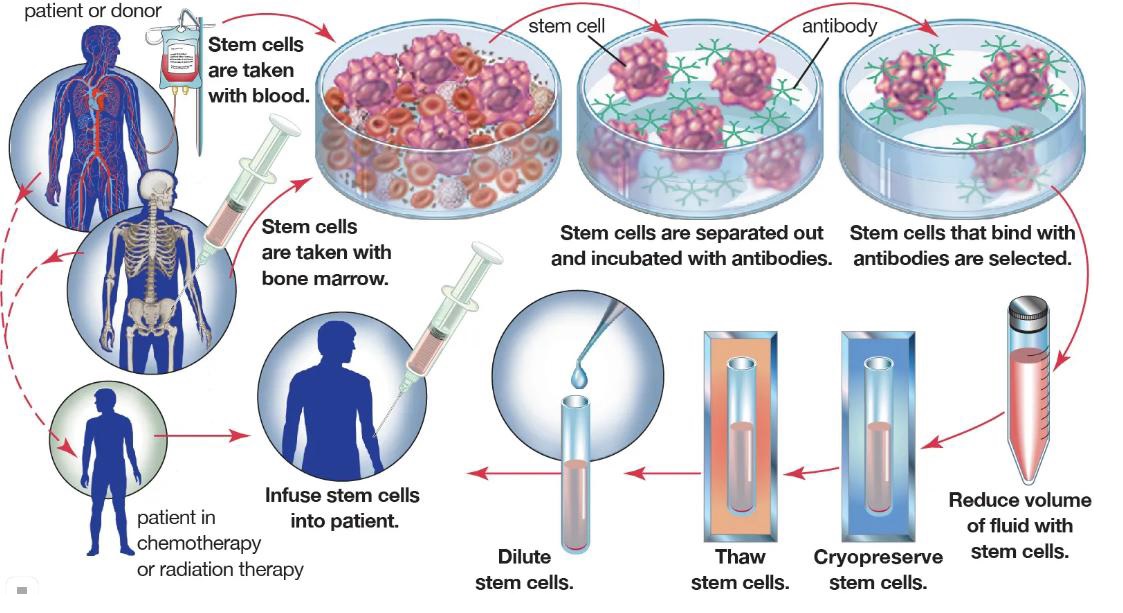
Every day, seriously ill children and adults are waiting for donors who are ready to donate healthy hematopoietic cells. The generosity of complete strangers gives them hope for recovery. This procedure is known as bone marrow donation and there are many myths and misconceptions associated with it. Together with experts from the AdVita Charitable Foundation and the Federal Research and Clinical Center for Pediatric Hematology, Oncology and Immunology named after V.I. Dmitry Rogachev, we analyzed some of the most common of them. We hope that every year more and more people in Russia will join the register of bone marrow donors. This will save the lives of hundreds of children and adults in need of transplants.<br />Myth #1: The bone marrow is the same as the spinal cord.<br />Fact: These two organs perform completely different functions and consist of different types of cells. “The spinal cord consists of neurons and processes of nerve cells and belongs to the central nervous system. The bone marrow is an organ of the hematopoietic system, a tissue located inside the bone, - explains Kirill Kirgizov, hematologist, head of the department of scientific research and clinical technologies of the Federal Research and Clinical Center of the Far Eastern State Optical Institute named after A.I. Dmitry Rogachev. “If the main task of the spinal cord is the transmission of impulses, then the bone marrow is responsible for the process of hematopoiesis and the production of immune cells.”<br />But, unfortunately, due to the lack of available information, many Russians do not fully understand what the bone marrow is and where it is located. “They even called us once and asked if it was possible to become a donor of a part of the brain,” says Maria Kostyleva, coordinator of the donor service of the AdVita Foundation. “Therefore, we always start the story of hematopoietic stem cell donation with a small anatomical overview.”<br />Myth #2: Donating bone marrow is very painful.<br />Fact: Donating hematopoietic cells is not associated with severe pain. “Since the bone marrow is often confused with the spinal cord, there is a widespread myth that the fence will be made from the spine and the donor will experience acute pain,” says Maria Kostyleva. “It’s actually a relatively painless procedure.” “Moreover, the phrase “bone marrow donation” no longer expresses the essence of this type of donation. The definition appeared in the 1960s, when only bone marrow obtained directly from the bone was used for transplantation, Kirill Kirgizov adds. “Today we are talking about transplantation of hematopoietic stem cells, which are also found in the bone marrow. These cells can be obtained from both bone marrow and peripheral blood.” Thus, bone marrow donation would be more properly referred to as hematopoietic stem cell donation.”<br />There are two ways to donate hematopoietic stem cells. In one case, the bone marrow is removed from the pelvic bone with a needle. “We perform this procedure under general anesthesia or with the help of epidural anesthesia, depending on the preferences of the donor,” explains Larisa Shelikhova, head of the department of HSCT No. 1. “We always select anesthesia individually, taking into account the donor’s condition and, above all, take care of his health.”<br />In the second case, hematopoietic stem cells are isolated from the peripheral blood of the donor, that is, from the blood circulating through the vessels of the body. “The only painful sensation in this case is the prick of the needle at the beginning of the procedure,” says Kirill Kirgizov. “Also, before we start separating cells, the donor receives injections of a drug for several days that stimulates the release of hematopoietic cells into the peripheral blood.”<br />When collecting hematopoietic cells from peripheral blood, the donor spends some time under medical supervision. “The donor may experience flu-like symptoms, in which case we also monitor the donor and, if necessary, provide symptomatic assistance,” says Kirill Kirgizov. Doctors recommend a specific method for collecting hematopoietic stem cells depending on the patient's diagnosis and the proposed method of treatment, but the donor will make the final decision in any case.<br />Myth #3: Donating bone marrow is dangerous<br />Fact: There are absolute and relative contraindications to hematopoietic stem cell donation. They are usually similar to contraindications to blood donation. Before a person donates hematopoietic cells, doctors conduct a thorough examination, which determines the absence of contraindications. This minimizes the risk of complications. “It would be an exaggeration to say that the donor does not risk anything by donating hematopoietic stem cells. However, the development of medical technologies makes this procedure quite safe,” explains Larisa Shelikhova. According to the regulations adopted in international practice, the decision on whether to allow a person to donate is made by doctors from a clinic that has nothing to do with the hospital where the transplant will take place. “This is done in order to protect the donor as much as possible,” explains Kirill Kirgizov. We follow this rule. Donor and recipient do not need to know about each other and cannot be in the same hospital. Acquaintance of the donor and the recipient is possible only two years after transplantation.”<br />The low risk to the health of the donor is also evidenced by the fact that, since recently, domestic insurance companies have been insuring donors of hematopoietic stem cells in case of complications. “This decision was revolutionary,” comments Kirill Kirgizov.<br />Myth #4: Recovery from bone marrow donation is difficult.<br />Fact: The ability to regenerate hematopoietic stem cells is so high that, if necessary, you can become a donor several times in your life without health consequences. “Hematopoietic cells are restored in the donor's body quite quickly, re-donation is possible as early as 3 months after cell collection,” says Larisa Shelikhova. “We definitely monitor the donor for about a day after the collection of hematopoietic stem cells and give recommendations on further monitoring and necessary tests.”<br />Myth #5: The state pays for the search and activation of donors<br />Fact: There are no quotas for activation of unrelated donors in Russia yet. The Ministry of Health allocates quotas for transplantation, as well as a small number of quotas for related donations. The number of quotas is very limited and does not cover the number of transplants, which entails the need to apply to charitable foundations. “Therefore, the payment for the activation of a Russian unrelated donor (a detailed examination, tests, necessary drugs in case of taking cells from peripheral blood), his travel to the clinic and accommodation are also paid by charitable organizations,” explains Maria Kostyleva. “But the price of activating a donor from Russia (the search for a donor in the domestic registry is free of charge) is much lower than the price of searching and activating a donor from the international registry. In Germany, it will cost about 18,000 euros, in Russia - from 150 to 300 thousand rubles. The Vasya Perevoshchikov National Bone Marrow Donor Registry officially exists and has been developing since 2013. The register united 12 regional Russian registers and one Kazakh one.<br />Myth #6: If a donor has not received a call from the registry within a year, then he did not suit anyone<br />Fact: It can take several years from the moment of blood sampling for HLA typing to the moment of donation of hematopoietic stem cells. International statistics of recent years show that during the year, approximately every thousandth participant in the register becomes a real donor. In Russia, it is estimated that now approximately every 700th person who donated blood for typing becomes a donor. Kirill Kirgizov explains: “This is due to the fact that in each case of unrelated donation, we are looking for a 100% match according to certain parameters, the so-called loci. In this case, many other factors play a role. Hematopoietic cells cannot be prepared in advance, the selection of a donor is always painstaking work, which takes into account all possible consequences for the donor and recipient.”<br />Myth #8: The probability that the patient will be cured after transplantation is small<br />Fact: Of course, everything depends on the diagnosis, condition at the time of transplantation and many other factors, but in any case, this is the last hope for patients awaiting transplantation, and the longer the recipient waits for his donor, the less chance remains.<br />“Medicine is developing rapidly. Opportunities that seemed unattainable become reality. Now our patients recover completely after transplantation much more often than five years ago,” says Larisa Shelikhova. “In addition, the list of diseases (autoimmune, genetic) that are now treated with transplantation has expanded.” “It is difficult to imagine a more significant and respectable act than donation,” says Kirill Kirgizov. “The donor consciously and gratuitously shares his healthy cells with a stranger, giving him a chance to recover.”<br />We believe that the increase in the donor registry, the disappearance of "terrible" myths about donation will give a chance for recovery to large and small patients. You can learn more about how to become a hematopoietic cell donor on the website of the AdVita Charitable Foundation. Donation of hematopoietic cells is a responsible and serious step. By doing it, we save lives.<br /><br />By MSc. Sura Hasan Hasnawi