تم نشر مقاله للدكتور * فاضل فرهود مكي * بعنوان Humans Finger Print
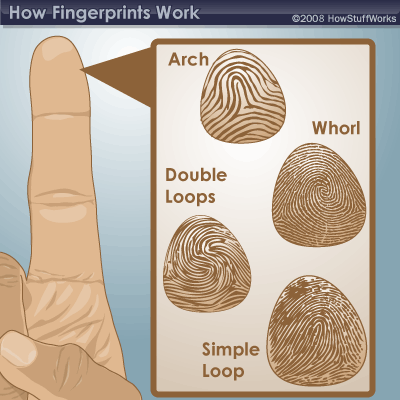
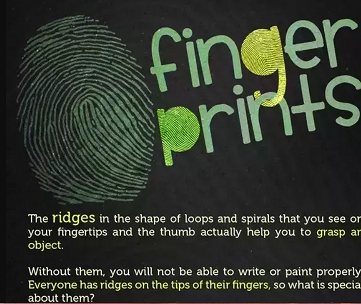
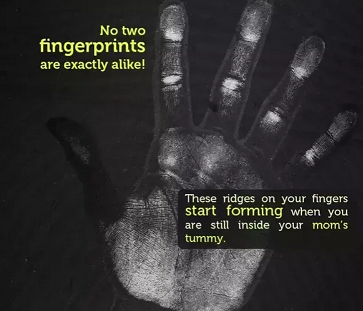
Fingerprints are the tiny ridges, whorls and valley patterns on the tip of each finger. They form from pressure on a baby's tiny, developing fingers in the womb. No two people have been found to have the same fingerprints -- they are totally unique. There's a one in 64 billion chance that your fingerprint will match up exactly with someone else's.<br />Fingerprints are even more unique than DNA, the genetic material in each of our cells. Although identical twins can share the same DNA -- or at least most of it -- they can't have the same fingerprints.<br /><br />Fingerprinting is one form of biometrics, a science that uses people's physical characteristics to identify them. Fingerprints are ideal for this purpose because they're inexpensive to collect and analyze, and they never change, even as people age.<br />¬Although hands and feet have many ridged areas ¬that could be used for identification, fingerprints became a popular form of biometrics because they are easy to classify and sort. They're also accessible.<br />Fingerprints are made of an arrangement of ridges, called friction ridges. Each ridge contains pores, which are attached to sweat glands under the skin. You leave fingerprints on glasses, tables and just about anything else you touch because of this sweat.<br />All of the ridges of fingerprints form patterns called loops, whorls or arches:<br />• Loops begin on one side of the finger, curve around or upward, and exit the other side. There are two types of loops: Radial loops slope toward the thumb, while ulnar loops slope toward the little finger.<br />• Whorls form a circular or spiral pattern.<br />• Arches slope upward and then down, like very narrow mountains.<br />Scientists look at the arrangement, shape, size and number of lines in these fingerprint patterns to distinguish one from another. They also analyze very tiny characteristics called minutiae, which can't be seen with the naked eye.<br />Early classification systems were based on the general ridge patterns, including the presence or absence of circular patterns, of several or all fingers. <br />environmental factors are thought to influence the formation of fingerprints, including blood pressure, oxygen levels in the blood, nutrition of the mother, hormone levels, the exact position of the fetus in the womb at particular times, the exact composition and density of the amniotic fluid that’s swirling around the fingers of the fetus as they touch surrounding structures, and the pressure with which they touch their surroundings. These myriad variables decide how each individual ridge is formed.<br />