
نشر مقالة علميه للاستــــــاذ ( مصطفى قيس عمران ) في قسم هندسة تقنيات الحاسوب بعنوان? How does a quantum computer work
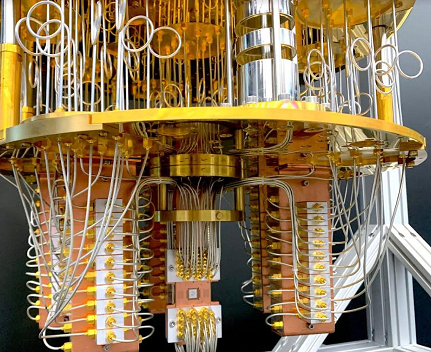
Quantum computers share some properties with classical ones. For example, both types of computers usually have chips, circuits, and logic gates. Their operations are directed by algorithms (essentially sequential instructions), and they use a binary code of ones and zeros to represent information.<br />Both types of computers use physical objects to encode those ones and zeros. In classical computers, these objects encode bits (binary digits) in two states—e.g., a current is on or off, a magnet points up or down.<br />Quantum computers use quantum bits, or qubits, which process information very differently. While classical bits always represent either one or zero, a qubit can be in a superposition of one and zero simultaneously until its state is measured.<br />In addition, the states of multiple qubits can be entangled, meaning that they are linked quantum mechanically to each other. Superposition and entanglement give quantum computers capabilities unknown to classical computing.<br />Qubits can be made by manipulating atoms, electrically charged atoms called ions, or electrons, or by nanoengineering so-called artificial atoms, such as circuits of superconducting qubits, using a printing method called lithography.<br /><br />Do quantum computers exist?<br /><br />Nascent quantum computers have existed in various forms for more than a decade. Several technology companies already have working quantum computers and make them available together with related programming languages and software development resources.<br />The technology with the broadest potential uses, in which quantum gates control qubits through logical operations, is in fast-moving, early development. Today, computers of this type generally have fewer than 100 qubits. The qubits are kept in a quantum state inside nested chambers that chill them to near absolute zero temperature and shield them from magnetic and electric interference.<br />This technology reached a milestone in 2019, when a quantum computer completed a specific calculation in a sliver of the time a classical supercomputer would have needed to solve the same problem. The feat is considered a proof of principle; the use of this type of quantum computer to solve practical problems is expected to be years away.<br />A different approach to quantum computing, called quantum annealing, is further along in development but limited to a specific kind of calculation. In this approach, a quantum computer housed in a cryogenic refrigerator uses thousands of qubits to quickly approximate the best solutions to complex problems. The approach is limited to mathematical problems called binary optimization problems, which have many variables and possible solutions. Some companies and agencies have purchased this type of computer or rent time on new models to address problems related to scheduling, design, logistics, and materials discovery.<br />