
نشر مقالة علميه للأستاذه ( م.سجى علي عبد الزهره ) في قسم هندسة تقنيات الحاسوب بعنوانMulti-path hybrid spectrum sensing in cognitive radio
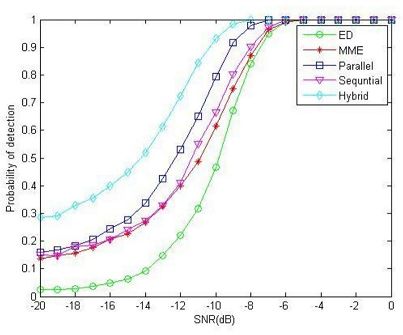
Inefficient utilization of the authorized spectrum emerges cognitive <br />radio (CR) as a hopeful technology for both present and future telecommunica-<br />tions. It is owing to the potency to leverage the obtainable bandwidth of other <br />wireless communication networks and thereby increase its occupancy. The key <br />feature for the cognitive radio system for distinguishing the blank spectrum is <br />spectrum sensing. This paper is intended to establish a hybrid sensing model for <br />spectrum detection in CR to enhance sensing efficiency of traditional techniques <br />of spectrum sensing, which consists of two parallel paths of hybrid detectors. The <br />first path is formed from two sequential detector stages; in the first phase, energy <br />detector is used to recognize the PU signal existence where the signal has not <br />been identified. Maximum-Minimum Eigenvalue (MME) is used as a second <br />stage to detect the PU signal presence. The second path consists of two parallel <br />stage detectors employing separate ED and MME to detect the PU signal indi-<br />vidually, the two results are gathered to make a decision, and then the final de-<br />tection decision is determined based on the two paths’ detection combined re-<br />sults. The proposed hybrid sensing approach adopted for enhancing the sensing <br />performance is validated with conventional methods. Simulation results show <br />that the proposed approach outperforms various traditional and hybrid ap-<br />proaches in terms of maximizing the detection probability on the specified limi-<br />tations on the false alarm probability, as it can increase the detection probability <br />to 94% instead of 79% for the parallel detector at SNR= -10 dB and Pfa=0.1.<br />