Factors Affecting Appearance
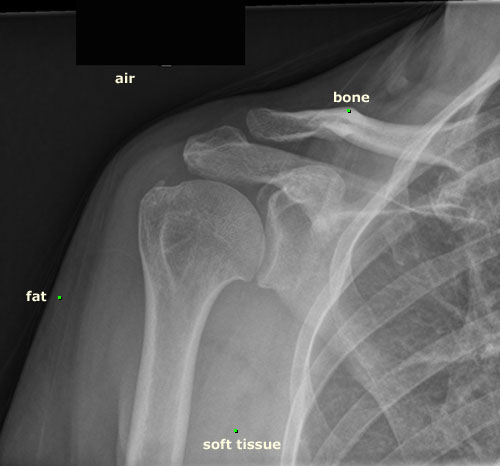
BY Mohameed abdalkareem<br />The composition, thickness and shape of a structure all interact to influence what an object looks like on a radiograph.<br /><br />DENSITY<br />What causes a structure to appear black, white, or gray on a radiograph? It is dependent on how much of the x-ray beam is absorbed by the structure vs how much passes through to reach the detector. The density of the object being imaged determines how much of the x-ray beam will be absorbed.<br />Dense structures absorb (attenuate) more of the x-ray beam than less dense structures. Thus, less of the beam passes through to hit the cassette and these structures appear white, termed ‘radiopaque’. The radiograph shown is a pair of metal scissors, which are radiopaque. Note the scissors are brighter white in areas where the metal is thicker, like the handles. Other dense structures include calcium, barium and iodine, all of which look white on radiographs. Barium and iodine will be discussed in later sections of this module.<br />Structures which are not very dense, such as air, absorb very little of the x-ray beam. Most of the beam passes through the air and strikes the detector. As a result, these structures appear black on x-rays, termed ‘radiolucent’. Note that on the radiograph shown, air surrounding the scissors is black.<br />The variable densities of structures in the body result in the four basic radiographic densities:<br />a. Air - black<br />b. Fat - gray/black<br />c. Soft tissues and organs - gray<br />d. Metal, calcium, and bone - white<br /><br />Fat is low density, but is slightly greater than air and so looks less black on a radiograph than air. Muscles, organs, and soft tissues are shades of gray, ranging from light to dark gray depending on the structure’s density. These shades of gray are referred to as water density.<br />