تم نشر مقالة علمية للتدريسي في قسم تقنيات التخدير المدرس حسن دوين بطي بعنوانMortality Rate Due to Intubation in Adult General ICUs: A Systematic Review and Meta-analysis
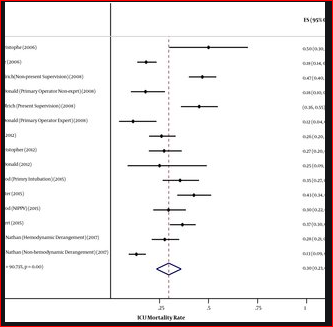
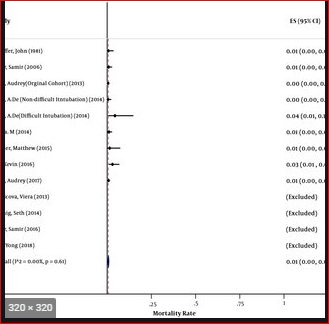
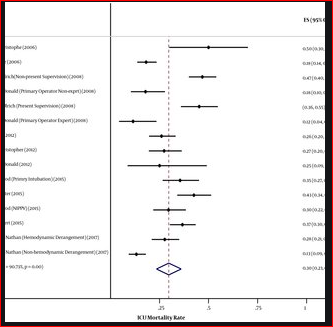
Mor: A Systematic Review and Meta-tality Rate Due to Intubation in Adult General ICUsanalysis<br />By anesthetist : Hasan dwain Al-hillfi. <br /> <br /><br /><br /><br /><br /><br /><br /><br /><br /><br /><br /><br /><br /><br /><br /><br /><br /><br /><br /><br /><br /><br />Background <br /> <br />Endotracheal intubation (ETI) which is an indispensable and common procedure in intensive care units (ICUs) for protecting patient's airway or providing invasive mechanical ventilation to treat respiratory failure which is considers as a common problem in critically ill patients.(1-7), and it is correlate with numerous complications including mortality. This procedure will be done in different locations for critically ill or non-critically ill patients, for example tracheal intubation performed before surgery in operating room (OR). Usually orotracheal intubation is done electively in OR in a comfortable condition, compared with (ICU) that is done in emergency conditions with trouble circumstances, and it should be carried out immediately to prevent aspiration because the patients are generally not in fasting situation (8). Some methods are used for tracheal intubation in critically ill patients such as fiber-optic, video laryngoscopy and direct laryngoscopy, but standard of care and the most common way is direct laryngoscopy with Macintosh and rarely Miller blade. It has high success rate in expert hands but in emergency intubation in (ICU) with poor patient's condition and non-expert operator decreases chance of first success intubation, as well, Frequent intubation attempts which have been related with an excessive danger of complications noted With low level of operator's experiences (8) ,(9) ,(10). <br /> <br /> <br /> <br />Different pharmacologic agents are utilize for induction such as propofol, ketamine, etomidate, benzodiazepine, opioids and neuromuscular blocking agents to provide perfect intubation condition but these drugs are associated with significant complications in hemodynamically unstable ICU patients, especially when used by those with low-level of training and experiences (11). Some serious complications might happen due to intubation. These complications may be patient's related, operators, instruments, drugs and emergency or time related (12, 13). Studies that were published in many journals in previous years hadn’t enough information, and there are few authors who wrote about mortality due to intubation in general ICU patients, with deficient management of these extremely vulnerable patients, we did systematic review and meta-analysis in adult general ICUs. The main objectives of our study were to determine mortality rate (death rate) due to intubation in adult general ICUs. <br /><br />Methods: <br /><br />The 4 dependent search strategies have been utilized in this systematic review and meta-analysis: (1) data sources, (2) study selection, (3) data extraction, and (4) statistics evaluation and quality assessment.<br /><br />Data Sources: <br />Studies on mortality rate and overall ICU mortality due to endotracheal intubation (ETI) published from previous years up to end of 2018 have been included. Intubation related mortality, is considered as mortality during and in 60 minutes after intubation and overall ICU mortality defined as mortality of intubated patients during admission and period of length in general ICU. PubMed, Embase and Google scholar have been systematically reconnoitered via utilizing appropriate textual content phrases and dictionary expression for articles relating to the following terms: any mortality rate phrases and their synonyms or acronyms; intensive care unit and its synonyms; intubation, its synonyms and acronyms and the age considered as adult more than 18 years old; but without any limitation on date, language and geographical sites. Searches and evaluation have been also undertaken in the reference lists of these papers (hand searching). All citations were downloaded into EndNote.<br /> <br />Study selection: <br /><br />Studies with narrative and descriptive assessment, with unknown case definitions or studies of pediatric ICUs and obstetrics ICU, emergency department (EDs), operating room(OR), wards, outside hospital and studies that mixed the different departments together without separated results or data were eliminated from the study. Potentially applicable articles were recognized according to the above-mentioned inclusion and exclusion criteria. In same searches of writers, the replications were omitted. The remaining articles had been assessed for enrollment, first by means of title, then by using abstract, before downloading the articles in full text. The subjects were arranged based on the following criteria: data and kind of study; the author; year; age; age standard deviation (age SD); sex percentage male/female; quality assessment; sample size and number of events. <br /><br />Date Extraction: <br /><br />The data were extracted from the Studies that involve the exact number or percentage of mortality related to intubation immediately after procedure till 60 minutes in elective or emergency intubation and difficult intubation in adult general ICUs specifically, by using usual care, direct laryngoscope for endotracheal intubation, without video laryngoscope or fibro optic, simple face mask for preoxygenation i.e., without high flow nasal cannula(HFNC) and non-invasive positive pressure ventilation (NIPPV) and also without loading of fluid or use of vasopressor prior to intubation. The main outcomes were considered: 1) death rate due to intubation in general ICUS.<br /> <br /> <br />Then we omitted the articles that had score of quality assessment less than (0.6). Twenty-eight articles were included in this study, mentioning the exact number of mortality rate and overall ICU mortality. After assessing the full text of including (28) articles by three authors independently and if necessary the fourth author, of epidemiologist, statistics had been inserted to an excel database, specifically designed for this review and analyzed using STATA software version 14.1. Figure1 shows a diagram describing the study design process. <br />Data analysis and Quality assessment: <br />Metatrope command was used depending on STATA version 14.1 (StataCorp, College Station, TX, USA) for raising proportions. We appraised 95% confidence intervals using the rating statistic and the real binomial method and Freeman-Tukey double arcsine transformation of proportions by using ftt option. Heterogeneity of the prevalence estimates between studies was decided by I2 Index. A random influence model was once utilized unless the I 2 was once < 25% in that case a constant outcome model would be used (11). Generation of a funnel plot and the Egger and Begg p-value permitted determination of the possibility publication bias of involved studies. The influence of study characteristics (such as age, date and quality score of studies) were explored using meta-regression. The methodology of selected studies was assessed according to STORBE CHECKLIST for cohort and cross- sectional and JADED tools for randomized clinical trial studies. Each study with higher than 0.6 from maximum score was considered as high quality study . <br /><br /><br /><br /><br /><br /> <br /><br /><br /> <br /><br /><br /><br /><br /><br /><br /><br /><br /><br /><br /><br /><br /><br /><br /><br />Result: <br /> <br />Of 7,866 literature consideration from three databases, 28 archives were eligible to be including in this systematic review and meta-analysis. Thirteen articles notified results about the proportion of mortality rate (death rate) due to intubation in general ICUs. The studies included in this meta-analysis had a 5 cross-sectional designs, 5 cohort study, 3 randomizes clinical trials. After exclusion of low quality score studies (quality score below 0.6, two articles), of 4754 individuals, 34 cases were dead, the pooled estimations of this rate was 1% (95% CI = 0–1%)(Fig.3). Data analysis confirmed that there used to be no longer substantial relationship between mortality rate and age (P = 0.27), year of study (P=0.88), but marginally significant quality score (P=0. 09).The evidences of publication bias used to be supplied by a funnel plat. The egger test (p=0.3%) and begg test (p=0.4%) were statistically significant for publication bias. Fifteen articles reported results about the proportion of ICU mortality related to intubation in general ICUs. The searches included in this meta-analysis had a 2 cross-sectional design, 11 cohort study, 2 randomized clinical trials. After exclusion of low quality score studies (quality score below 0.6, two articles), of 2054 individuals, 604 cases were dead, the pooled estimations of this rate was 30% (95% CI = 23–36%)(Fig.2). Data analysis showed that there was once now not a significant relation between ICU mortality rate and age (P = 0.89), year of study (P=0.97) and quality score (P=0.18). The evidences of publication bias were furnished by a funnel plat. The egger test (p=11%) and begg test (p=2%) were not statistically significant for publication bias. . . <br /> <br /> <br /><br /> <br /><br /> <br /><br /><br /> <br /><br /><br /><br /><br /><br /><br /><br /><br /><br /><br /><br />Discussion: <br />Tracheal intubation is a routine and lifesaving technique in intensive care unit. Life- threating complications may occur in a significant ratio of intubations but, those are less frequent in preparation included situations (2, 4, 6, 8, 12).<br />Based on our research, this is the first systematic review and meta-analysis study that evaluated the mortality rate of intubation in general ICUs specifically. <br />This study, described mortality affiliated with intubation if they happened during or within 60 minutes of the procedure. Of 4754 intubation done, 34 cases died (1%). ICU mortality of intubated patients was defined as death of intubated patients during ICU stay, of 2054 individuals, 604 cases died (30%) in the current study.<br /><br />Kevin et al and Matthew et al (13, 14) reported that the rate of death during intubation and 60 minutes after performed intubation were (3%) and it is higher than our reported study. Schwartz's study (6) showed 3% intubation related mortality and was higher than the current study, this study was not included in our study because it reported the mortality rate outside intensive care units (ICUs).<br /><br />Regarding our study, 13 articles mentioned mortality rate due to intubation range from 0%-4%. The reported mortality rate in three articles is completely differing from others. In Audrey et al study this rate is 4%, Kevin et al 3%, and Matthew et al 2.8%.<br />Other studies reported the percentages of death rate within (30-60 minutes) range from (0%-1%).(15-17).<br /><br />The most popular complication of tracheal intubation in the intensive care unit is Hypoxemia (4, 18) and the potent risk factor for periprocedural cardiac arrest and death (5). Matthew et al (14) reported that the incidence of death were lower in Apneic Oxygenation via high-flow nasal cannula oxygen preoxygenation during larngoscope (0%), compared with usual care (2.8%).<br /> Audrey et al (19), in their paper found that the mortality was high in post intubation cardiac arrest (29%) compared to intubation without cardiac arrest (0%). Post Intubation cardiac arrest is more frequent during emergency situations and may increase death due to time shortage to perform oxygenation and stabilize the hemodynamics. Hypoxemia, hemodynamic failure before intubation, lack of oxygenation and age older than 75 years are potentially high-risk factors that increase intubation related cardiac arrest and death. <br />Acute respiratory failure due to dramatic changes in lung and high shunt fraction that may lead to disturbance in gas exchange, acute respiratory distress syndrome patients are at higher risk of hypoxia. So intubation of these patients should be done with adequate preparation (8, 20, 21).<br />Christophe et al (2), found that uses of non-invasive ventilation for pre-oxygenation in general ICUs had lower overall ICU mortality (30%), compared with usual care (50%), they also mentioned that decreased SPO2 less than 80% was higher with usual care (46%) compared with NIV (7%).<br />Audrey et al (22), reported that the incidence of death was a little higher in difficult intubation (0.5%), compared with non-difficult intubation (0%)in 2013. De Jong et al (23), reported that the incidence of death was high with difficult intubation (4%), compare with non- difficult intubation (0%) in 2014.<br /><br /><br /> <br />Emergency endotracheal intubation (EEI) in intensive care unit is a complex process with numerous possible failure points, mostly complications of emergency process are acute hypoxemia, hypotension or death. Critically ill patients undergoing emergent intubation have a higher than expected rate of post-intubation hypotension. Robert S. Green et al(24) reported that ICU mortality was higher with post intubation hypotension (37%) compared with non- hypotension after intubation (28%).<br /> Direct laryngoscopic intubation (DL) was associated with high rate of mortality (3%) compared with another device (Bronchoscopic intubation),(0%), Kevin et al (13). Griesdale et al (4), reported that use of (DL) was associated with high rate of overall ICU mortality (25%) compared with video laryngoscope (VL),(15%). <br />ICU mortality was a little higher in primary intubation (35.5%) compared with failed NIPPV (29.5%) in the study of Mosier and his group(25).<br />Use of intravenous anesthetic drugs and neuromuscular block drugs are associated with lower mortality but majority of ICU patients are hemodynamically unstable, which may increase the rate of complication events and mortality rate following anesthetic, hypnotic and analgesic drugs administration. Mort et.al. In 2007 reported that hemodynamic effects of the pharmacologic agents used for induction in emergency endotracheal intubation in ICU patients are common. Wilcox et al (26), showed that using of muscle relaxant drugs have lower prevalence of hypoxemia and procedure-related complications, and improve tracheal intubation conditions, and when utilize by staffs with enough training and experiences, diminishes the procedure-related complications.<br />Audrey et al divided their patients into two groups of easy and difficult intubation, in the first group mortality rate was 0%, but in the second group (difficult intubation group), the mortality rate was 4%. So according to this article one of the most important reason for higher rate of mortality due to intubation is difficult intubation.<br />Kevin et al also had two groups, in the first group (intubation by bronchoscopy) mortality rate was 0%, but in the second group (intubation by direct laryngoscopy) mortality rate was 3%, referred to low rate of first success intubation by using direct laryngoscopy (DL). .<br />Matthew et al mentioned that the mortality rate was higher 2.8% with non- supplement oxygen during laryngoscopy compared with supplement 0%.<br />Higher incidence of intubation related overall ICU mortality was observed in 3 articles among 15 articles and 50% was referred to preoxygenation 3-min prior to intubation by using non-rebreather bag-valve mask, compared with non-invasive ventilation (NIV) 30%, Christophe Baillard. 47% refer to non- attending supervision, Schmidt(27). 43% refer to intubation failure by non-anesthesiologist ICU trainees. Peter Luedike. (28).<br />Standard of care for endotracheal intubation has been used in intensive care unit but it is associated with many complications that increase mortality, also intensive care specialists believed that the additional procedures added to the standard of care will improve outcome and decrease rate of post intubation mortality.<br /> Insertion of ETI in intensive care unit is often decisive and we should take care not only airway management and equipment, but also hemodynamic stability, gas exchange, neurologic protection and drugs usage.<br /><br /><br /><br /><br />Limitation: <br />Our study has some limitations. The different protocols for intubation are used in different ICUs and the patient's conditions are not clearly defined or even not mentioned in some papers. Like with all previous meta-analyses, the presented review is subject to information bias. The second potential impairment of the study relates to the accuracy of data summation. The possibility that the fellows had different skills or training level. <br />Conclusion: Mortality related intubation in adult general intensive care units are a range from 0%-4%. There is not any correlation between mortality rate and age or year of publication. Difficult intubation, use of direct laryngoscopy, lack of preoxygenation or oxygen therapy during intubation and attending or non- attending physician may be involved in mortality related intubation and should be take into account for performance of tracheal intubation in ICU patients. <br />References:<br />1. Roux D, Reignier J, Thiery G, Boyer A, Hayon J, Souweine B, Papazian L, Mercat A, Bernardin G, Combes A. Acquiring procedural skills in ICUs: a prospective multicenter study. Crit care med. 2014;42:886-895.<br />2. Baillard C, Fosse J-P, Sebbane M, Chanques G, Vincent F, Courouble P, Cohen Y, Eledjam J-J, Adnet F, Jaber S. Noninvasive ventilation improves preoxygenation before intubation of hypoxic patients. Am J of respir and crit care med. 2006;174:171-177.<br />3. L’Her E: Clinical practice and risk factors for immediate complications of endotracheal intubation in the intensive care unit: a prospective, multiple-center study, S. Jaber, J. Amraoui, JY Lefrant, C. Arich, R. Cohendy, L. Landreau, Y. Calvet, X. Capdevila, A. Mahamat, JJ Eedjam, in: Crit Care Med, 34.(2006), 2355. Elsevier Masson; 2007.<br />4. Griesdale DE, Bosma TL, Kurth T, Isac G, Chittock DR. Complications of endotracheal intubation in the critically ill. J. Intensive Care Med. 2008;34:1835-1842.<br />5 . Adnet F, Borron SW, Racine SX, Clemessy J-L, Fournier J-L, Plaisance P, Lapandry C. The intubation difficulty scale (IDS) proposal and evaluation of a new score characterizing the complexity of endotracheal intubation. Anesthesiology: J of ASA. 1997;87:1290-1297.<br />6. Schwartz DE, Matthay MA, Cohen NH. Death and other complications of emergency airway management in critically ill adults a prospective investigation of 297 tracheal intubations. Anesthesiology: The Journal of the ASA. 1995;82:367-376.<br />7. Jaber S, Jung B, Corne P, Sebbane M, Muller L, Chanques G, Verzilli D, Jonquet O, Eledjam J-J, Lefrant J-Y. An intervention to decrease complications related to endotracheal intubation in the intensive care unit: a prospective, multiple-center study. J. Intensive Care Med. 2010;36:248-255.<br />8. Jaber S, Amraoui J, Lefrant J-Y, Arich C, Cohendy R, Landreau L, Calvet Y, Capdevila X, Mahamat A, Eledjam J-J. Clinical practice and risk factors for immediate complications of endotracheal intubation in the intensive care unit: a prospective, multiple-center study. Crit care med. 2006;34:2355-2361.<br />9. Healy DW, Maties O, Hovord D, Kheterpal S. A systematic review of the role of videolaryngoscopy in successful orotracheal intubation. BMC anesthesiology. 2012;12:32.<br />10 . Griesdale DE, Liu D, McKinney J, Choi PT. Glidescope® video-laryngoscopy versus direct laryngoscopy for endotracheal intubation: a systematic review and meta-analysis. CJA/Journal canadien d'anesthésie. 2012;59:41-52.<br />11. Ried K. Interpreting and understanding meta-analysis graphs--a practical guide. Aust Fam Physician. 2006;35:635-638.<br />12. Petrini F, Accorsi A, Adrario E, Agrò F, Amicucci G, Antonelli M, Azzeri F, Baroncini S, Bettelli G, Cafaggi C. Raccomandazioni per il controllo delle vie aeree e la gestione delle difficoltà. Minerva Anestesiologica. 2005;71:617-657.<br />13. Ma KC, Chung A, Aronson KI, Krishnan JK, Barjaktarevic IZ, Berlin DA, Schenck EJ. Bronchoscopic intubation is an effective airway strategy in critically ill patients. J of crit care. 2017;38:92-96.<br />14. Semler MW, Janz DR, Lentz RJ, Matthews DT, Norman BC, Assad TR, Keriwala RD, Ferrell BA, Noto MJ, McKown AC. Randomized trial of apneic oxygenation during endotracheal intubation of the critically ill. Am J Respir Crit Care Med. 2016;193:273-280.<br />15. Lakticova V, Koenig SJ, Narasimhan M, Mayo PH. Video laryngoscopy is associated with increased first pass success and decreased rate of esophageal intubations during urgent endotracheal intubation in a medical intensive care unit when compared to direct laryngoscopy. J. Intensive Care Med. 2015;30:44-48.<br />16. Koenig SJ, Lakticova V, Narasimhan M, Doelken P, Mayo PH. Safety of propofol as an induction agent for urgent endotracheal intubation in the medical intensive care unit. J. Intensive Care Med. 2015;30:499-504.<br />17. Badía M, Montserrat N, Serviá L, Baeza I, Bello G, Vilanova J, Rodríguez-Ruiz S, Trujillano J. Complicaciones graves en la intubación orotraqueal en cuidados intensivos: estudio observacional y análisis de factores de riesgo. Medicina Intensiva. 2015;39:26-33.<br />18. Simpson G, Ross M, McKeown D, Ray D. Tracheal intubation in the critically ill: a multi-centre national study of practice and complications. Br. J. Anaesth. 2012;108:792-799.<br />19. De Jong A, Rolle A, Molinari N, Paugam-Burtz C, Constantin J-M, Lefrant J-Y, Asehnoune K, Jung B, Futier E, Chanques G. Cardiac arrest and mortality related to intubation procedure in critically ill adult patients: A multicenter cohort study. Crit care med. 2018;46:532-539.<br />20 . Mort TC. Emergency tracheal intubation: complications associated with repeated laryngoscopic attempts. Anesthesia & Analgesia. 2004;99:607-613.<br />21 . Davis DP, Dunford JV, Poste JC, Ochs M, Holbrook T, Fortlage D, Size MJ, Kennedy F, Hoyt DB. The impact of hypoxia and hyperventilation on outcome after paramedic rapid sequence intubation of severely head-injured patients. J Trauma Acute Care Surg. 2004;57:1-10.<br />22. De Jong A, Molinari N, Terzi N, Mongardon N, Arnal J-M, Guitton C, Allaouchiche B, Paugam-Burtz C, Constantin J-M, Lefrant J-Y. Early identification of patients at risk for difficult intubation in the intensive care unit: development and validation of the MACOCHA score in a multicenter cohort study. Am J of respir and crit care med. 2013;187:832-839.<br />23. De Jong A, Molinari N, Pouzeratte Y, Verzilli D, Chanques G, Jung B, Futier E, Perrigault P-F, Colson P, Capdevila X. Difficult intubation in obese patients: incidence, risk factors, and complications in the operating theatre and in intensive care units. Br J Anaesth. 2014;114:297-306.<br />24. Green RS, Turgeon AF, McIntyre LA, Fox-Robichaud AE, Fergusson DA, Doucette S, Butler MB, Erdogan M, Group CCCT. Postintubation hypotension in intensive care unit patients: a multicenter cohort study. J of crit care. 2015;30:1055-1060.<br />25. Mosier JM, Sakles JC, Whitmore SP, Hypes CD, Hallett DK, Hawbaker KE, Snyder LS, Bloom JW. Failed noninvasive positive-pressure ventilation is associated with an increased risk of intubation-related complications. Ann. Intensive Care. 2015;5:4.<br />26. Smischney NJ, Seisa MO, Heise KJ, Wiegand RA, Busack KD, Deangelis JL, Loftsgard TO, Schroeder DR, Diedrich DA. Predictors of hemodynamic derangement during intubation in the critically ill: A nested case-control study of hemodynamic management—Part II. J of crit care. 2018;44:179-184.<br />27. Luedike P, Totzeck M, Rammos C, Kindgen-Milles D, Kelm M, Rassaf T. The MACOCHA score is feasible to predict intubation failure of nonanesthesiologist intensive care unit trainees. J of crit care. 2015;30:876-880.<br />28 . Schmidt UH, Kumwilaisak K, Bittner E, George E, Hess D. Effects of supervision by attending anesthesiologists on complications of emergency tracheal intubation. Anesthesiology: The J of the ASA. 2008;109:973-977.<br /> <br /> <br /><br /> <br /> <br /><br /><br /><br /> <br /><br /> <br /> <br /> <br /> <br /><br /> <br /><br /><br /><br />