
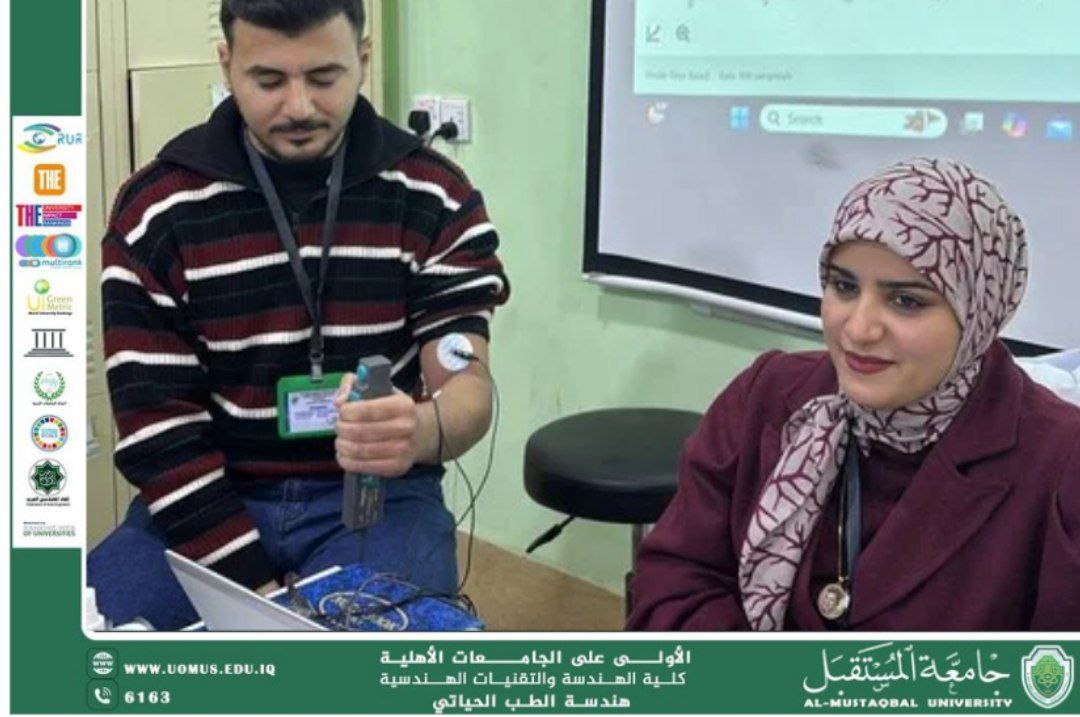


مقالة علمية بعنوان " Surface Electromyography (sEMG)" للمهندسة ضحى حسين حمزة
Surface Electromyography (sEMG)<br />Introduction<br />Surface Electromyography (sEMG) is a non-invasive neurophysiological technique used to record and analyze the electrical activity of muscles. By employing surface electrodes placed on the skin, sEMG facilitates the assessment of neuromuscular function without requiring invasive procedures, making it a valuable tool in clinical diagnostics, rehabilitation, biomechanics, and human-machine interactions. Compared to intramuscular EMG, sEMG offers greater patient comfort and ease of application while maintaining the ability to provide meaningful physiological insights.Voluntary muscle contraction is the result of communication between the brain and individual muscle fibers of the musculoskeletal system. A thought is transformed into electrical impulses that travel down interneurons and motor neurons (in the spinal cord and peripheral nerves) to the neuromuscular junctions that form a motor unit.The individual muscle fibers within each motor unit contract with an all-or-none response when stimulated, meaning that the muscle fiber contracts to its maximum potential or not at all. The strength of contraction of a whole muscle depends on how many motor units are activated and can be correlated with electrical activity measured over the muscle with a technique called electromyography, or EMG.<br />Principles of sEMG<br />sEMG operates by detecting the bioelectrical signals generated by motor units during muscle contraction. These signals are recorded using surface electrodes, amplified, and processed to extract relevant parameters such as muscle activation patterns, signal amplitude, and frequency content. Several factors influence the quality and reliability of sEMG measurements, including electrode placement, skin impedance, inter-electrode distance, and the use of appropriate signal processing techniques.<br /><br />Applications of sEMG<br />1. Medical and Clinical Applications<br />• Diagnosis of Neuromuscular Disorders: sEMG aids in evaluating conditions such as muscular dystrophy, stroke-related motor impairments, and peripheral neuropathies.<br />• Rehabilitation Monitoring: Clinicians use sEMG to track muscle function recovery and optimize physical therapy protocols for patients with musculoskeletal injuries or neurological disorders.<br />2. Rehabilitation and Prosthetic Control<br />• Personalized Therapy: sEMG-guided rehabilitation strategies enable targeted interventions based on real-time muscle activity analysis.<br /><br />• Prosthetic and Assistive Device Integration: sEMG signals are utilized in controlling myoelectric prostheses, exoskeletons, and assistive robotic technologies for individuals with limb loss or motor impairments.<br />3. Sports Science and Ergonomics<br />• Athlete Performance Optimization: By analyzing muscle activation patterns, sEMG helps in designing efficient training regimens and minimizing injury risks.<br />• Postural and Ergonomic Assessments: Used in occupational health to evaluate muscle fatigue and reduce strain-related injuries in workplace settings.<br />4. Human-Machine Interfaces (HMI) and Wearable Technologies<br />• Brain-Computer Interfaces (BCI): sEMG is integrated with BCIs and neuroprosthetics to facilitate seamless communication between the human nervous system and external devices.<br />• Wearable and Real-Time Monitoring Systems: Advances in wireless sEMG technology have enabled continuous muscle activity tracking in real-world conditions, benefiting healthcare, sports, and human performance research.<br /><br />Advancements in sEMG Technology<br />Recent developments in sEMG technology have focused on improving signal acquisition, minimizing noise interference, and enhancing real-time data processing. The incorporation of artificial intelligence (AI) and machine learning algorithms has significantly refined the interpretation of sEMG signals, leading to greater accuracy in medical diagnostics, sports analytics, and neurorehabilitation applications. Additionally, the miniaturization of sEMG sensors and the advent of flexible, skin-integrated electrodes have expanded its applicability in ambulatory settings.<br /><br />Conclusion<br />sEMG is a crucial tool in the study of neuromuscular function, offering broad applications across clinical medicine, rehabilitation, sports science, and human-machine interaction. As technological advancements continue to enhance its precision and usability, sEMG is poised to revolutionize the fields of healthcare, biomechanics, and assistive device development, ultimately improving human motor performance and quality of life.<br />