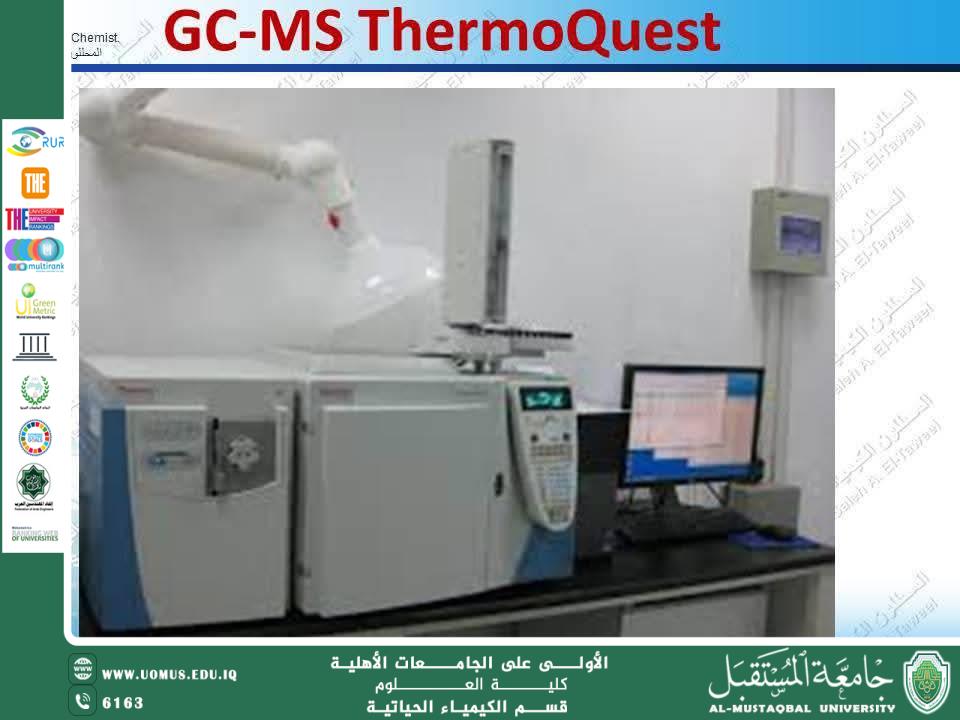
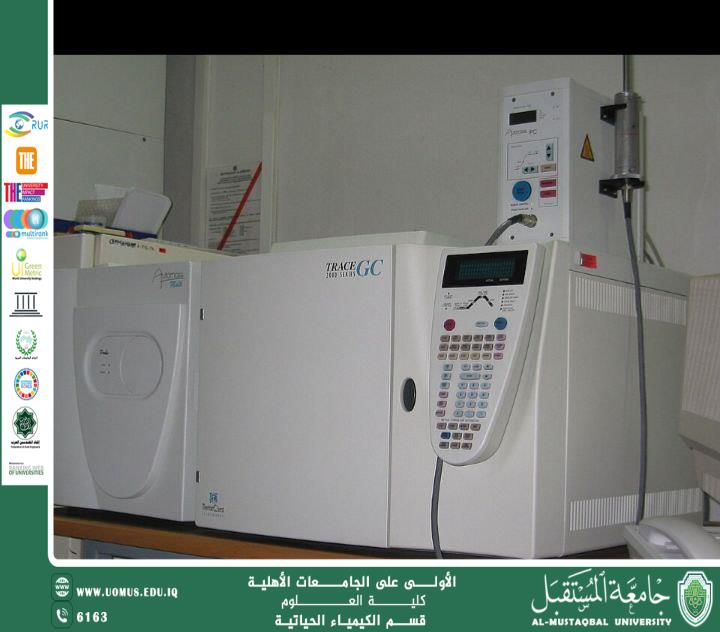
Scientific Article by Lecturer Haider Mutlaq Musa Title: Gas Chromatograph (GC)
Gas Chromatograph (GC)
The Gas Chromatograph (GC) is an analytical instrument used for both qualitative and quantitative analysis of mixtures of organic compounds, especially volatile ones. The analysis is based on gas chromatography.
In this technique:
The mobile phase is a gas.
The stationary phase is a long column (column) with a very small diameter compared to HPLC columns.
Applications:
GC has wide applications across various fields:
Biotechnology
Pharmaceutical analysis
Food analysis
Chemistry and cosmetics
Energy and environmental studies
Specialized analyses such as:
Pesticide residues
Antibiotic residues
Organic environmental pollutants (especially petrochemical compounds)
Main Components of a Gas Chromatograph
Slide 1 – Main Parts
Gas Supply
Provides the mobile phase (gas) that carries the sample through the system.
The gas is pressurized by a pump and mixes with the liquid sample in the sample injector (3), passes through the column (4), reaches the detector (5), and exits the system as waste.
Oven
Provides optimal temperature conditions for successful separation.
Temperature programs:
Sample injector temperature: vaporizes the sample for easy transport by the mobile phase.
Column initial temperature
Column final temperature
Sample Injector
The sample is injected here in a specific volume.
Column (Stationary Phase)
The heart of the GC, where the actual separation occurs.
Columns are usually made of stainless steel, glass, or copper.
Dimensions: diameter ranges from 0.06 to 0.25 inches; length ranges from a few centimeters to hundreds of meters.
In gas-liquid partition chromatography:
The stationary phase can be liquid coated on solid porous particles filling the column.
Or it can be a capillary column with liquid coating on the inner surface.
Capillary columns have smaller capacity; therefore, a gas splitter is used to avoid column overloading by diverting most of the sample outside the column.
Detector
Receives the separated components from the column.
Measures each compound individually to generate an accurate chromatogram.
If compounds are not separated, the detector reads them together, producing an incorrect chromatogram.
Common detectors:
FID: Flame Ionization Detector
NPD: Nitrogen Phosphorous Detector
ECD: Electron Capture Detector
TCD: Thermal Conductivity Detector
MSD: Mass Spectrometry Detector
Data Integration System
Computer software controlling the GC components and collecting data from the detector.
Key outputs:
Retention time of each compound
Peak area of each compound
If you want, I can also convert this into a ready-to-use 1-slide-per-component format for a PowerPoint presentation with simple diagrams/icons for each part. This will make it visually closer to your original Arabic slide deck.
Al-Mustaqbal University
Ranked First among Iraqi Private Universities