
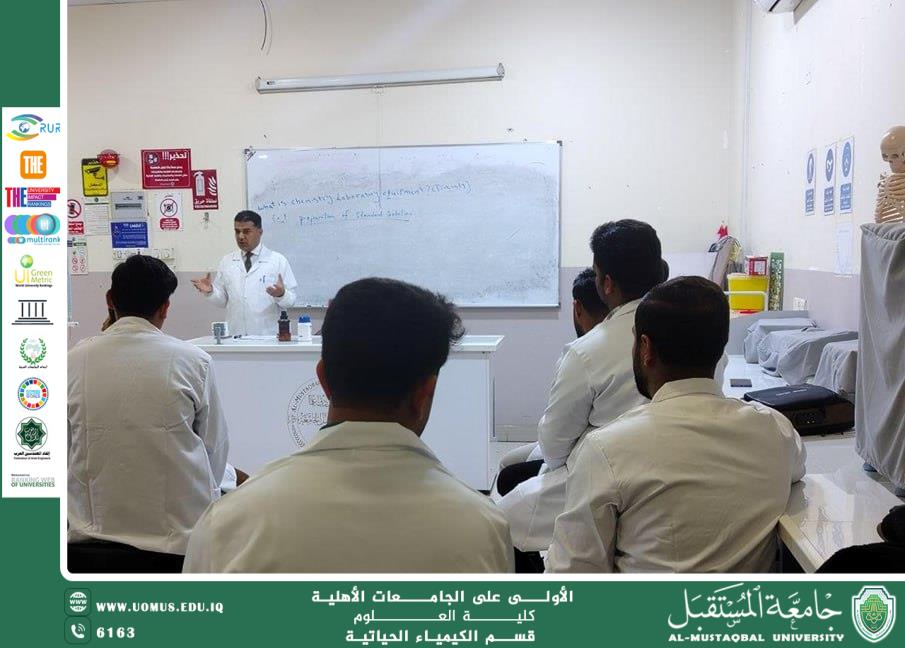
Scientific Article by the Head of the Department of Biochemistry Prof. Dr. Nasser Abdul Hassan Nasser Practical Lessons and Their Role in Improving University Education Outcomes
Practical lessons are considered one of the fundamental pillars of modern university education, as reliance on theoretical instruction alone is no longer sufficient to prepare students capable of keeping pace with labor market demands and rapid scientific development. Hence, the importance of practical lessons emerges in improving university education outcomes by linking theoretical knowledge with real-world application and developing students’ diverse skills.
First: Enhancing Understanding and Comprehension
Practical lessons contribute significantly to reinforcing the theoretical concepts that students acquire in lecture halls, as hands-on application provides an opportunity for deeper understanding of scientific material. When students actively participate in experiments or practical tasks, learning becomes clearer, more meaningful, and more enduring, reducing reliance on rote memorization.
Second: Developing Practical and Professional Skills
Practical lessons play a vital role in developing students’ practical skills, such as critical thinking, problem-solving, teamwork, and the use of modern tools and technologies. These skills are among the core requirements sought by the labor market, making graduates more competent and better prepared to practice their specialization.
Third: Enhancing Self-Confidence and Responsibility
Engagement in practical lessons helps students build confidence in their abilities, as they experience the results of their efforts when successfully conducting experiments or completing applied tasks. Moreover, these lessons foster a sense of responsibility and discipline through adherence to instructions and the proper maintenance of laboratory equipment and facilities.
Fourth: Improving the Quality of Educational Outcomes
Practical lessons positively impact the quality of university education by contributing to the graduation of students who possess both theoretical knowledge and practical competence. This integration raises the overall level of graduates, enhances the reputation of educational institutions, and makes academic programs more effective and impactful.
Fifth: Linking Education to Real-World and Labor Market Requirements
Practical lessons serve as an effective means of connecting university education with real-life and labor market requirements, as they simulate situations that students are likely to encounter in their future professional careers. Consequently, education becomes more relevant to practical life and less detached from societal needs.
Conclusion
In conclusion, achieving distinguished university education outcomes is not possible without adequate attention to and continuous development of practical lessons. They are an essential component in building well-rounded students who are scientifically and professionally competent and capable of contributing effectively to their communities. Therefore, strengthening applied education represents a necessary step toward improving the quality of university education and achieving its intended goals.
Al-Mustaqbal University
Ranked First among Private Iraqi Universities