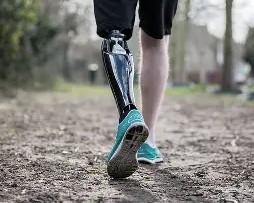
elow-Knee Prostheses and Their Role in Enhancing Mobility Independence
presented by Engineer Aya Talib Hassan
introduction
Below-knee amputation is one of the most common types of lower limb amputation. It may result from various causes such as accidents, vascular diseases, diabetes, or war-related injuries. The loss of a limb poses significant physical and psychological challenges that directly affect mobility and independence. Therefore, below-knee prostheses represent an effective medical and engineering solution that contributes to restoring movement, enhancing mobility independence, and improving quality of life.
Definition of Below-Knee Amputation
Below-Knee Amputation (BKA) refers to the surgical removal of the lower part of the leg while preserving the knee joint. This type of amputation is medically preferred whenever possible, as the knee joint plays a crucial role in movement control, balance, and achieving more efficient gait compared to above-knee amputation.
Components of a Below-Knee Prosthesis
A below-knee prosthesis consists of several key components that work together to ensure functional performance, including:
Socket: The part that connects the prosthesis to the residual limb, carefully designed to distribute pressure and minimize friction.
Liner: Used to provide comfort, protect the skin, and reduce shock.
Pylon: Acts as a structural support connecting the socket to the prosthetic foot.
Prosthetic Foot: Available in various types (conventional or dynamic-response) to provide stability and propulsion during walking.
Role of Prostheses in Enhancing Mobility Independence
Below-knee prostheses play a vital role in restoring mobility, with key benefits including:
Improved walking ability and balance due to preservation of the natural knee joint.
Reduced dependence on others in performing daily activities such as mobility and stair negotiation.
Enhanced self-confidence and psychological independence as a result of regained functional mobility.
Social and vocational reintegration by enabling individuals to return to work or education.
Role of Rehabilitation and Physical Therapy
Successful prosthetic use does not depend solely on fitting the device, but also on comprehensive rehabilitation and physical therapy programs that focus on:
Strengthening the remaining muscles.
Training the patient to use the prosthesis efficiently.
Improving balance and coordination.
Preventing complications such as skin ulcers and lower back pain.
Role of Prosthetics and Orthotics Engineering
Prosthetics and orthotics engineers play a key role in designing and developing prostheses tailored to each patient’s needs, considering biomechanical and functional aspects. The use of modern technologies, lightweight materials, and smart systems enhances prosthetic efficiency and significantly improves mobility independence.
Conclusion
Below-knee prostheses are a fundamental element in the rehabilitation of individuals with lower limb amputations. They contribute effectively to enhancing mobility independence and improving overall quality of life. This highlights the importance of integrating medical, engineering, and rehabilitation approaches to achieve optimal functional and psychological outcomes for patients.