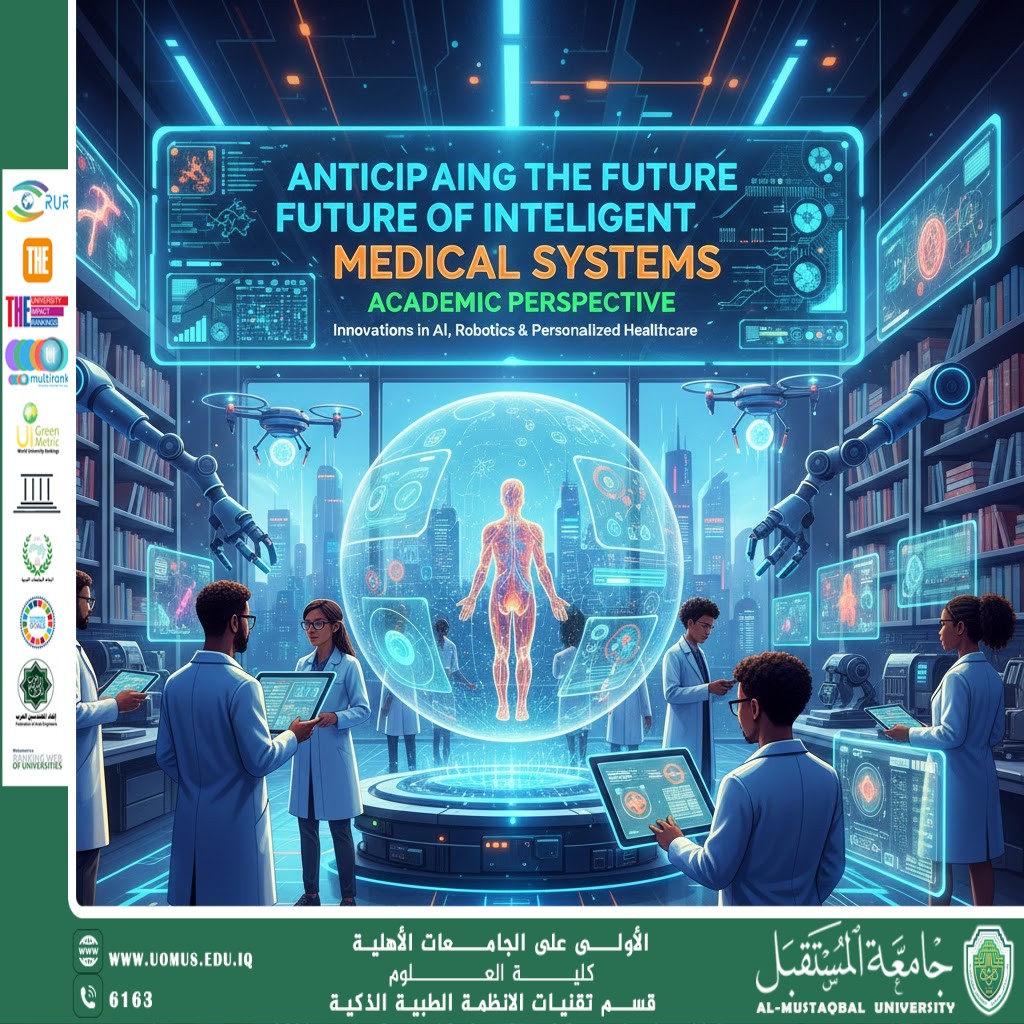

Anticipating the Future of Intelligent Medical Systems from an Academic Perspective (M. M. Qusay Munir Diab)
The healthcare sector is undergoing a rapid qualitative transformation driven by advances in artificial intelligence, data analytics, and intelligent systems. As a result, intelligent medical systems have become one of the most prominent strategic pillars in academic research and higher education. Their role is no longer limited to supportive tools; rather, they have become a fundamental element in reshaping traditional concepts of diagnosis, treatment, and healthcare management. This reality requires academic institutions to anticipate their future and prepare for it scientifically and intellectually.
From an academic perspective, intelligent medical systems represent a fertile environment for interdisciplinary research, where medicine intersects with engineering, artificial intelligence, and data science. This integration opens wide horizons for developing more accurate diagnostic models and clinical decision-support systems capable of analyzing massive volumes of medical data and extracting patterns that are difficult for the human mind to perceive with the same speed and efficiency. Accordingly, universities play a pivotal role in directing scientific research toward innovative, data-driven healthcare solutions grounded in evidence-based practice.
In the field of education, intelligent medical systems are expected to bring about a qualitative shift in teaching methods and clinical training. Intelligent simulations and interactive systems can provide students with practical experiences that closely mirror real medical environments, enhancing their analytical skills and decision-making capabilities, and preparing them to operate effectively within modern healthcare settings. Consequently, integrating concepts of digital health and intelligent systems into academic curricula has become an educational necessity to meet future labor market demands.
At the level of applied research, the future of intelligent medical systems is closely linked to the advancement of predictive medicine and personalized healthcare. Intelligent systems can contribute to predicting diseases before their onset and designing tailored treatment plans for each patient based on genetic, clinical, and lifestyle data. This direction offers universities significant opportunities to develop pioneering research projects that serve society and contribute to improving public health indicators.
Anticipating the future of intelligent medical systems also requires addressing the ethical and legal challenges associated with their use, such as medical data privacy, the reliability of decisions generated by intelligent systems, and the evolving role of physicians amid increasing technological reliance. Here, the academic community bears a crucial responsibility in promoting responsible research practices and establishing scientific and ethical frameworks that ensure the safe and effective use of these systems.
In conclusion, anticipating the future of intelligent medical systems from an academic perspective is both a scientific and strategic responsibility entrusted to universities and research institutions. Through sustained investment in research, education, and capacity building, academic institutions can serve as key drivers in developing intelligent medical systems that contribute to building a more efficient and sustainable healthcare ecosystem—one that aligns with the demands and challenges of the digital age.
University of Al-Mustaqbal the first university in Iraq.