
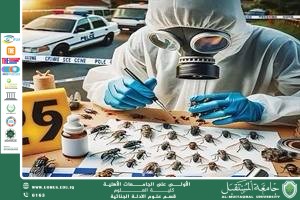
The Role of Forensic Entomology in Solving Mysterious Crimes Asst. Lect. Bushra Hussein Atiya
Forensic entomology is a specialized branch of forensic science that focuses on the study of insects associated with decomposing bodies and crime scenes. This discipline plays a crucial role in solving mysterious crimes, particularly when traditional methods fail to determine the time or circumstances of death.
⸻
Concept of Forensic Entomology
Forensic entomology involves the study of insect species, their life cycles, and behavior to obtain valuable forensic evidence. After death, specific insects—especially flies and beetles—colonize the body in a predictable sequence, which helps investigators estimate the postmortem interval.
⸻
Importance in Criminal Investigations
Forensic entomology is important because it can:
• Estimate the postmortem interval (PMI).
• Indicate whether a body has been moved.
• Help distinguish injuries occurring before or after death.
• Assist in detecting cases of neglect or abuse.
⸻
Major Forensic Insect Groups
Insects associated with decomposing bodies are classified into:
• Flies (Diptera) such as blowflies and flesh flies, which arrive early.
• Beetles (Coleoptera) appearing in later decomposition stages.
• Incidental insects that are present but not directly involved in decomposition.
⸻
Scientific Methods of Insect Evidence Analysis
The analysis of entomological evidence includes:
• Examining insect life stages (eggs, larvae, pupae, adults).
• Measuring larval size and estimating age.
• Evaluating environmental factors such as temperature and humidity.
• Applying molecular techniques (insect DNA analysis) for accurate species identification.
⸻
Role in Solving Mysterious Crimes
Forensic entomology contributes to solving complex cases by:
• Estimating time of death in advanced decomposition cases.
• Detecting toxins through insect tissue analysis.
• Determining burial or exposure conditions.
• Supporting forensic pathology and other forensic evidence.
⸻
Challenges and Limitations
Despite its value, forensic entomology faces limitations such as:
• Climate-dependent insect activity.
• Regional variation in insect species.
• Requirement for specialized taxonomic expertise.
⸻
Conclusion
Forensic entomology is a powerful and precise forensic tool that provides critical information in mysterious crime investigations. Its integration with modern laboratory techniques continues to enhance its reliability and importance in forensic science.
Al-Mustaqbal University – the first university in Iraq.
SDG4