"Scientific article by Ms. Tamara Nihad Abbas entitled “Light Diffraction and Its Applications in Optical Systems
Introduction
Light diffraction is considered one of the important wave phenomena in the field of optics. It occurs when light passes through narrow apertures or near the edges of opaque objects, where the dimensions of these apertures or obstacles are comparable to the wavelength of light. This phenomenon causes light to bend and spread instead of traveling strictly in straight lines. The importance of light diffraction lies in its direct impact on the resolution of optical systems, as well as its wide range of scientific and technological applications.
Concept of Light Diffraction
Light diffraction is a physical phenomenon that arises from the wave nature of light, in which light spreads and bends when passing through a narrow slit or around the edge of an object. This behavior is explained using the Huygens–Fresnel principle, which states that every point on a light wavefront acts as a source of secondary wavelets that interfere with one another to form the final diffraction pattern.
Types of Light Diffraction
1. Single-Slit Diffraction
This occurs when light passes through a single narrow slit, producing a bright central maximum surrounded by less intense secondary fringes. The shape of the diffraction pattern depends on the slit width and the wavelength of the light.
2. Double-Slit Diffraction
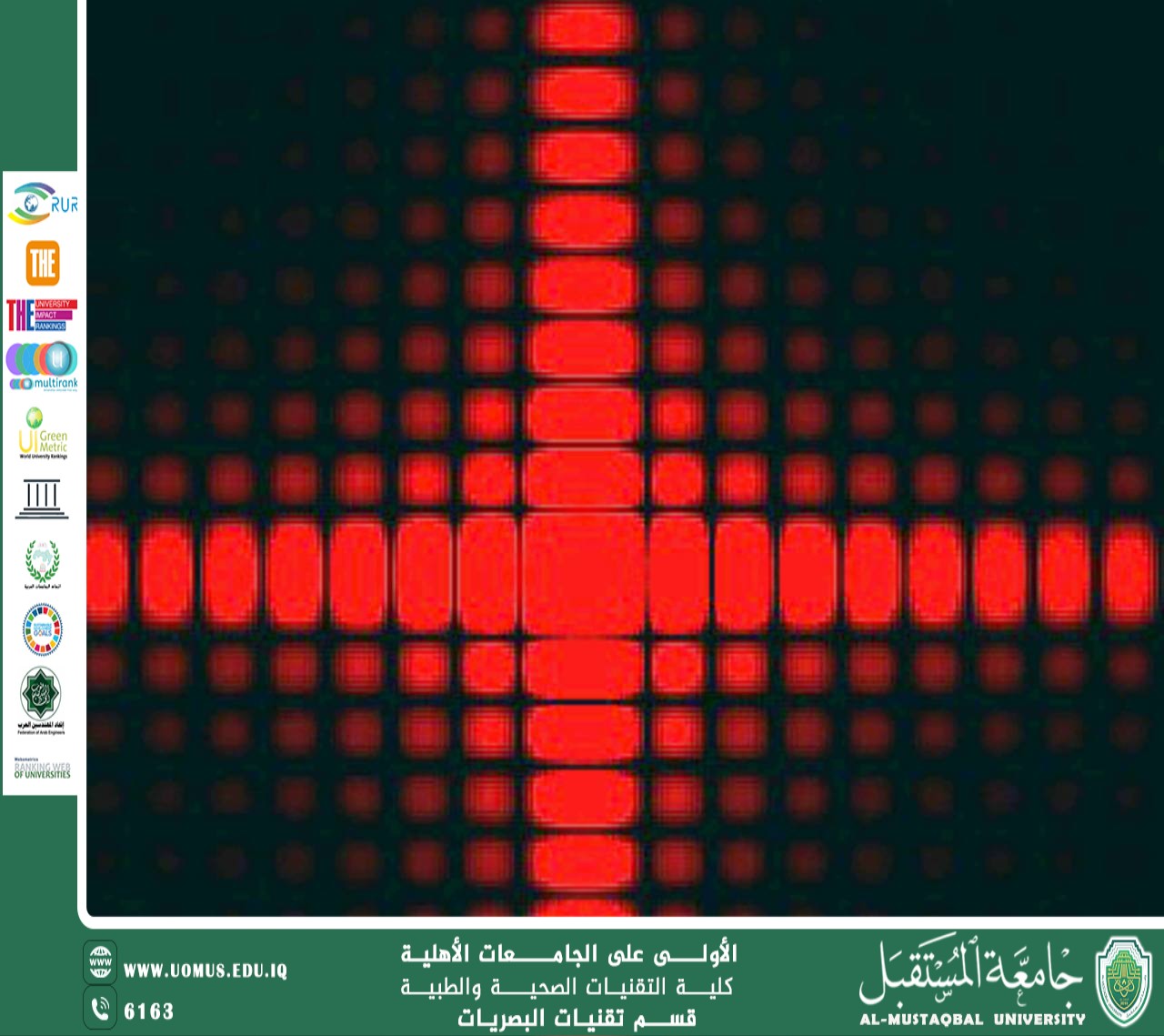
When two closely spaced slits are used, the light emerging from them interferes, forming a pattern that results from both interference and diffraction. This phenomenon forms the basis of the famous Young’s double-slit experiment.
3. Diffraction Using Diffraction Gratings
A diffraction grating consists of a large number of parallel slits and is used to separate light into its spectral components with high precision.
Light Diffraction in Optical Systems
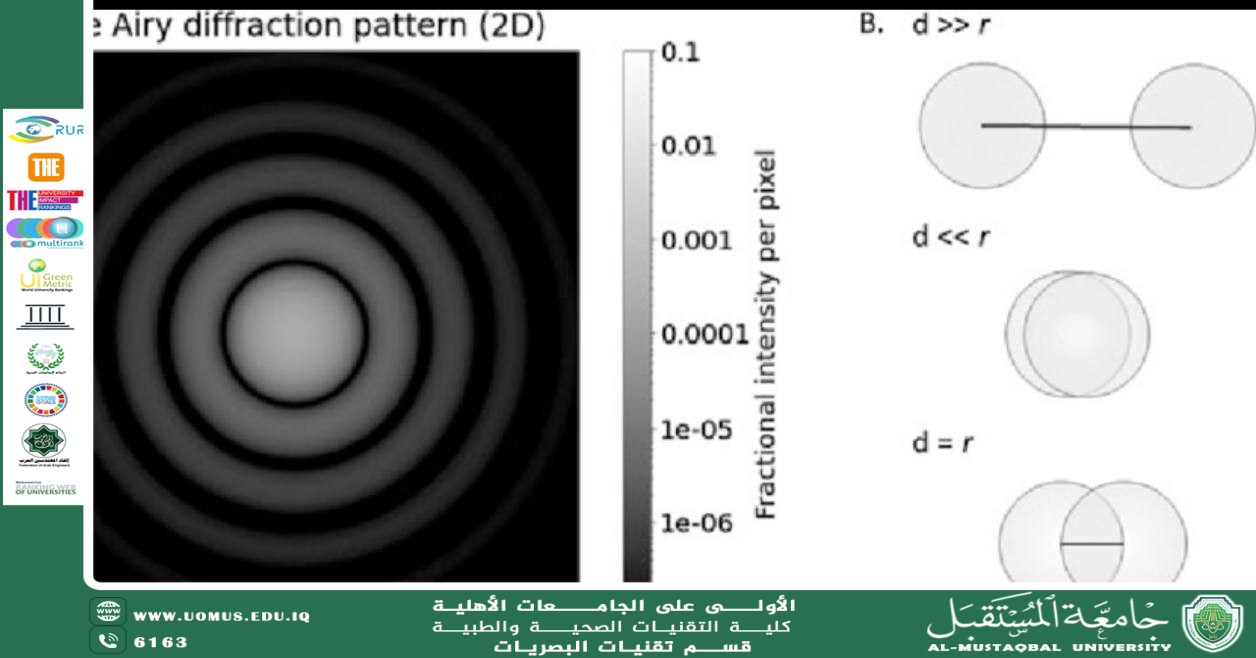
Light diffraction represents a limiting factor in the performance of optical systems, as it imposes an upper limit on optical resolution. When light passes through a lens or a circular aperture, a pattern known as the Airy disk is formed, which determines the smallest distance at which two closely spaced points can be distinguished. Therefore, even ideal optical systems are affected by diffraction and cannot produce a perfectly sharp point image.
Applications of Light Diffraction
1. Spectral Analysis
Diffraction gratings are used in spectrometers to separate light into its constituent wavelengths, aiding in the analysis of the composition of materials and elements.
2. Microscopes and Medical Devices
Diffraction affects the resolution of optical microscopes and is taken into account when designing medical imaging devices.
3. Optical Communications
Light diffraction plays a role in the design of optical fibers and laser systems to reduce losses and improve signal transmission efficiency.
4. Optical Discs
The technology used to read compact discs (CDs and DVDs) relies on the diffraction of light reflected from the microscopic tracks stored on the disc surface.
Conclusion
Light diffraction is a fundamental phenomenon in wave optics and has a significant effect on determining the resolution of optical systems. Although it represents a limitation in some applications, it is effectively utilized in many scientific and technological fields, making it an essential element in the advancement of modern optical sciences.
University of Al-Mustaqbal – The First and Leading Private University