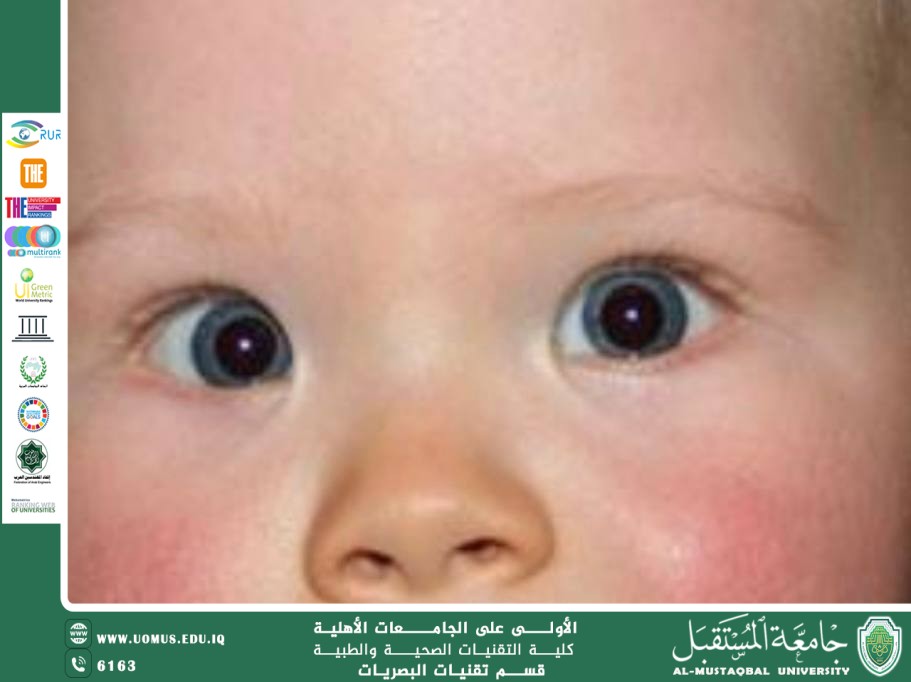
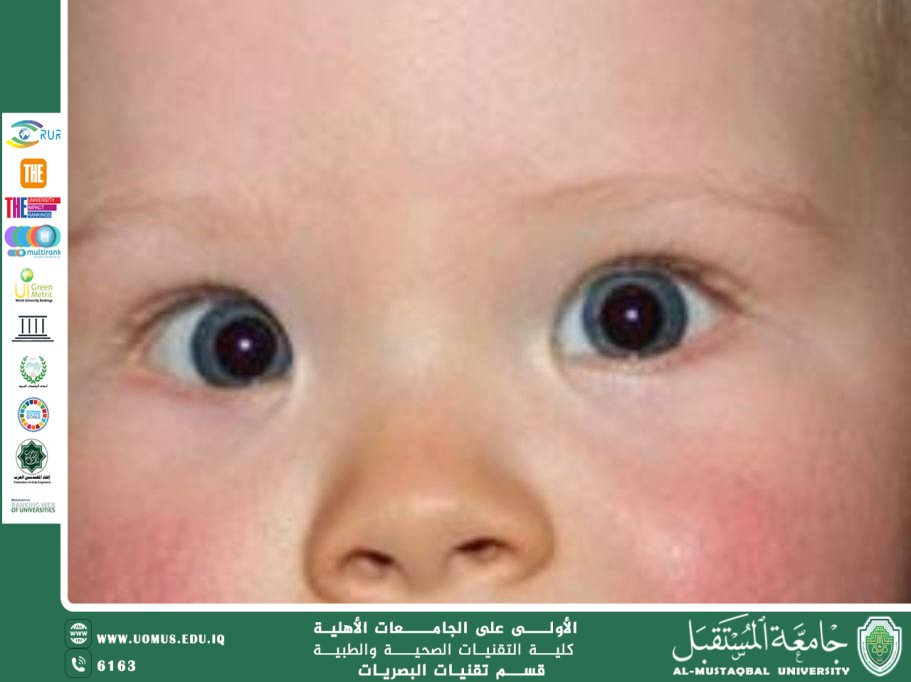
A scientific article by instructor Mustafa Haider entitled Pseudostrabismus
Pseudostrabismus refers to the appearance of eye
misalignment in the absence of true misalignment of the
visual axes (Donahue, 2016). The apparent misalignment
may result from certain facial morphological features,
including the eyelids, inter-pupillary distance, and nasal
structure, or from an abnormal angle kappa (Birch, 2012).
The appearance of pseudostrabismus can vary depending on
the direction and magnitude of the angle kappa (Mandal et
al., 2018). Among its various forms, pseudoesotropia—an
apparent inward deviation of the eyes—is the most
common, followed by pseudoexotropia and
pseudohypotropia/pseudohypertropia (American Academy
of Ophthalmology [AAO], 2021). Accurate recognition of
these variants is essential for differentiating
pseudostrabismus from true strabismus and for providing
appropriate parental counseling.Causes and Natural History
Pseudostrabismus in infants is frequently associated with a
broad nasal bridge and the presence of epicanthal folds,
which are small folds of skin covering the inner corners of
the eyes (Donahue, 2016; Mandal et al., 2018). These
features can obscure the medial sclera, creating the optical
illusion that the eyes are crossed, although the visual axes
remain properly aligned (Birch, 2012). Pseudostrabismus is
most commonly observed as pseudoesotropia, but other
forms such as pseudoexotropia and
pseudohypotropia/pseudohypertropia may also occur (AAO,
2021).
As the child grows and facial structures mature, the nasal
bridge narrows and the epicanthal folds become less
prominent, often resulting in spontaneous resolution of
pseudostrabismus without intervention (AAO, 2021).
Understanding this natural course is crucial for reassuring
parents and avoiding unnecessary medical procedures or
anxiety.Diagnosis
The diagnosis of pseudostrabismus should only be made
after ruling out the presence of true manifest or intermittent
strabismus (Donahue, 2016; Birch, 2012). A thorough
history is essential, including details about birth weight,
gestational age, general health, and any prior procedures to
treat retinopathy of prematurity, as these factors may
provide diagnostic clues (Mandal et al., 2018). Early
photographs of the child can assist in documenting the onset
of the apparent misalignment, assessing its stability over
time, and supporting the diagnosis of pseudostrabismus.
Physical examination should encompass visual and motor
evaluation, as well as careful inspection of facial
morphology, including the nasal bridge, orbital anatomy, and
eyelid configuration (Donahue, 2016). Cycloplegic refraction
and a dilated eye examination are recommended in every
case. A detailed ocular motility assessment, comprising
cover-uncover and alternate cover tests, is considered the
gold standard for detecting true strabismus. In
uncooperative infants, the Hirschberg light reflex test may
be used to estimate ocular alignment (Birch, 2012).
Cycloplegic refraction is particularly important in cases of
pseudoesotropia to exclude high hyperopia, which may
indicate intermittent accommodative esotropia.
Once pseudostrabismus is confirmed, parental reassurance
and education regarding the signs of true strabismus are
crucial. Families should be advised to seek prompt
evaluation if any new signs of ocular misalignment develop,
as early diagnosis of manifest strabismus is critical and may
otherwise be overlooked in children previously diagnosed
with pseudostrabismus (AAO, 2021).References
American Academy of Ophthalmology. (2021). Pediatric eye
disease: Strabismus. https://www.aao.org/eye-
health/diseases/strabismus
Birch, E. E. (2012). Strabismus and amblyopia in children.
Journal of American Association for Pediatric Ophthalmology
and Strabismus, 16(1), 1–7.
https://doi.org/10.1016/j.jaapos.2011.11.002
Donahue, S. P. (2016). Common pediatric eye disorders.
Pediatrics in Review, 37(9), 372–384.
https://doi.org/10.1542/pir.2015-0114
Mandal, A., Aggarwal, S., & Sinha, R. (2018).
Pseudostrabismus in infants: Clinical significance and
parental counseling.
University of Al-Mustaqbal – The First and Leading Private University