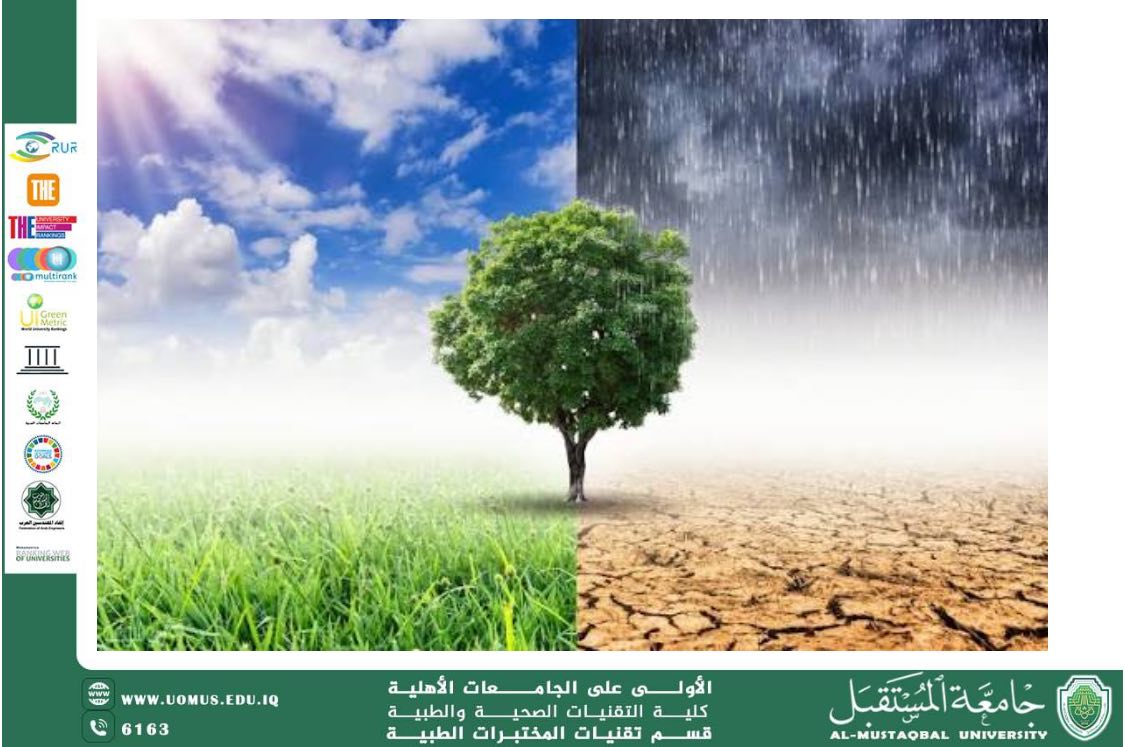

A Scientific Article by Ms. Saja Fadhil Abbas Entitled: Mechanisms Adopted to Control Humidity and Climatic Factors in Scientific Laboratories and Their Impact on the Safety of Chemical Materials
Mechanisms Adopted to Control Humidity and Climatic Factors in Scientific Laboratories and Their Impact on the Safety of Chemical Materials
Introduction
Scientific laboratories are the cornerstone of scientific research and practical applications in the fields of medicine, chemistry, biology, and engineering sciences. The success of laboratory work largely depends on the stability of the environment surrounding experiments, particularly with regard to humidity, temperature, and various climatic factors. Any imbalance in these factors may lead to the deterioration of chemical materials, distortion of experimental results, and increased risks to laboratory personnel. Hence, the importance of adopting precise scientific mechanisms and specialized materials to control humidity and climatic factors, ensuring work safety and the quality of scientific outcomes.
Impact of Humidity and Climatic Factors on Chemical Materials
High humidity directly affects many chemical substances, especially hygroscopic materials that absorb water vapor from the air, leading to changes in their physical and chemical properties. This may result in the agglomeration of solid substances, chemical degradation, or changes in solution concentrations, which negatively affects the accuracy of results. Sudden temperature fluctuations may also cause expansion or contraction of glassware and sensitive instruments, influencing calibration and measurement accuracy, and increasing the likelihood of water vapor condensation inside containers and sensitive devices.
Mechanisms Adopted to Control Climatic Factors within Laboratories
Modern laboratories rely on a set of integrated mechanisms to ensure a stable laboratory environment. Among the most important are air-conditioning and ventilation systems equipped with humidity control units, which maintain temperature and humidity within safe limits appropriate to the nature of laboratory work. Dehumidifiers are also used as an effective solution in regions with humid climates, as they reduce water vapor in the air and help maintain a stable and safe environment.
Proper Storage and Its Role in Protecting Laboratory Materials
Proper storage is one of the most important preventive measures to limit the effects of humidity and climatic factors. This includes storing chemical materials in tightly sealed containers made of moisture-resistant materials, in addition to classifying and placing them in designated cabinets according to their chemical nature. It is also recommended to use environmentally controlled cabinets for sensitive materials, such as highly reactive reagents or volatile substances.
Materials Used to Reduce the Impact of Humidity
Moisture-absorbing materials, such as silica gel and calcium chloride, are widely used inside containers and laboratory cabinets to absorb water vapor and prevent it from reaching chemical substances. In addition, moisture-resistant containers and multi-layer insulation and packaging materials play an important role in protecting materials during long-term storage or transportation, ensuring the preservation of their effectiveness and stability.
Administrative and Training Role in Enhancing Laboratory Safety
The effectiveness of technical mechanisms and materials cannot be achieved without informed management and clear organizational procedures. This requires training personnel to monitor humidity and temperature indicators, comply with safety instructions, and regularly update storage records. Moreover, the presence of written protocols for dealing with climatic changes and emergency situations contributes to risk reduction and ensures the continuity of laboratory work.
Conclusion
Controlling humidity and climatic factors within scientific laboratories represents a fundamental element in maintaining the safety of chemical materials and the accuracy of research results. This is achieved through the integration of modern technical mechanisms, specialized materials, effective management, and continuous training.
Through such integration, laboratories become stable and safe scientific environments capable of supporting scientific research and applied education in accordance with the highest standards of quality and accreditation.
Al-Mustaqbal University is the first university in Iraq
Department of Medical Laboratory Techniques – First in the Iraqi National Ranking.