Comparative Model Between the Semester System and the Bologna Process
Introduction
Structural transformations in Iraqi higher education systems represent a response to the requirements of academic globalization and labor market needs. Currently, there is a methodological and practical tension between the traditional course-based (Semester System) and the Bologna Process, which the Ministry of Higher Education and Scientific Research has begun to implement gradually, particularly in technical, engineering, and science colleges.
The Core Comparison Between the Two Systems
A Comparative Study: Bologna Process vs. Semester System in Iraqi Higher Education
⸻
1. Philosophical and Methodological Framework
• Semester (Course-Based) System:
This system relies on dividing the academic year into two independent semesters, during which specific subjects are taught in each term. The core philosophy is “subject-centered learning,” where the instructor’s primary goal is to cover the syllabus within a defined time frame.
• Bologna Process:
An international framework aimed at standardizing quality criteria. It adopts a student-centered learning philosophy, where academic workload is not measured solely by in-class teaching hours, but by all activities undertaken by the student to achieve the intended learning outcomes.
⸻
2. Academic Measurement Unit (Credits vs. ECTS)
• In the Semester System:
Academic “credits” are used, usually based on the number of weekly lecture hours (for example, one theoretical hour equals one credit).
• In the Bologna Process:
The European Credit Transfer and Accumulation System (ECTS) is adopted. One ECTS credit corresponds to 25–30 hours of actual student workload, including lectures, self-study, library preparation, and examinations. A typical semester requires 30 ECTS credits.
⸻
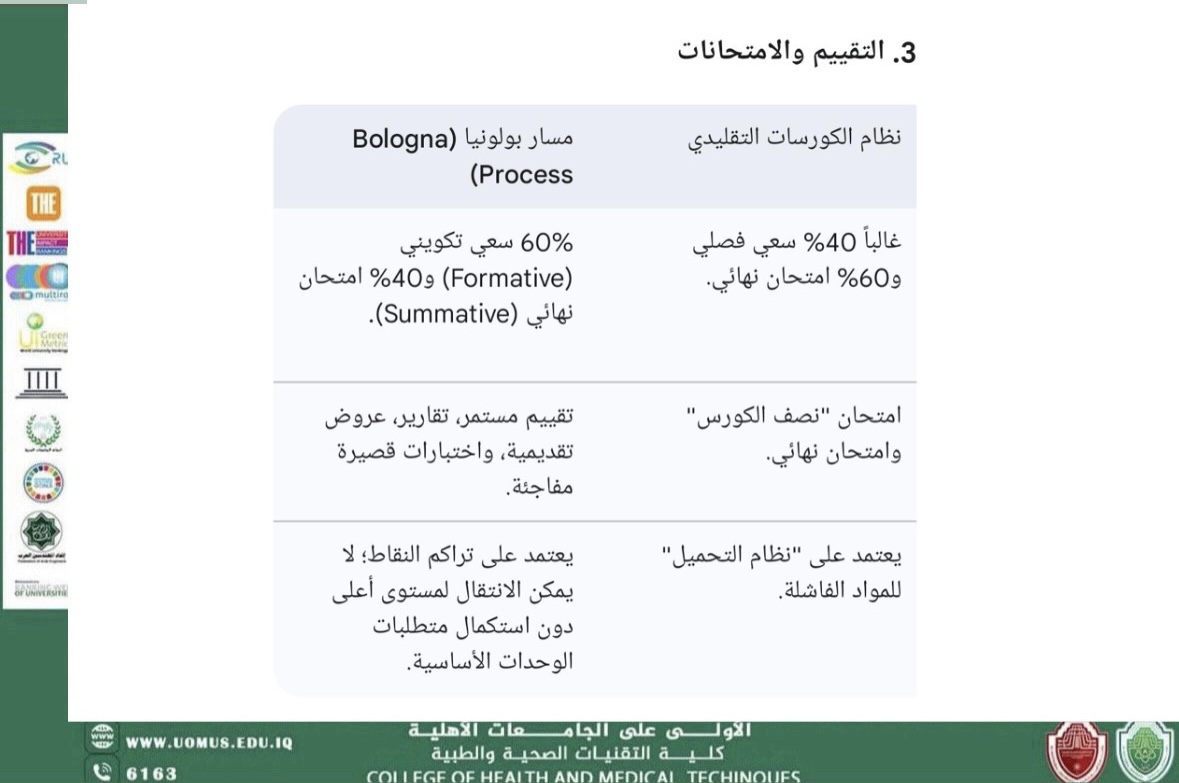
3. Assessment and Examinations
(As detailed in Appendix No. 1)
The structural transformations in Iraqi higher education systems are driven by academic globalization and labor market demands. This has created a methodological and practical contrast between the traditional Semester System and the Bologna Process, which is being gradually implemented by the Ministry of Higher Education and Scientific Research, particularly in technical, engineering, and scientific institutions.
The following academic article presents a core comparison between the two systems:
⸻
Comparison: Bologna Process vs. Semester System in Iraqi Higher Education
1. Philosophical and Methodological Framework
• Semester System:
Relies on dividing the academic year into two independent semesters, each with specific courses. The philosophy is subject-centered learning, where the instructor aims to complete the syllabus within a limited time.
• Bologna Process:
An international framework for quality standardization based on student-centered learning, where effort is measured through all student activities required to achieve learning outcomes, not only classroom hours.
2. Academic Measurement Unit (Credits vs. ECTS)
• Semester System:
Uses academic credits based mainly on weekly lecture hours.
• Bologna Process:
Uses ECTS, where one credit equals 25–30 hours of total student workload. A full semester normally equals 30 ECTS credits.
⸻
4. Connection to the Labor Market and Flexibility
• Semester System:
Curricula are often fixed for long periods and rely heavily on theoretical instruction, which may create a gap between graduates and actual job market requirements.
• Bologna Process:
Focuses on competencies, with curricula designed around the skills and abilities students must master upon graduation. It also facilitates international recognition of Iraqi degrees, enabling graduates to apply more easily to European and global universities.
⸻
5. Practical Challenges in the Iraqi Context
Despite the theoretical advantages of the Bologna Process, its implementation in Iraq faces several challenges:
• Infrastructure:
Requires flexible learning spaces and laboratories accessible for extended hours, which are lacking in some institutions.
• Academic Culture:
Difficulty in transitioning faculty members from the role of “lecturer” to “facilitator,” and challenges for students in adapting to self-directed learning.
⸻
Applied Model in Radiological Techniques Departments
According to the Bologna Process guidelines adopted in Iraqi universities and technical colleges, academic workload and course structure are organized using the ECTS system.
Practical Example in Radiological Techniques Departments
For two courses, one of which is a core subject:
• Computed Tomography Physics (CT) – a core course
• Magnetic Resonance Imaging (MRI) – a specialized course
According to the Bologna Process in the Department of Radiological Techniques, the courses “Computed Tomography (CT) Physics” and “Magnetic Resonance Imaging (MRI)” are considered specialized core subjects within the discipline.
. Computed Tomography Physics (CT)
• Number of ECTS credits: Usually 5 credits.
• Total required workload: 5 credits × 25 hours = 125 hours per semester.
• Distribution of hours:
• Scheduled hours (classroom and laboratory): 60 hours (for example, 2 hours theoretical + 2 hours practical per week).
• Unscheduled hours (self-study, report preparation, reviewing resources): 65 hours.
2. Magnetic Resonance Imaging (MRI)
• Number of ECTS credits: Usually 6 credits (due to the complexity of the subject).
• Total required workload: 6 credits × 25 hours = 150 hours per semester.
• Distribution of hours:
• Scheduled hours: 75 hours.
• Unscheduled hours: 75 hours (including clinical training or simulation).
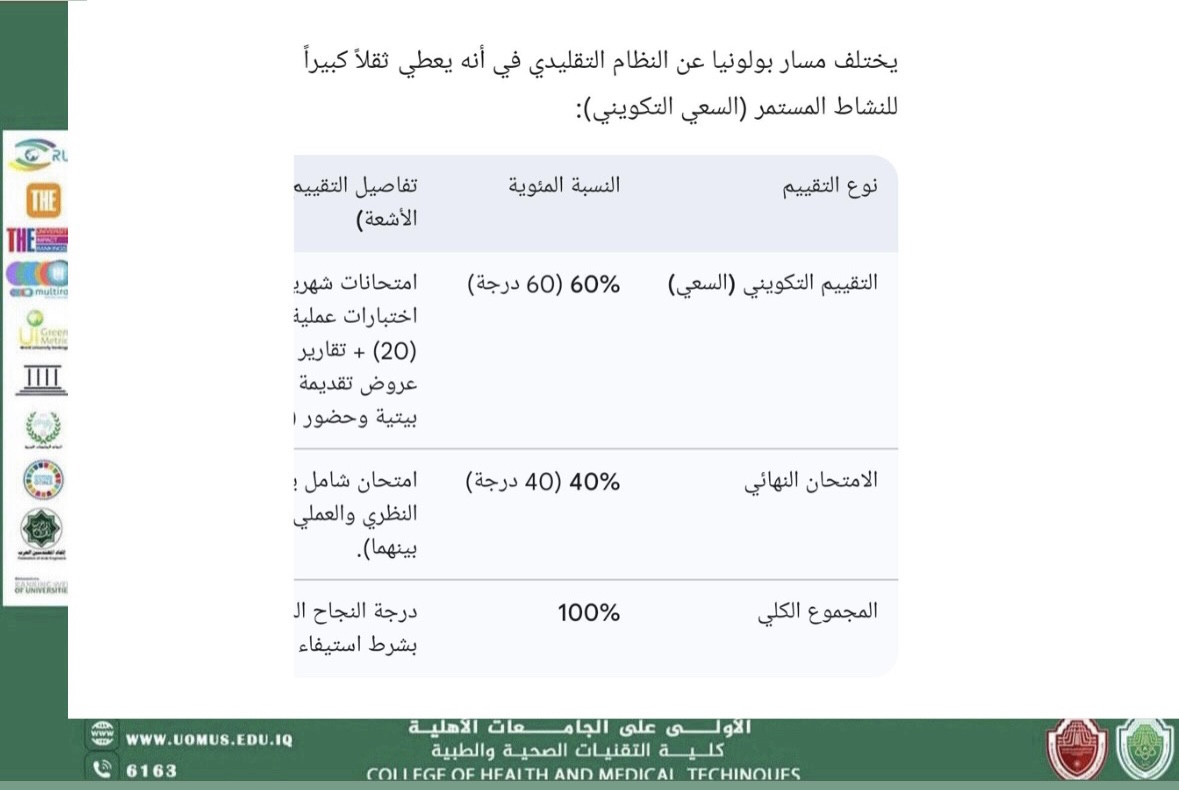
3. Grading Distribution System (According to the Bologna Process)
The Bologna Process differs from the traditional system in that it places significant weight on continuous assessment (formative assessment).
Conclusion
The transition to the Bologna Process represents a qualitative leap to move Iraqi higher education out of regional isolation toward international standards. While the course-based system remains more stable and easier to manage at present, it lacks the flexibility required by the labor market and future professions.
As shown below, the fundamental differences in teaching these two subjects are:
• In the old course-based system: The student memorized radiation physics to pass a final exam at the end of the semester, with the focus on passing a written exam.
• In the Bologna Process:
• In the CT course, the student is required to draw diagrams of the stages of image reconstruction as an in-class activity.
• In the MRI course, the student is required to prepare a presentation on the risks of magnetic fields and how to handle emergencies as part of continuous assessment.
The goal is to ensure that the student has acquired competence.
Scientific References:
• Ministry of Higher Education and Scientific Research (2023). Guide to Procedures for Implementing the Bologna Process in Iraqi Universities.
• Al-Zuhairi, Talal (2023). “Implementing the Bologna Process in Iraqi Universities: Obstacles and Solutions,” Al-Sabah Academic Newspaper.
• European Commission (2020). ECTS Users’ Guide, Publications Office of the European Union.
• Al-Husseini, H. (2022). “Comparative Study between Credit System and Bologna Process in Engineering Education.” Journal of University of Babylon for Pure and Applied Sciences.