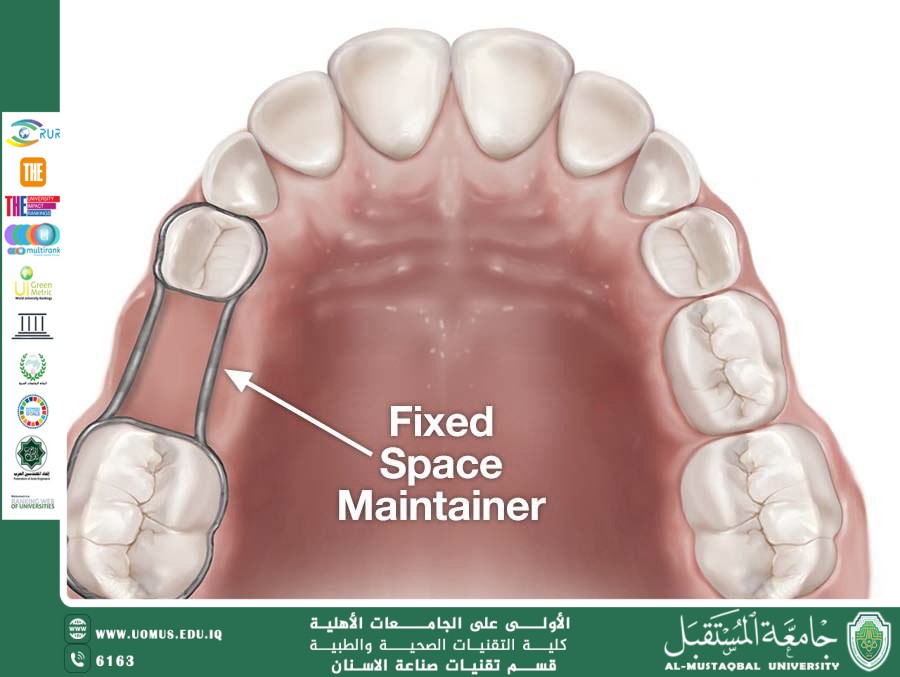
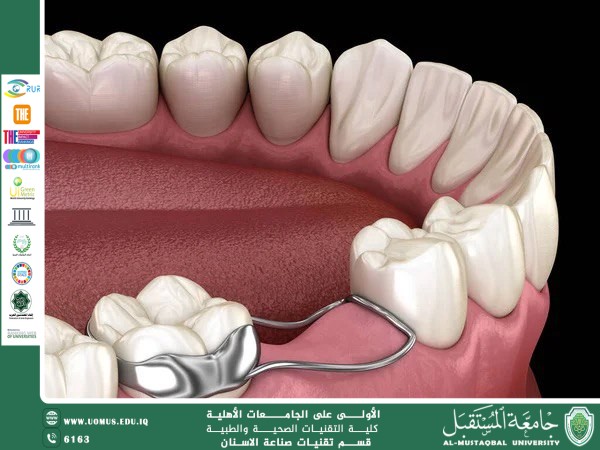
Space Maintainers
Space Maintainers
Definition: A device used to preserve arch length following the
premature loss of a primary tooth or teeth.
The S.M. allows the permanent tooth to erupt unhindered into alignment
and occlusion.
The best space maintenance treatment is the preservation of primary
molars until natural exfoliation.
The premature loss of primary teeth is still one of the most common
controllable causes of malocclusion.
Factors considered in space maintainer construction:
In construction of S.M. certain considerations are important for the
dentist after the ultimately loss of primary teeth.
1. Time elapsed since loss
It is very important factor because if the space closes occurs during the
1st 6 months after extraction. So space maintainer prefer to be done
immediately after extraction. If a patient comes after one year after one
extraction. In this case a change already been developed . so there is no
need to a construct a space maintainer but we can do a space regainer
(space maintainer appliance )that will regain the lost space before the
eruption of the permanent teeth (active space maintainer).
2. Dental age of the patient.
The chronologic age of the patient is not so important as the development
age. The development age is very important because in the time of
eruption of teeth. Some children have erupted their bicuspid at 8 years
other at 12 years.
The dentist must depend on dental X-Ray to be sure that tooth will erupt
in the right time. According to the researcher , the tooth starts to erupt
when 3\4 of the root develop regardless of child chronological age. If 3\4
of the root is not formed, so do space maintainer.
1
3. 4. Amount of bone covering unerupted tooth.
the tooth will erupt when 3\4 of the root developed. This is known by the
radiograph also one can estimate if there is infection. So we see the
resorption of bone and the crown of the permanent it will erupt in jaw
prematurely before 3\4 of the root formed So in this case we prepare a
space maintainer. When 3\4 of the root is formed as develop. We remove
the space maintainer so we let the tooth to erupt. also we can see the
amount of the bone covering the unerupted tooth if the amount of bone is
thick so we can predict that the eruption will not occur and we can
construct S.M.
A guide for predicting emergency is that erupting premolars usually
require 4 to 5 months to move through 1 mm of bone as measured on a
bite-wing radiograph.
This method of prediction is less reliable than that based on root
development. If the amount of bone is thin we predicted that the tooth
eruption will occur early and there is no need for S.M.
Sequence of the eruption of teeth.
The dentist should observe the relationship of developing teeth adjacent
to the space create by the untimely loss of a tooth. For e.g. if 2 nd primary
molar has lost prematurely and the 2 nd permanent molar is ahead of the
second of the second premolar in its eruption. There is a possibility that
permanent molar will exert a strong force on the 1 st permanent molar
causing it to drift mesially and to occupy some of the space required by the
2 nd premolar.
Othe e.g. 1 st permanent molar lost prematurely and permanent lateral
incisor in an active state of eruption ( it will cause distal movement of
primary canine and an encroachment on the space needed by the 1 st
premolar.
This condition frequently accompanied by a shift in the midline toward
the area of the loss.
In the mandibular arch, “a falling in “ of the anterior segment may occur
and an increased over bite way result.
2
5. Delayed eruption of the permanent teeth.
Individual permanent teeth are often observed to be delayed in their
development and consequently in their eruption ( partially impacted
permanent teeth or deviation in the eruption path ). It is necessary to
extract the primary tooth, construct a S.M. and allow the permanent tooth
to erupt and assume its normal position. If the permanent teeth in the
same area of opposing dentition have erupted, it is advisable to
incorporate an occlusal “stop” in the appliance to prevent suppuration in