
Chromosome Structure: Organization and Biological Significance Prepared by: Lect. Abbas Hamza Khudhair Department of Biochemistry – College of Science – Al-Mustaqbal University
A chromosome is a highly organized and compact structure composed of DNA and histone proteins that carries genetic information. This organization ensures that DNA is efficiently packaged within the nucleus and accurately transmitted during cell division.
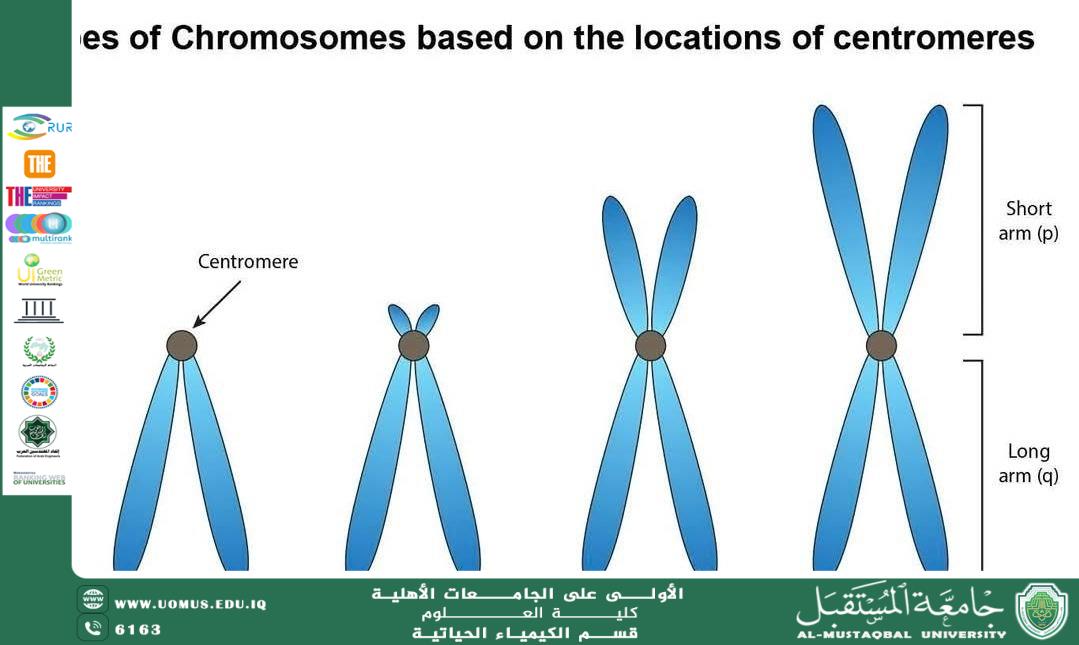
Each replicated chromosome consists of two identical sister chromatids. Each chromatid has two arms separated by a central constriction known as the centromere. The centromere is the region where the two sister chromatids are joined and forms the kinetochore, which serves as the attachment site for spindle fibers during mitosis and meiosis, allowing proper chromosome movement and segregation.
The p arm (from the French petit, meaning small) is the short arm of the chromosome, while the q arm is the long arm. Both arms contain genes and regulatory DNA sequences that are essential for normal cellular function and development.
At the molecular level, DNA is wrapped around histone proteins to form nucleosomes, which further fold into chromatin fibers. In addition, chromosomes possess telomeres at both ends, which protect DNA from degradation and prevent end-to-end fusion.
Based on the position of the centromere, chromosomes are classified into:
Metacentric: centromere in the middle
Submetacentric: centromere slightly off-center
Acrocentric: centromere near one end
Telocentric: centromere at the end (not found in humans)
This highly organized chromosomal structure is essential for genome stability, proper gene regulation, and accurate inheritance of genetic material