Cosmic Physics and Chemistry: From the Birth of the Universe to the Formation of Matter By Asst. Prof. Dr. Karrar Majid Abid
The universe cannot be understood in isolation from chemistry, just as chemistry cannot be separated from cosmic physics. The relationship between the two begins in the earliest moments of the universe’s formation and extends to the most subtle interactions occurring within atoms and molecules. Cosmic physics provides the overall framework of the universe, while chemistry explains how matter forms and transforms within this framework.
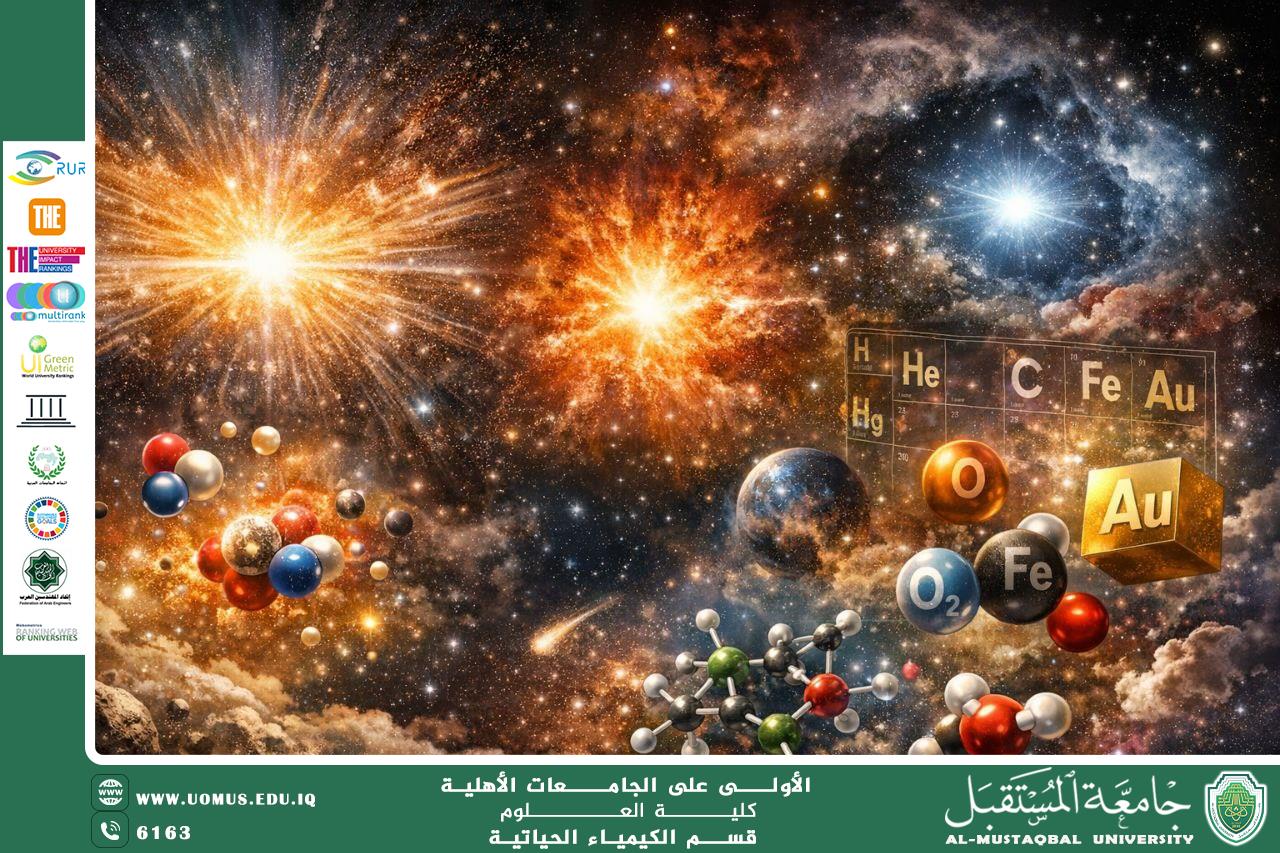
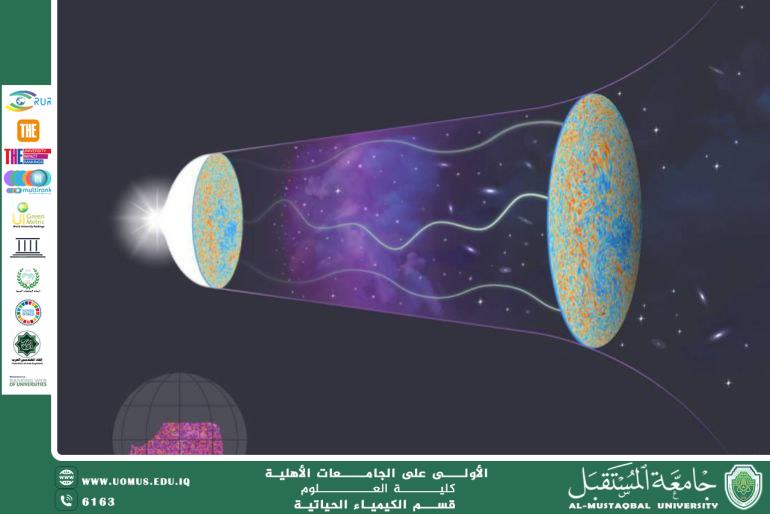
Immediately after the Big Bang, the universe existed in a state of extremely high energy and temperature, conditions that did not allow the existence of atoms or molecules as we know them. As the universe expanded and cooled, elementary particles began to fuse, forming protons and neutrons, followed by the emergence of the simplest atomic nuclei, such as hydrogen and helium nuclei. Here, the first steps of cosmic chemistry take place: cosmic physics sets the timeframes and conditions, while nuclear chemistry explains how these elements were formed.
With the birth of stars, the relationship between cosmic physics and chemistry reached a deeper level. Deep within stars, nuclear fusion reactions produce heavier elements such as carbon, oxygen, and nitrogen—essential elements for organic chemistry and life. When massive stars explode as supernovae, these elements are expelled into space, becoming part of the gas clouds that form new generations of stars and planets. In this sense, the atoms that make up our bodies are the product of cosmic processes governed by both the laws of physics and chemistry.
In interstellar space, chemistry appears in its most unusual forms. Extremely low temperatures and pressures allow for reactions not typically seen on Earth, where complex molecules form on the surfaces of cosmic dust grains, including simple organic compounds. This interstellar chemistry explains how matter can gradually acquire increasing complexity even under the harshest conditions and provides a crucial link to understanding the formation of life’s initial compounds.
Cosmic physics also plays a central role in explaining the distribution of elements across the universe, a process known as cosmic chemical evolution. The varying elemental ratios in galaxies and stars reflect a long history of nuclear reactions and stellar explosions. Through spectroscopy, a tool that combines physical and chemical principles, scientists can determine the chemical composition of celestial bodies despite their enormous distances from Earth.
The connection between cosmic physics and chemistry not only enriches our understanding of the universe but also opens practical applications in various fields, such as the study of planetary atmospheres, astrochemistry, and the search for chemical indicators of life beyond Earth. Chemistry is thus not merely an Earth-bound science; it is a universal language that explains how the universe’s initial energy transformed into organized, reactive, and evolving matter.
Ultimately, this intertwined relationship shows that cosmic physics sets the universal laws, while chemistry gives these laws their material content, together forming a comprehensive story of the universe’s origin, the structure of matter, and its destiny.
Al-Mustaqbal University
Ranked First Among Private Universities in Iraq