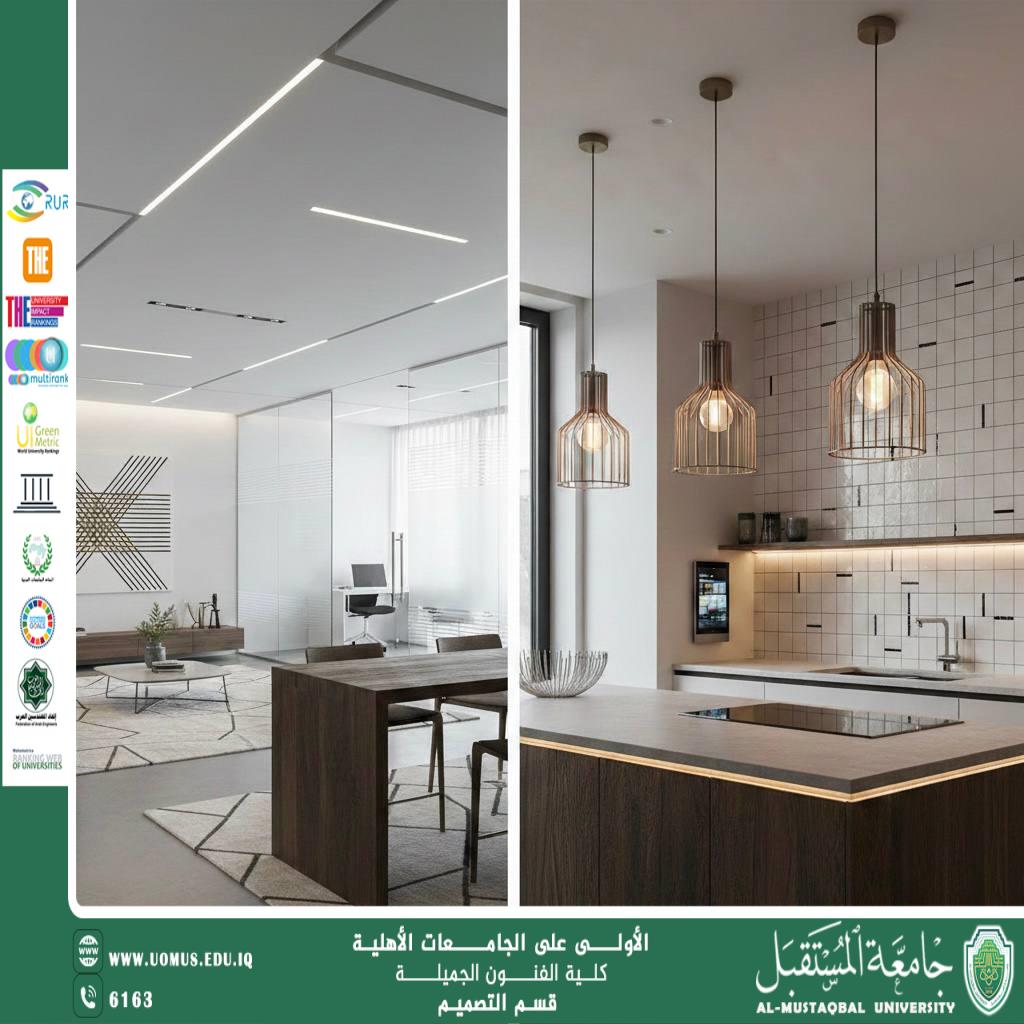

The Dashed Line and Its Aesthetic and Functional Significance in Contemporary Interior Design
The line is considered one of the fundamental formative elements in visual arts and design, as it constitutes the primary structure from which formal and spatial relationships emerge. Among the various types of lines, the dashed line stands out as a visual element that carries meanings beyond mere formal construction, becoming an effective tool in directing visual perception and organizing interior space. This article aims to examine the concept of the dashed line, analyze its aesthetic and functional dimensions, and clarify its relationship with contemporary interior design.
Concept of the Dashed Line
The dashed line is a sequence of separate linear units interrupted by calculated spaces, giving it a rhythmic and dynamic character. Unlike the continuous line, which suggests stability and completeness, the dashed line expresses incomplete continuity, delayed movement, or an implied direction without imposing it rigidly.
Aesthetic Significance of the Dashed Line
The dashed line possesses aesthetic value based on visual rhythm and variation, as it contributes to breaking monotony and adding vitality to interior surfaces. From a perceptual perspective, it is associated with concepts such as lightness, flexibility, and non-linearity, making it suitable for modern design trends that seek to move beyond classical rigidity. This type of line also helps create visual balance between mass and void, a fundamental principle in interior composition.
The Dashed Line and Function in Interior Design
The role of the dashed line is not limited to aesthetics; it extends to organizational and guiding functions within space. It is used to define movement paths or create subtle visual separation between functional zones, such as distinguishing work areas from relaxation spaces without relying on physical barriers. It is also employed in floor designs, suspended ceilings, and lighting patterns, acting as a visual medium that guides users through the space.
The Relationship Between the Dashed Line and Spatial Perception
The dashed line contributes to expanding spatial perception, as it does not completely enclose the visual field, allowing the eye to mentally complete the form. This characteristic is particularly important in small spaces, where the dashed line helps reduce the sense of enclosure and enhances feelings of openness and continuity.
Contemporary Applications of the Dashed Line
In contemporary interior design, the dashed line appears in wall patterns, geometric decorations, furniture details, and even lighting compositions. It is often employed within design contexts that emphasize minimalism or conceptual design, where the line becomes an expressive element linking form and meaning.
Conclusion
The dashed line can be considered a design tool with profound aesthetic and functional dimensions in interior design. It not only enriches visual composition but also contributes to spatial organization, movement guidance, and enhanced sensory perception of space. Therefore, awareness of its significance and its deliberate, methodical use is essential in serving the overall design vision.
Almustaqbal University, The First University in Iraq.
الهدف الرابع (التعليم الجيد)