An Analytical Scientific Perspective on Challenges and Future Prospects Soil and Water Scarcity in Iraq:
Soil and Water Scarcity in Iraq:
An Analytical Scientific Perspective on Challenges and Future Prospects
Introduction
Prof. Dr. Mahdi Abdul-Kadhim Abd
Soil and water are among the most vital natural resources underpinning food security and environmental stability in Iraq. For thousands of years, the Tigris and Euphrates rivers have constituted the civilizational foundation of agriculture in Mesopotamia, making Iraq one of the oldest agricultural centers in the world. However, recent decades have witnessed a significant decline in the efficiency of these two resources due to water scarcity, climate change, poor resource management, in addition to population pressure and unplanned urban expansion. This article aims to present an analytical scientific examination of the relationship between soil characteristics in Iraq and the problem of water scarcity, highlighting agricultural and environmental impacts and proposing future visions for sustainable management.
⸻
First: Soil Characteristics in Iraq
Iraqi soils vary according to climatic, geological, and hydrological conditions. They can generally be classified into alluvial soils in floodplains, desert soils in the western and southern regions, and mountainous soils in northern Iraq.
Alluvial soils are relatively young in formation and moderately rich in nutrients; however, they suffer from increasing physical and chemical problems such as salinity, waterlogging, and weak soil structure. Desert soils are poor in organic matter, highly permeable, and have limited productive capacity without proper management and technological interventions. Mountainous soils, on the other hand, possess better drainage capacity but are vulnerable to water erosion and soil degradation.
⸻
Second: The Concept of Water Scarcity and Its Causes in Iraq
Water scarcity is defined as the insufficiency of available water resources to meet agricultural, industrial, and domestic needs. In Iraq, this problem results from a set of interrelated factors, most notably:
1. Declining water inflows from upstream countries due to the construction of dams and major water projects.
2. Climate change, accompanied by rising temperatures and increased evaporation rates.
3. Population growth and the resulting increasing pressure on water resources.
4. Traditional irrigation methods based on surface flooding, leading to significant water losses.
5. Deterioration of water infrastructure and high loss rates within water conveyance networks.
⸻
Third: Impact of Water Scarcity on Soil Properties
Water scarcity directly and indirectly affects the physical, chemical, and biological properties of soils. Water deficiency leads to:
• Increased accumulation of salts in the root zone due to insufficient leaching.
• Degradation of soil structure and increased compaction, limiting water and air permeability.
• Reduced biological activity in soils, particularly beneficial microorganisms.
• Decline in organic matter content as a result of reduced plant productivity.
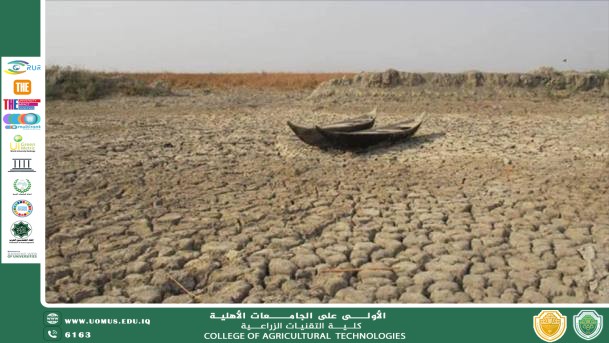
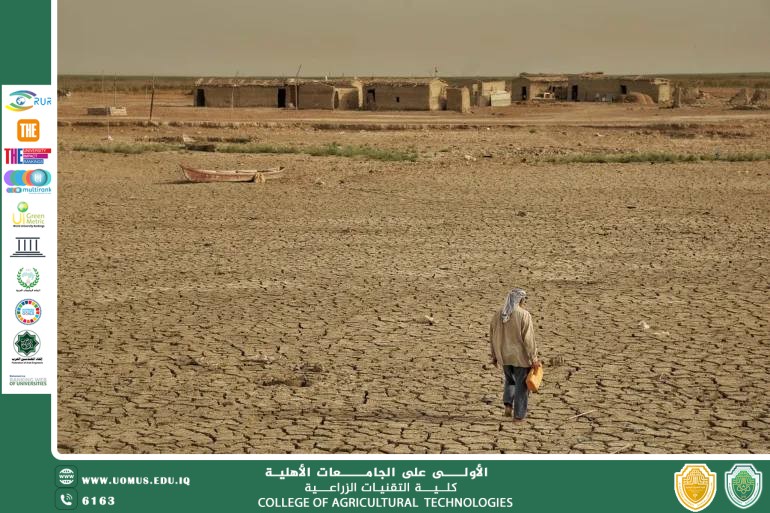
Soil salinity is considered one of the most serious consequences of water scarcity in Iraq. Agricultural reports indicate that vast areas of agricultural land have become affected by varying degrees of salinization, leading to reduced productivity and the abandonment of large tracts of farmland.
⸻
Fourth: Agricultural and Environmental Implications
Soil degradation associated with water scarcity negatively impacts the agricultural sector through reduced yields of strategic crops such as wheat, barley, and rice, decreased crop diversity, and increased production costs. These effects extend to the environmental dimension, where desertification intensifies, natural vegetation cover declines, and dust storms increase, thereby affecting public health and environmental stability.
⸻
Fifth: Strategies for Sustainable Soil and Water Management
Addressing water scarcity and soil degradation requires the adoption of integrated scientific strategies, including:
• Developing modern irrigation technologies such as drip and sprinkler irrigation to reduce water losses.
• Improving soil management through the use of organic amendments and the adoption of crop rotation systems.
• Breeding and introducing plant varieties tolerant to drought and salinity.
• Enhancing water harvesting programs and utilizing rainfall and floodwaters.
• Raising agricultural awareness among farmers regarding the importance of integrated resource management.
⸻
Sixth: Future Prospects
Ensuring the sustainability of soil and water resources in Iraq requires a high level of coordination between scientific research institutions and policymakers, in addition to strengthening regional cooperation in managing transboundary water resources. Investment in agricultural scientific research and the modernization of water policies constitute fundamental pillars for confronting future challenges.
⸻
Conclusion
The close relationship between soil and water scarcity in Iraq highlights the magnitude of challenges facing agriculture and food security. This issue cannot be addressed without a comprehensive vision based on science and sustainable planning. Preserving soil resources and managing water efficiently is no longer an option, but a national necessity to ensure a secure agricultural and environmental future for coming generations.
Al-Mustaqbal University – the leading private university in Iraq.