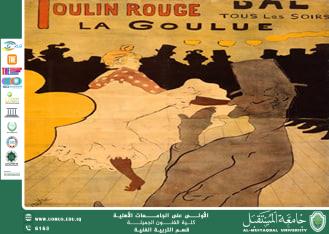

An Article Titled “The Development of Poster Styles” by Lecturer Dr. Hamza Alawi Musarbat.
Since the mid-19th century, posters have evolved into true works of art while retaining their original purpose: advertising and information dissemination. For centuries, posters have been part of the public sphere. Advertisers, political activists, and artists have used their bold and eye-catching designs to communicate and spread messages among the public.
The Birth of the Modern Poster
Until the end of the 19th century, most posters consisted only of text with little color or design. They were primarily used to convey important messages from governments and occasionally for advertising purposes. It wasn't until 1880 that posters became a powerful channel for mass communication with the invention of the three-stone lithography process. This lithography process, perfected by Jules Charret, allowed designers to use virtually any color imaginable and made the entire printing process fast and inexpensive, enabling mass production. With these improvements, posters quickly became a powerful advertising tool. Charret was the inventor of the improved lithography process and one of the most prolific poster artists of his time. During his 30-year career, he designed over 1,000 posters. He was also the first designer to introduce gender into advertising. His posters are among the earliest examples of using the female image for promotional purposes. The Golden Age of Poster Design
A number of young French artists created poster art during the late 19th and early 20th centuries. However, it was Henri de Toulouse-Lautrec who elevated poster design to the level of fine art. His first poster for the Moulin Rouge in 1891 heralded the beginning of the Belle Époque, a period of peace and technological, scientific, and cultural prosperity in Europe.
Almost every artist in Europe designed posters and magazine covers for various institutions and companies during this time. In France, posters were used to promote cabarets; in Spain, bullfights; in Germany, trade fairs; and in Italy, opera and fashion.
The Art Nouveau style quickly became the leading trend in poster design, thanks to Alphonse Mucha. Influenced by Byzantine and Pre-Raphaelite art, this artistic movement sought to dismantle the conventions between fine and applied arts. First appearing in Brussels, Belgium, Art Nouveau was quickly adopted by artists in Paris. From there, it spread rapidly throughout Europe, particularly in cities with strong artistic communities or independence movements.
With the death of Toulouse-Lautrec and the retirement of Charet, Art Nouveau slowly fell out of fashion. A new generation of artists wanted to push the boundaries even further. Leonetto Capello, an Italian cartoonist working in Paris at the crossroads of centuries, soon became famous for his unique style of poster design. The images he used on his posters were humorous and whimsical, quickly attracting attention.
Meanwhile, artists in Germany, Austria, and England were pushing for a new style that broke completely with the curves and colors of Art Nouveau. They used flat colors, simple shapes, and naturalism, all of which were the foundations of Modernism.
Posters Between the World Wars
Shortly after World War I, the Art Nouveau movement took over the art world. Different artistic styles emerged almost overnight. Dadaism, Cubism, Futurism, and Expressionism flourished throughout Europe. However, by the mid-1920s, all these styles had merged into Art Deco.
The key visual characteristics of this style were simplified and fluid forms and lines. Everything appeared simple, clean, and straightforward. Although it arose from the remnants of Modernism, this style was not immune to the trends of the time.
There was a veritable obsession with all things ancient Egyptian and Persian during the 1920s. Throughout Europe and the United States, people flocked to antique galleries and auctions. Art Deco managed to incorporate exotic, ancient styles.
Meanwhile, in the Soviet Union, Constructivism helped build a new technological society. The Steinberg brothers (L. Lisitsky and Rodchenko) created the future through their poster style, which later greatly influenced Western designers.
Constructivists created bold poster compositions for the optimistic 1950s.
After the long and devastating 1940s, the world entered a new, optimistic era. It was an era of rapid technological innovation and a rapidly growing middle class. Televisions, telephones, and household appliances entered nearly every home in the United States. People had more free time for leisure activities such as travel and popular culture.
This decade was characterized by two very different poster styles. The 1950s style was characterized by its lighthearted, playful imagery, along with bright, vibrant colors, bold text blocks, and intricate graphics. Posters had cartoon-like styles with human figures depicting strong facial expressions.
This was also a popular style for travel posters, as it was very impactful and evoked a sense of wonder and adventure.
In contrast, posters in the International Typographical or Swiss style were more structured, clear, and minimalist, with almost architectural features. They primarily used photography alongside typographic elements.
This is one of the most popular retro poster styles today, and you will see it frequently in art galleries and theaters.
The Age of Rebellion
In the late 1960s and throughout the 1970s, poster designs reflected the revolutionary ideas of the younger generations.
...Almustaqbal University, The First University in Iraq