An Article Titled “The Theory of Prohibition in Islamic Arts: Intellectual and Aesthetic Dimensions” by Assistant Lecturer Israa Qasim.
The theory of prohibition in Islamic art is considered one of the most prominent intellectual issues that have contributed to shaping the features and uniqueness of Islamic art throughout history. This theory is closely linked to a religious and doctrinal value system that seeks to preserve the concept of monotheism and to exalt the Divine Essence above any form of depiction or anthropomorphic representation. Rather than hindering artistic creativity, this theory established an intellectual and aesthetic framework that encouraged the Muslim artist to develop alternative modes of expression rich in symbolism and spiritual depth.
The theory of prohibition is primarily rooted in the cautious Islamic stance toward the depiction of living beings, particularly the human figure, due to concerns about imitating divine creation or reviving idolatrous practices known in pre-Islamic civilizations. This position was especially reflected in religious arts, such as mosque architecture and Qur’anic manuscripts, where figurative representation was absent and replaced by abstract artistic forms based on geometry, vegetal ornamentation, and Arabic calligraphy.
This prohibition played a significant role in directing aesthetic sensibilities toward abstraction. Geometric patterns emerged as expressions of cosmic order and divine precision, while vegetal motifs carried symbolic meanings associated with life, eternity, and paradise. Arabic calligraphy, meanwhile, assumed a central position in Islamic art, transforming Qur’anic text into a visual aesthetic element that unites spiritual meaning with formal beauty, thereby endowing the artwork with a sacred and contemplative dimension.
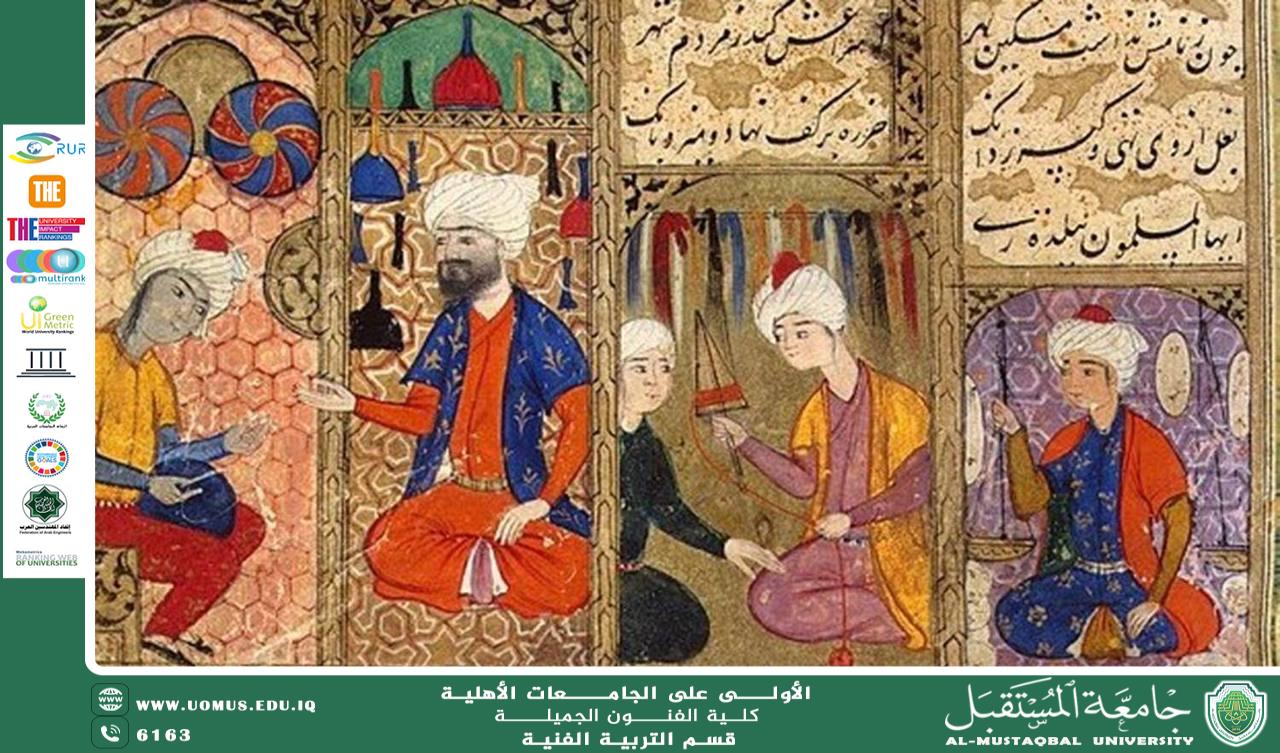
The concept of prohibition was neither rigid nor absolute; its interpretations varied across Islamic societies and historical periods. In certain contexts, figurative imagery appeared in literary and scientific manuscripts, particularly within Persian and Ottoman art, while maintaining a clear separation from religious spaces. This demonstrates that the theory of prohibition functioned more as a regulatory framework guiding the course of Islamic art rather than a restrictive force, allowing stylistic diversity within defined intellectual and ethical boundaries.
The uniqueness of Islamic art lies in its ability to transform apparent limitations into creative foundations. Abstraction thus became both an aesthetic and philosophical characteristic, expressing spiritual transcendence and orientation toward the Absolute. Consequently, the theory of prohibition played a fundamental role in shaping a distinctive artistic identity that does not rely on mimetic representation of reality, but rather on conveying its essence and deeper meaning....Almustaqbal University, The First University in Iraq
.