An article titled "The Use of Biosensors in Monitoring Patients' Vital Signs" by Lecturer M.M. Zainab Sattar Jabbar
Biosensors represent one of the most important technological advancements in modern healthcare, providing an effective and accurate means of continuously monitoring patients' vital signs in real time. This article aims to review the types of biosensors, their operating principles, clinical applications, and their impact on improving the quality of healthcare provided to patients.
1. The 21st century witnessed a tremendous revolution in healthcare technology, and one of the most prominent of these revolutions was the emergence of biosensors, which revolutionized the way patients' vital signs are monitored. These sensors rely on converting biological signals into measurable and analyzable electrical or optical signals. Continuous monitoring of vital signs is crucial in diagnosing diseases, tracking the progression of medical conditions, and evaluating the effectiveness of treatments. Biosensors have contributed to improving the accuracy of measurements, reducing medical intervention, and enabling patients to monitor their health independently. The Concept of Biosensors
2.1
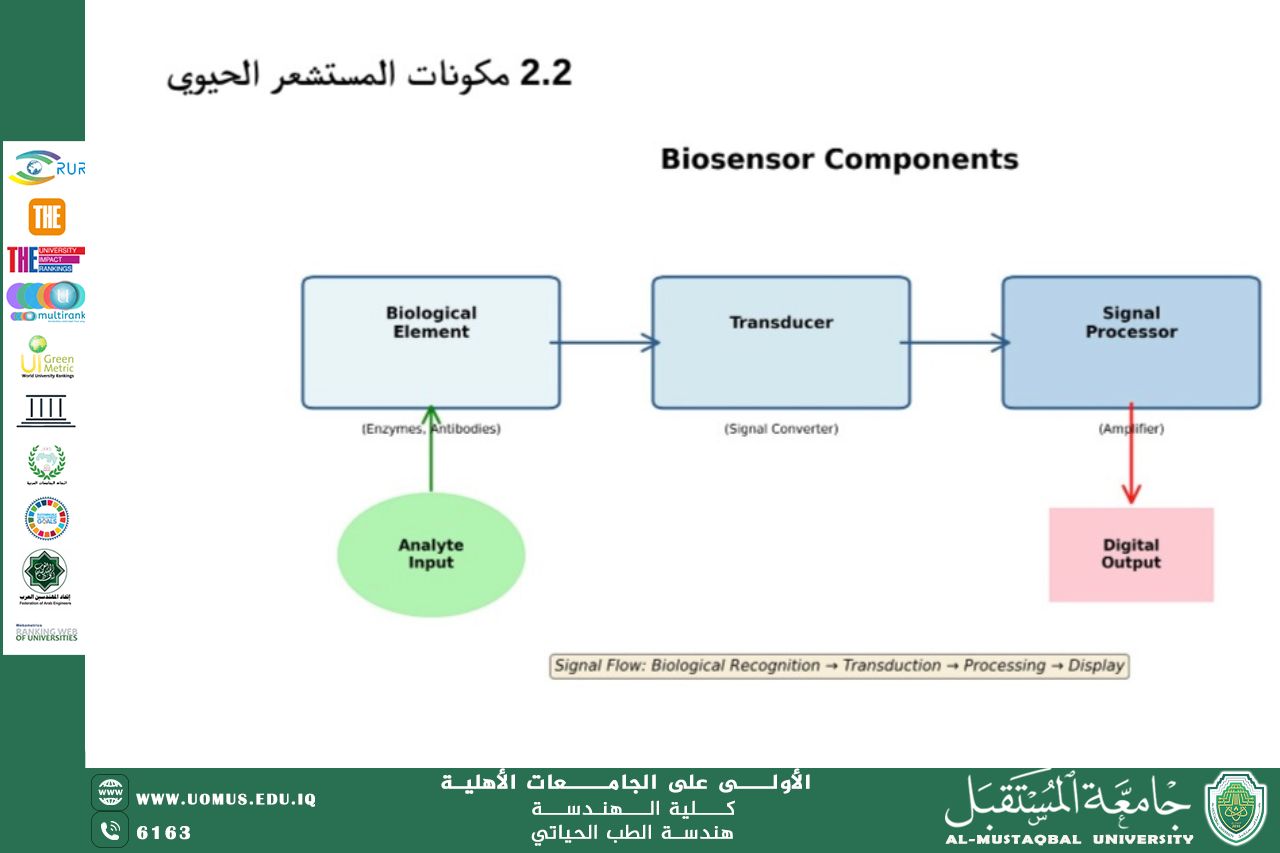
A biosensor is an analytical device that combines a sensitive biological element with a physicochemical converter to detect and measure a specific substance or physiological parameter. A biosensor consists of three main components: the sensitive biological element (e.g., enzymes or antibodies), the converter (which transforms the biological signal into a measurable signal), and the signal processing system.
The element to be measured converts the biological signal into an electrical signal. The signal processor amplifies and converts it into a digital reading that can be displayed and analyzed.
• The sensitive biological element reacts selectively with the target substance (enzymes, antibodies, nucleic acids, cells).
• The converter transforms the biological reaction into a measurable electrical or optical signal.
• The signal processing system amplifies, processes, and displays the resulting signal.
The main classification of biosensors used in the medical field, along with their most prominent applications, varies.
These sensors are classified according to their operating principle and the type of conversion used. Each type has specific advantages that make it suitable for specific applications in health monitoring.
Electrochemical Sensors
3.1
Electrochemical sensors are among the most common types used in medical applications. These sensors measure electrical changes resulting from biochemical reactions. One of their most prominent applications is glucose meters, which are used daily by millions of diabetics worldwide.
Optical Sensors
3.2
These sensors utilize the properties of light—absorption, reflection, and fluorescence—to detect biological substances.
Applications include pulse oximeters for measuring blood oxygen saturation and fluorescent sensors for detecting proteins and nucleic acids.
3.3 Mass Sensors
These sensors measure changes in mass resulting from biological binding. They use techniques such as quartz crystal balances and surface acoustic waves to detect biological reactions with high accuracy.