Ebenaceae
Al-Mustaqbal University
College of Agricultural Technologies
Department of Medicinal Plants and Natural Products Technologies
Prof. Dr. Tahani Jawad Mohammed Ali
Persimmon Fruit (Persimmon)
The persimmon belongs to the family Ebenaceae.
⸻
First: Japanese Persimmon (Diospyros kaki)
It consists of deciduous trees and shrubs and is considered the most important and widely cultivated persimmon species.
• Floral buds are borne laterally on the previous year’s growth.
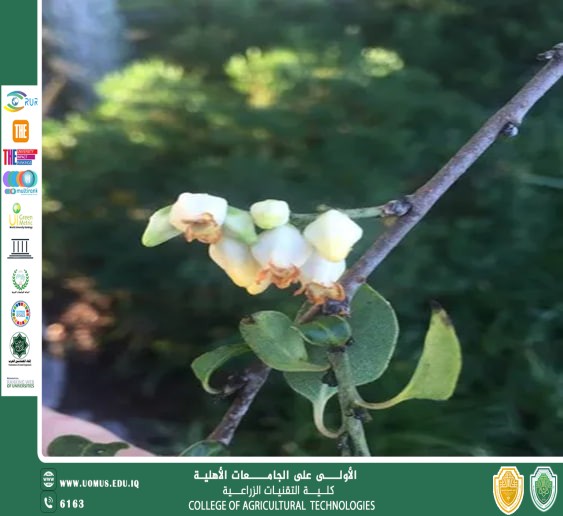
• Flowers are white in color.
• Persimmon trees bear three types of flowers:
1. Perfect (bisexual) flowers
2. Female flowers
3. Male flowers
The same tree may bear one or more types of flowers simultaneously.
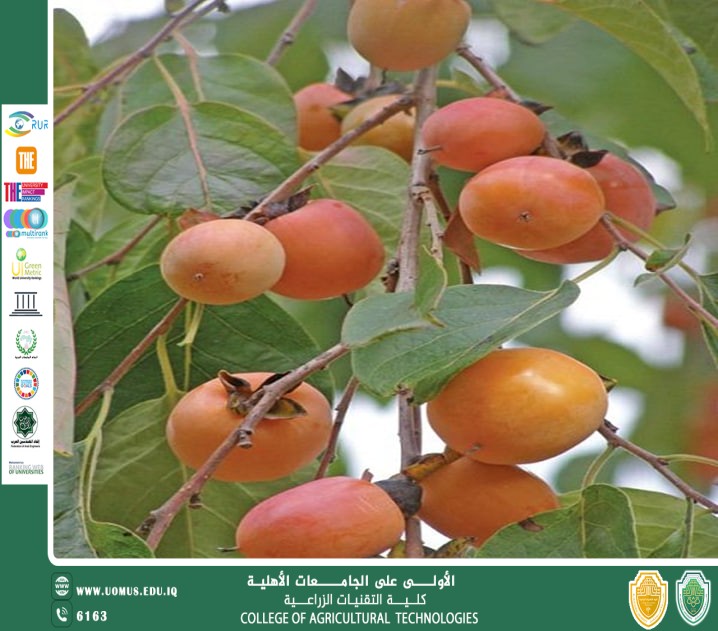
The fruits are large, fleshy, and juicy, containing seeds ranging from 1 to 10 seeds. The calyx remains attached to the base of the fruit.
⸻
Second: American Persimmon (Diospyros virginiana)
These trees are of less economic importance and are mostly dioecious, meaning male flowers grow on one plant and female flowers on another. Pollination occurs by insects. Some cultivars set fruits parthenocarpically, such as Ruby and Early Golden.
⸻
Third: Lotus Persimmon (Diospyros lotus)
A monoecious plant used as a rootstock for Japanese persimmon. Its fruits are small and turn black when fully ripe.
⸻
Fourth: Chinese Persimmon (Shang) (Diospyros oleifera)
A dioecious plant whose importance is limited to the extraction of tannins (astringent substances).
⸻
Suitable Climate
1. Japanese persimmon trees grow successfully in subtropical and temperate regions with warm winters. Trees may be damaged or killed if winter temperatures fall below –12°C.
2. Persimmon trees require a long, moderately warm summer with moderate humidity. Excessive humidity may cause fruit rot.
3. Persimmons grow well in various soil types provided they are well-drained, well-aerated, and rich in organic matter.
Planting distance: 3–5 meters.
⸻
Signs of Maturity
Fruits are harvested when their color changes from yellow to red while they are still firm.
Harvesting should be done using scissors, leaving part of the calyx and stalk attached. Fruits should not be pulled by hand to avoid injury and disease infection.
⸻
Removal of Astringent (Tannin) Substances from Fruits (Very Important)
Fruits of non-astringent cultivars can be eaten fresh immediately after ripening. However, some cultivars contain high concentrations of astringent tannins in the flesh, which must be removed as follows:
Q: How can the astringent (tannin) substances in persimmon fruits be removed?
1. Hot water treatment at 40°C for 15–24 hours.
2. Treatment with CO₂ gas for 3–4 days at 20°C.
3. Spraying fruits on the tree with ethanol at a concentration of 5–20%.
4. Ripening fruits using ethylene gas.
⸻
Persimmon Cultivars
First: Classification According to the Type of Flowers
1. Cultivars bearing only female flowers, such as Tampan and Yed.
2. Cultivars bearing both female and male flowers, such as Gailey.
3. Cultivars bearing female flowers, with male flowers appearing in some years, such as Okame.
4. Cultivars bearing only female flowers in some years and only male flowers in other years.
5. Some cultivars, such as Tamopan, set fruits parthenocarpically and are seedless.
Second: Classification According to Astringency of Fruit Flesh
1. Non-astringent cultivars, such as Kawabata and Jiro.
2. Astringent cultivars, such as Costana and Emon.
⸻
Al-Mustaqbal University… the leading private university in Iraq.