Time management strategies and their role in improving professional efficiency: A scientific article by Lecturer M.s.c Zainab Jassim Mohammed
Introduction
Time is one of the most valuable and limited resources in professional life. Despite its importance, it is often wasted due to poor planning and lack of organization. In today’s fast-paced work environments, effective time management has become a critical skill for enhancing professional efficiency and improving work quality. This article explores the concept of time management, key strategies, and their impact on professional efficiency.
Concept of Time Management
Time management refers to the systematic process of planning, organizing, and controlling how time is spent to achieve specific goals efficiently and effectively. It is not about working longer hours, but about making optimal use of available time.
Concept of Professional Efficiency
Professional efficiency is the ability to perform job tasks effectively with high quality while making optimal use of available resources, including time, effort, and knowledge. It is influenced by skills, experience, motivation, and organizational abilities.
Relationship Between Time Management and Professional Efficiency
Effective time management plays a vital role in enhancing professional efficiency by:
Reducing work-related stress
Improving task quality
Increasing focus and minimizing errors
Enhancing job satisfaction
Boosting productivity
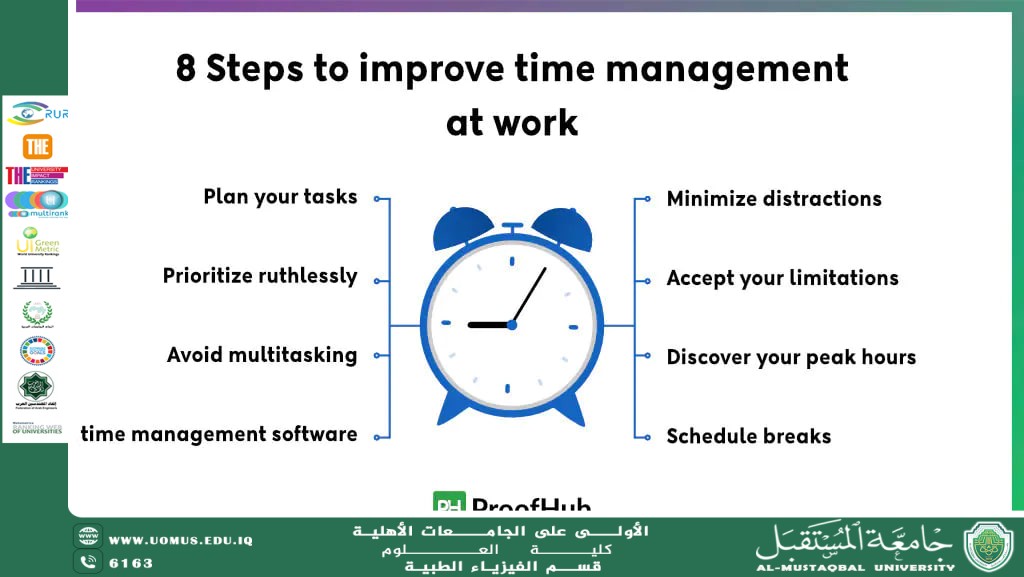
Time Management Strategies
1. Clear Goal Setting
Defining clear short-term and long-term professional goals helps direct efforts toward priority tasks and prevents time wastage.
2. Prioritization of Tasks
Prioritization involves ranking tasks based on urgency and importance. Tools such as the Eisenhower Matrix assist professionals in making informed decisions about task execution.
3. Advance Planning
Daily and weekly planning enables balanced workload distribution and prevents last-minute pressure and delays.
4. Task Breakdown
Breaking large tasks into smaller components makes them more manageable and reduces feelings of overwhelm, leading to steady progress.
5. Minimizing Distractions
Distractions such as unnecessary meetings, excessive social media use, and frequent interruptions negatively affect concentration and efficiency.
6. Utilizing Technology
Digital tools and task management applications help organize schedules, track progress, and enhance time utilization.
7. Continuous Review and Evaluation
Regular assessment of time usage allows individuals to identify weaknesses and improve future planning strategies.
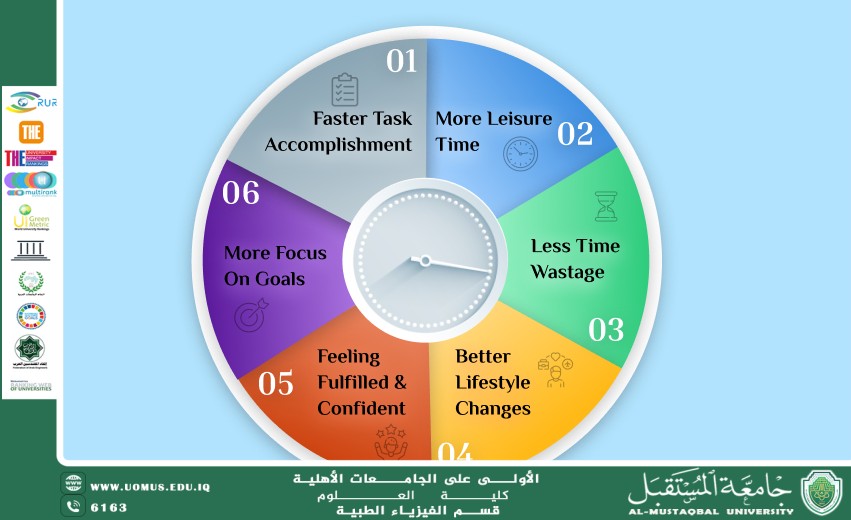
Impact of Time Management on Professional Efficiency
Applying effective time management strategies leads to:
Higher quality work
Faster task completion
Reduced occupational stress
Improved work-life balance
Long-term professional sustainability
Conclusion
Time management is a fundamental pillar of professional success. Professional efficiency cannot be achieved without conscious and effective use of time. By adopting structured time management strategies, individuals and organizations can enhance productivity, maintain well-being, and achieve sustainable professional growth.
"AL_mustaqbal University is the first university in Iraq"