

The Impact Of Smartphones On Children And Adolescents The Impact of Smartphones on Children and Adolescents By: Lecturer Ala Salman Hamza
The Impact of Smartphone Use on Children and Adolescents
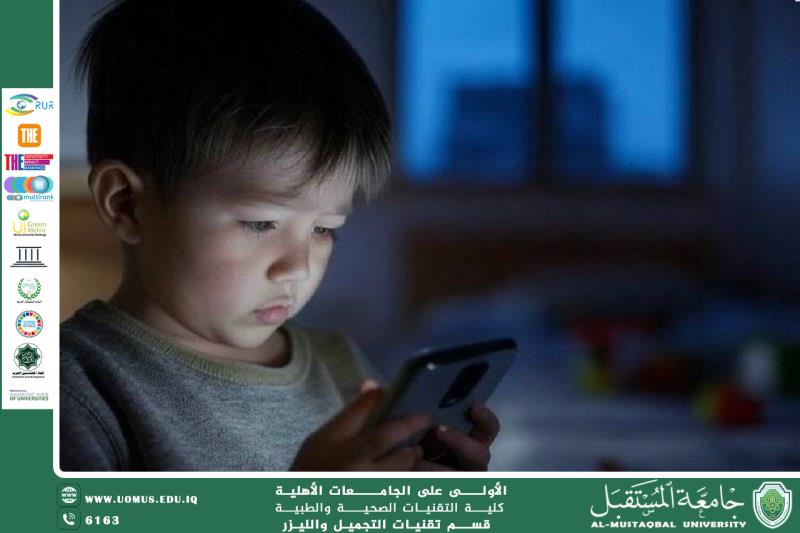
Have you ever contemplated that blue glow illuminating our faces in the dark, that parallel world we carry in our pockets? It is not merely a device, but a gateway to a micro-universe through which our relationships, memories, and even our brain chemistry are managed. On this glass surface, a touch becomes an addiction, a notification an emotional alarm bell, and rapid scrolling a machine reshaping the minds of the rising generation.
In the Cage of Connection: Connected Isolation
It begins innocently: a screen glowing like visual candy for a young child. But it soon transforms into an ever-open window onto an endless world. Here, the teenager constructs their digital identity based on "likes" and comments, within a perilous social laboratory where acceptance is conditional, and the personal image is editable and filterable. Genuine communication withers, replaced by dialogues of short texts and emojis, as if we are reducing complex human emotions to a library of emoticons.
The Anatomy of Attention: The Distracted Generation
The developing brain changes to suit its environment. Under the constant bombardment of rapid stimuli (short videos, quick-touch games), the capacity for sustained focus shrinks. Patience for long tasks or deep reading becomes a neural challenge. The neural pathways that tolerate boredom and support reflective thinking are "pruned" in favor of those seeking the new and instantly striking. We are raising a generation of minds thirsty for novelty and quickly bored by the old.
Sleep and Blue Mirrors
At night, phones turn into toxic meditation lamps. The emitted blue light suppresses melatonin production, the sleep hormone, tricking the brain into thinking it's daytime. But the effect is deeper: just before sleep, the mind is flooded with emotional content (arguments, news, social comparisons), entering the realm of dreams and anxiety while carrying the burdens of the digital world to bed. Sleep, the brain's primary repair workshop, is slowly being robbed.
Conclusion: Towards Conscious Coexistence
The device itself is not evil; it is a mirror that amplifies and accelerates processes that have always existed: curiosity, the need to belong, the search for identity. The challenge is not to eliminate the gateway, but to teach the young how to cross it consciously, and how to return. How to distinguish between digital noise and genuine dialogue, between the urgent notification and the authentic purpose.
In the end, the smartphone is the first machine in history that we grant a place in our bed, our pocket, our relationships, and our brain chemistry.
AL_mustaqbal University is the first university in Iraq