
A scientific article by Ms. Hanin Haider Hussein entitled "Optics in Ancient Civilizations"
Optics in Ancient Civilizations
Optics is considered one of the oldest sciences through which humans sought to understand the surrounding world. Since early times, it has been closely linked to attempts to explain light, vision, and related phenomena. Before the emergence of the modern scientific method, ancient civilizations approached optics from philosophical, religious, and practical perspectives. Their observations and ideas formed the first building blocks that later contributed to the development of this science. Although approaches to optics differed from one civilization to another, they all shared a common goal: understanding the nature of light and its influence on humans and the universe.
Optics in Ancient Egyptian Civilization
The ancient Egyptians regarded light as a sacred element closely associated with the sun, which they considered the source of life. This belief was reflected in religious architecture, as temples were designed to allow sunlight to enter at specific times of the year, such as the alignment of the sun with the sanctuary.
The Egyptians also used mirrors made of polished copper or bronze, indicating their practical understanding of light reflection. Although no written scientific theories of optics have been found, their practical applications suggest an early awareness of the properties of light.
Optics in the Babylonian Civilization
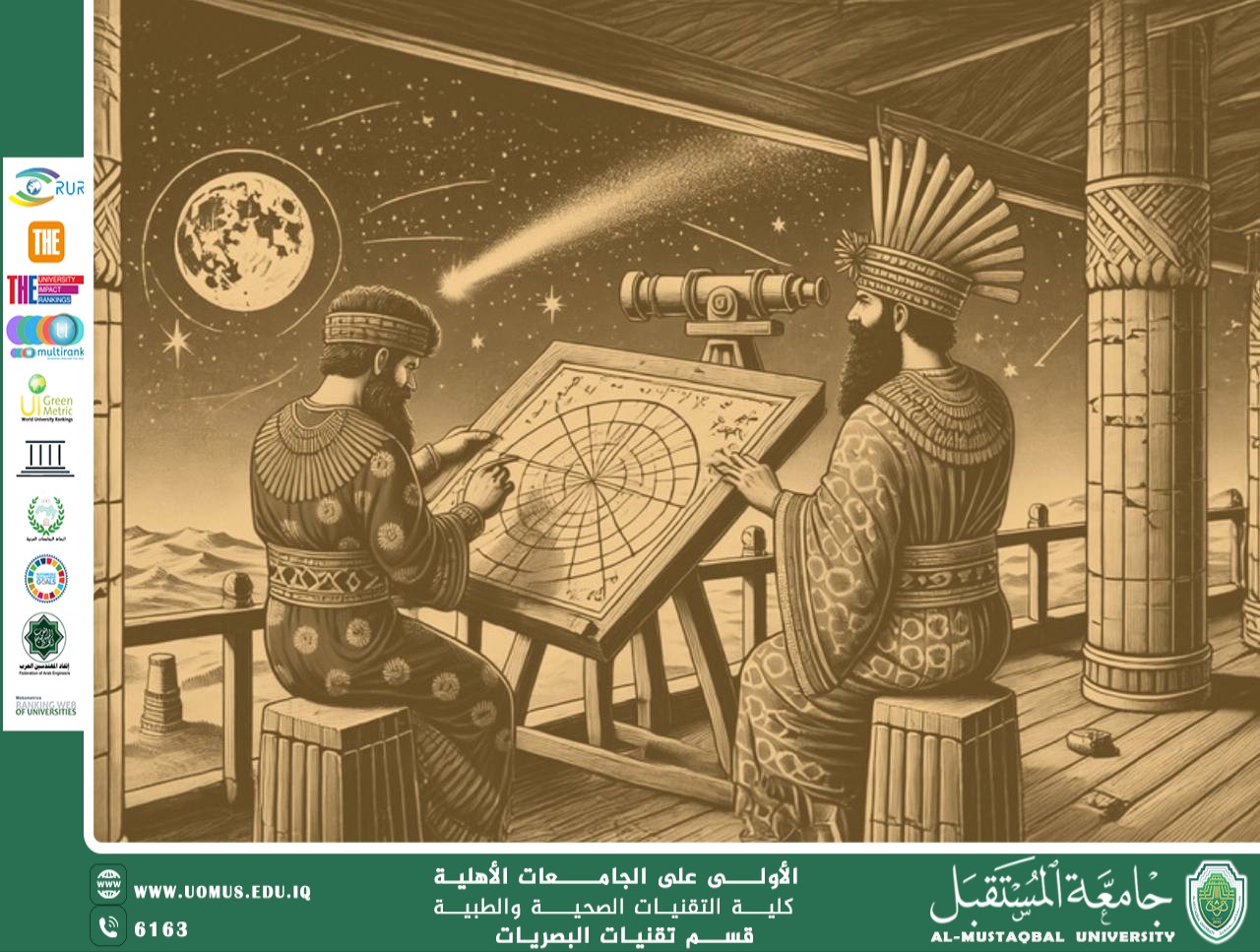
The study of light in Babylonian civilization was closely connected to astronomy, as the Babylonians were deeply interested in observing celestial bodies and their movements. This required a basic understanding of the role of light in vision and observation. They used precise calculations to determine the positions of stars and planets, demonstrating their awareness of the importance of light in transmitting visual information. However, their interpretations remained largely confined within astronomical and religious frameworks rather than experimental science.
Optics in the Greek Civilization
Greek civilization is considered the most influential in establishing the theoretical foundations of optics in ancient times. Greek philosophers attempted to explain vision and light using reason and logic.
• Pythagoras and his followers believed that vision occurs as a result of rays emitted from the eye toward visible objects.
• Plato adopted the idea that vision results from the interaction between a light emitted from the eye and an external light coming from objects.
• Aristotle opposed this view, arguing that vision occurs when light enters the eye from objects through a transparent medium—an explanation closer to modern scientific understanding.
Euclid provided a geometric treatment of optics, studying the reflection of light and its propagation in straight lines, and establishing geometric laws of vision. Meanwhile, Ptolemy attempted to study the refraction of light by measuring angles as light passed between different media, representing an important step toward a quantitative understanding of optical phenomena.
Optics in the Chinese Civilization
Chinese civilization approached light from philosophical and natural perspectives, linking it to concepts of energy and motion. Early Chinese scholars understood the principle of shadows and observed that light travels in straight lines, as seen in their early description of the camera obscura phenomenon. Despite the absence of mathematical formulation, these observations contributed to the practical understanding of light.
Optics in the Indian Civilization
Ancient Indian texts addressed light and vision within philosophical and scientific frameworks. Some writings indicated that light travels from objects to the eye rather than the reverse. The study of light was also associated with astronomy and medicine, particularly in explaining the process of vision and certain natural phenomena.
University of Al-Mustaqbal – The First and Leading Private University