Information Security in Electronic Medical Records (Prof. Dr. Mehdi Ebady Manaa)
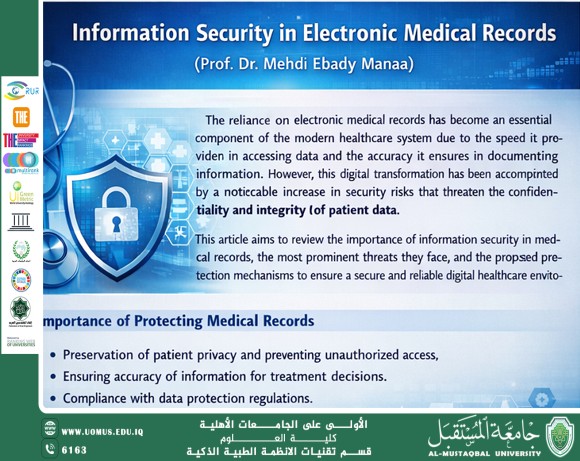
The reliance on electronic medical records has become an essential component of the modern healthcare system due to the speed it provides in accessing data and the accuracy it ensures in documenting information. However, this digital transformation has been accompanied by a noticeable increase in security risks that threaten the confidentiality and integrity of patient data. This article aims to review the importance of information security in medical records, the most prominent threats they face, and the proposed protection mechanisms to ensure a secure and reliable digital healthcare environment.
Medical records represent a vital repository of sensitive health information, as they contain personal data, diagnoses, treatment reports, and complete medical histories of patients. With the transition from paper-based systems to electronic systems, this data has become vulnerable to various cyber threats. Consequently, medical information security has become a fundamental pillar for ensuring the quality of healthcare services and protecting individual privacy.
The importance of protecting medical records lies in several key aspects, most notably the preservation of patient privacy and the prevention of unauthorized access to their data, as well as ensuring the accuracy of information upon which physicians rely in making treatment decisions. Moreover, compliance with data protection standards and regulations represents a legal requirement for healthcare institutions. In addition, any security breach may result in significant financial and reputational losses and negatively affect the credibility of the institution.
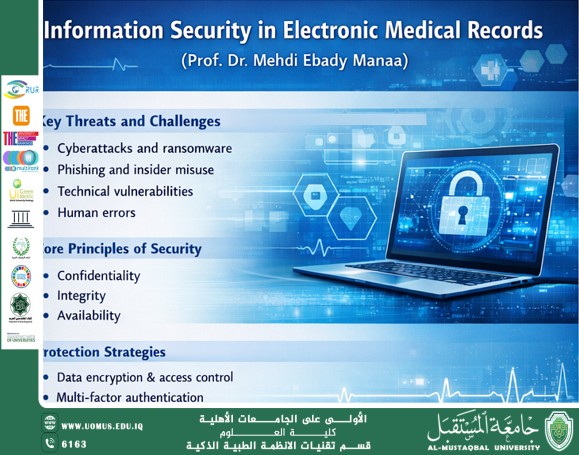
Electronic medical record systems face a wide range of risks, such as cyberattacks, ransomware, phishing, and the misuse of privileges by employees, in addition to technical vulnerabilities in networks and outdated systems. Human errors also constitute a major factor in the occurrence of security incidents, due to lack of awareness or the absence of secure usage policies.
Medical information security is based on three core principles: confidentiality, integrity, and availability. Achieving these principles requires the implementation of a set of technical and organizational measures, such as data encryption, multi-factor authentication systems, strict user access control, as well as the use of firewalls, intrusion detection systems, and regular data backups.
To achieve effective protection, a comprehensive security strategy should be adopted, including periodic system updates, training of medical and administrative staff in cybersecurity practices, and the establishment of clear policies for risk management. Furthermore, the use of modern technologies such as artificial intelligence in threat detection and behavioral analysis can contribute to enhancing the level of security.
Information security in medical records is no longer merely a technical option but rather an ethical and legal necessity imposed by the nature of digital transformation in the healthcare sector. Ensuring the protection of this data requires integrated cooperation between technology, legislation, and human resources. Investment in information security is a direct investment in patient safety and the sustainability of healthcare services, and it represents a foundation for building a secure and reliable digital healthcare future.
Al-Mustaqbal University the first university in Iraq.
الهدف الثالث: الصحة الجيدة والرفاه (SDG 3)