Chiral Specificity and Recent Developments in Pharmacology and Biochemistry
estabraq Arif, [2/6/2026 10:41 PM]
Chiral Specificity and Recent Developments in Pharmacology and Biochemistry
Chirality is a fundamental concept in biochemistry and pharmacology, reflecting the three-dimensional asymmetry that characterizes most biological molecules. Living systems are inherently chiral: enzymes, receptors, transport proteins, and nucleic acids all possess stereochemical specificity. As a result, biological interactions are highly selective toward the spatial arrangement of molecules. This phenomenon, known as chiral specificity, has profound implications for drug action, efficacy, safety, and metabolism. In recent decades, advances in pharmacology and biochemistry have highlighted the critical importance of chirality in drug design, development, and clinical application.
Chiral Specificity in Biological Systems
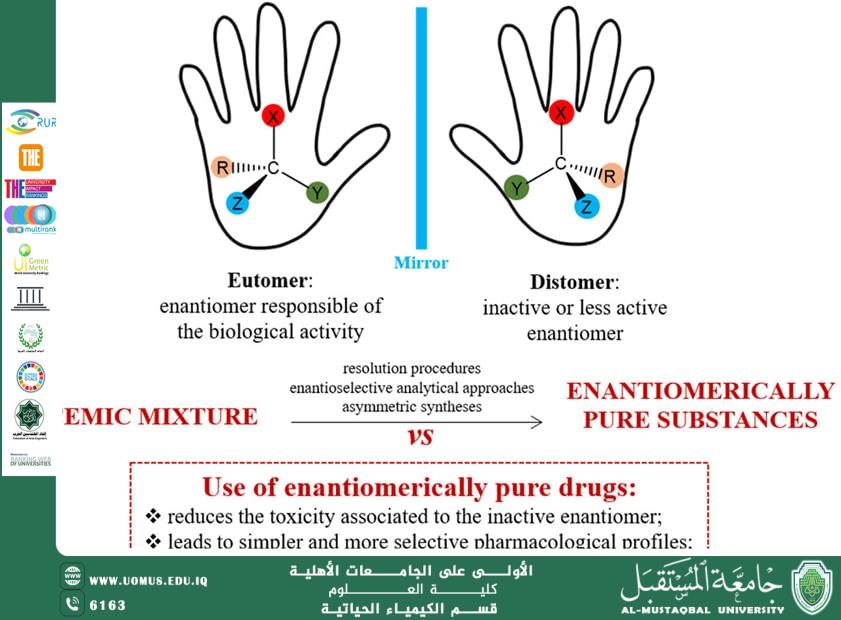
Chiral specificity arises from the structural asymmetry of biological macromolecules. Enzymes and receptors contain chiral active sites that can distinguish between enantiomers of the same compound. Although enantiomers share identical chemical formulas and physical properties in achiral environments, they may exhibit markedly different biological effects.
Typically, only one enantiomer of a chiral drug fits optimally into the active site of an enzyme or receptor, leading to the desired pharmacological response. The other enantiomer may show reduced activity, no activity, or even adverse or toxic effects. This stereoselectivity underlies many critical biochemical processes, including substrate recognition, enzyme catalysis, and signal transduction.
Chiral Drugs and Pharmacological Implications
Historically, many drugs were marketed as racemic mixtures, containing equal amounts of both enantiomers. However, clinical experience revealed that enantiomers can differ significantly in their:
• Pharmacodynamic activity
• Pharmacokinetic behavior
• Toxicological profile
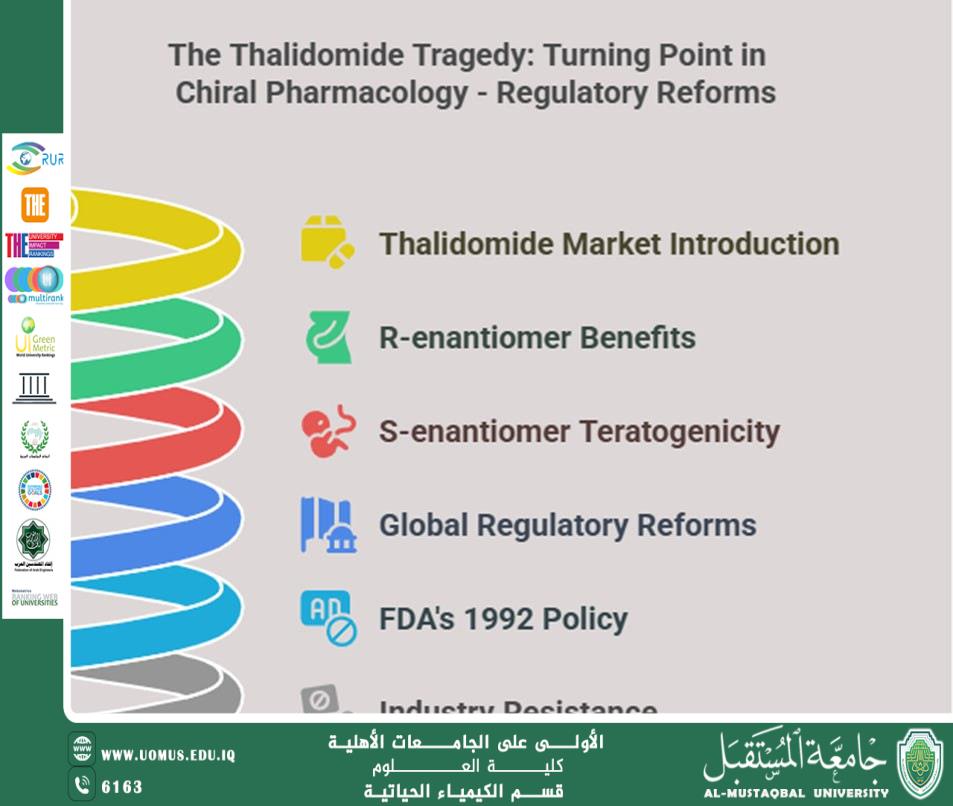
A classic example is thalidomide, where one enantiomer exhibited therapeutic sedative effects, while the other caused severe teratogenic effects. The discovery that in vivo interconversion between enantiomers could occur underscored the limitations of assuming chiral stability and emphasized the need for stereochemical evaluation during drug development.
Recent Developments in Pharmacology
Modern pharmacology has increasingly shifted toward the development of single-enantiomer drugs. This approach aims to enhance therapeutic efficacy while minimizing adverse effects. Advances in asymmetric synthesis, chiral separation techniques, and analytical methods have enabled the isolation and production of enantiomerically pure compounds.
Examples include:
• The development of esomeprazole from omeprazole
• Escitalopram as the active enantiomer of citalopram
These developments reflect a broader trend toward precision medicine, where stereochemistry is considered a key determinant of drug performance.
Advances in Biochemistry and Molecular Understanding
In biochemistry, improved structural biology techniques—such as X-ray crystallography and cryo-electron microscopy—have provided detailed insights into enzyme–substrate and receptor–ligand interactions at the molecular level. These tools have clarified how subtle stereochemical differences influence binding affinity and catalytic efficiency.
Furthermore, the study of stereoselective metabolism has expanded understanding of how different enantiomers are processed by enzymes such as cytochrome P450 isoforms. This knowledge is critical for predicting drug interactions, variability in patient responses, and personalized therapeutic strategies.
Chiral specificity is a cornerstone of biochemical and pharmacological interactions. Recognition of the distinct biological roles of enantiomers has transformed drug discovery and development, shifting the field away from racemic formulations toward stereochemically refined therapies. Recent advances in pharmacology and biochemistry continue to emphasize the necessity of understanding and controlling chirality to ensure drug safety, efficacy, and innovation. As scientific techniques evolve, chiral specificity will remain central to the future of rational drug design and molecular medicine.