
Reliability analysis of power systems using Monte Carlo methods
Lecturer Zahraa Ibrahim states that the reliability of electrical power systems is one of the most important indicators reflecting the efficiency and stability of the electrical grid. It is directly related to the system's ability to supply electrical loads continuously and within acceptable quality limits, while minimizing outages and faults. With the increasing complexity of modern power grids and the integration of renewable energy sources and non-linear loads, it has become essential to use advanced analytical methods to accurately assess the reliability of these systems.
Traditional methods for analyzing power system reliability rely on simplified mathematical models and fixed assumptions about operating and fault conditions. However, these methods are often limited when dealing with large and complex systems characterized by uncertainty and random changes in their components. This is where Monte Carlo simulation methods have emerged as one of the most effective and flexible approaches for analyzing the reliability of electrical power systems.
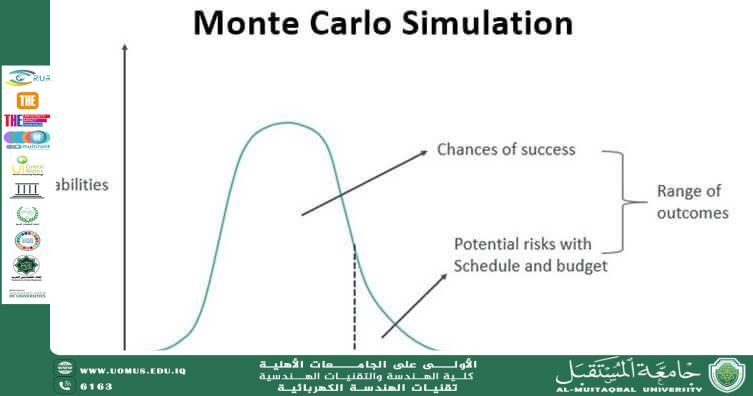
The Monte Carlo method is based on the principle of probabilistic simulation, where electrical system components, such as generators, transmission lines, transformers, and circuit breakers, are represented using probabilistic models that rely on fault rates and repair times. A large number of random scenarios representing different system operating conditions over long periods are generated, and the system's performance is then analyzed in each scenario individually.
This method is distinguished by its ability to simulate the real-world behavior of an electrical system, as it takes into account the random nature of faults, load variations, and operating conditions. By repeating the simulation thousands or even millions of times, accurate estimates of key reliability indicators can be obtained, such as: Load Loss Rate (LOLP), Hours of Power Outage (LOLE), Unsupplied Power (EENS), and System Availability. Two main types of Monte Carlo simulations are used in reliability analysis: Sequential Monte Carlo simulations, which consider the chronological order of events, such as fault occurrence and repair duration, and Non-Sequential Monte Carlo simulations, which analyze cases without regard to chronological order and are faster to execute than the former.
Despite their significant advantages, these methods require high computational effort, especially when analyzing large and complex power systems. However, continuous advancements in computing power, the use of intelligent algorithms, and variance reduction techniques have greatly improved the efficiency of these methods and reduced simulation time.
In conclusion, power system reliability analysis using Monte Carlo methods is a powerful and effective tool for understanding the behavior of electrical networks under conditions of uncertainty. It also supports decision-makers in planning and developing power systems, improving their stability, and ensuring the continuity of electricity supply with the highest level of reliability, particularly in light of the increasing use of renewable energy sources and smart grids.
Al-Mustaqbal University, the leading university in Iraq.