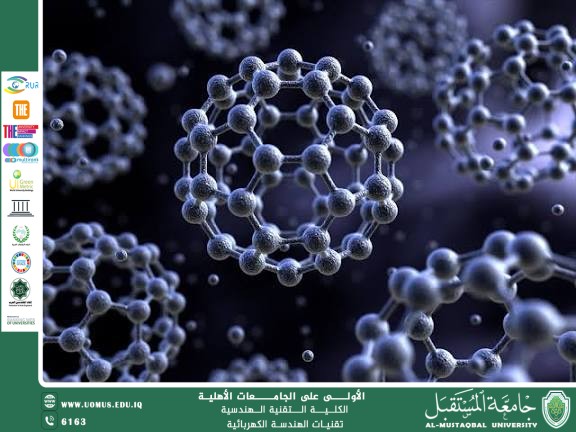

nanoelectronics
Engineer Israa Issa Ibrahim
As we reach the limits of silicon miniaturization, nanoelectronics emerges as a brilliant solution, relying on materials and devices that measure only a few nanometers (a nanometer is one-billionth of a meter, roughly 50,000 times smaller than a human hair).
1. Why do we need nanoelectronics?
Traditional processors face two major problems today:
Energy leakage: When transistors become extremely small, electrons begin to “jump” from their paths (quantum tunneling), causing significant energy loss.
Excessive heat: Packing billions of transistors into a tiny space generates massive heat, which hinders performance.
2. Revolutionary materials in the world of nanotechnology
Nanoengineering relies on materials with unique electrical properties that are not found in conventional materials:
Carbon Nanotubes (CNTs): Cylinders of carbon atoms capable of conducting current with almost zero resistance, making them many times faster than silicon.
Graphene: A two-dimensional material (one atom thick) with remarkable flexibility and ultra-fast data transfer capability.
Quantum Dots: Nanocrystals that emit specific colors when electrically stimulated, as seen today in advanced QLED television screens.
3. Practical applications and future prospects
The role of nanoelectronics goes beyond making “your phone thinner”; it extends to:
Neuromorphic Chips: Processors that mimic the human brain, consuming very little power while providing massive parallel processing capabilities.
Nanoscale Biosensors: Highly precise devices that can be implanted in the body to monitor blood sugar or detect viruses electrically within seconds.
Nano RAM (NRAM): Memory that combines the speed of RAM with permanent storage capacity and high resistance to extreme conditions like heat and radiation.
4. Major challenges (obstacles for engineers)
Despite its technical brilliance, nanoengineering faces significant manufacturing challenges:
Assembly precision: Aligning millions of nanoscale components with atomic accuracy requires complex techniques like self-assembly.
Cost: Building factories capable of working at this scale (cleanrooms) costs billions of dollars.
Photovoltaic cells and nanotechnology (engineering addition)
Nanoelectronics is also used to improve solar cell efficiency by incorporating nanowires that capture a broader spectrum of sunlight, potentially increasing renewable energy efficiency to unprecedented levels.
Al-Mustaqbal University, the first university in Iraq.