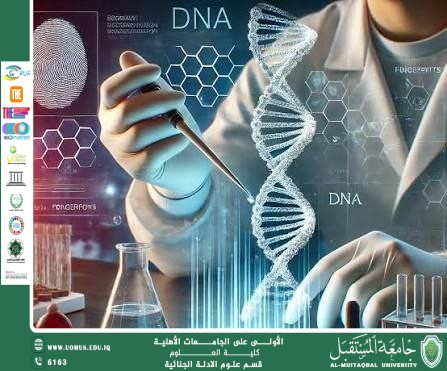

DNA Analysis as a Decisive Piece of Evidence in Criminal Investigations (Asst. Lecturer Huwayda Nazzal Hussein)
Introduction
Advances in life sciences have revolutionized forensic investigations, with DNA analysis playing a central role in this transformation. DNA evidence has become one of the most powerful scientific tools in modern criminal investigations due to its high accuracy and reliability. Courts increasingly rely on DNA analysis as decisive forensic evidence.
Concept and Scientific Basis of DNA
DNA is the genetic material found in the nucleus of cells and carries the biological code responsible for inherited traits. Its structure is stable, and its genetic pattern differs from one individual to another, making it ideal for human identification.
In forensic investigations, DNA profiles from crime scenes are compared with those of suspects or databases.
Sources of DNA at Crime Scenes
DNA can be collected from various sources at crime scenes, including:
Bloodstains
Saliva on objects or clothing
Hair with roots
Skin cells transferred by touch
Tissues and bodily fluids
Even minimal amounts of DNA can provide valuable forensic information.
Stages of DNA Analysis in Forensic Laboratories
DNA analysis involves several precise stages, starting with proper collection and preservation to prevent contamination. DNA is then extracted, purified, amplified, and analyzed.
Each stage is critical, and any error may affect the credibility of the final result.
Forensic Value of DNA Analysis
DNA analysis is invaluable because it can:
Directly link suspects to crime scenes
Exclude innocent individuals
Identify unknown victims
Support or challenge witness testimonies
Thus, DNA evidence is often decisive in criminal trials.
Role of DNA Analysis in Cold Cases
DNA technology has enabled the reopening of many cold cases. Advances in laboratory methods allow the analysis of old or degraded samples that were previously unusable.
This has led to exonerations and convictions years after crimes occurred.
Legal and Ethical Challenges
Despite its strengths, DNA analysis presents challenges such as:
Sample contamination risks
Genetic privacy protection
Misinterpretation of results
Strict legal and scientific standards are essential to ensure ethical use.
Conclusion
DNA analysis stands as one of the most decisive tools in modern forensic science. Its scientific precision has strengthened justice systems and enhanced the accuracy of criminal investigations.
Al-Mustaqbal University – the first university in Iraq.