Histology and Its Role in Diagnosing Causes of Death (Asst. Lecturer Huwayda Nazzal Hussein)
Introduction
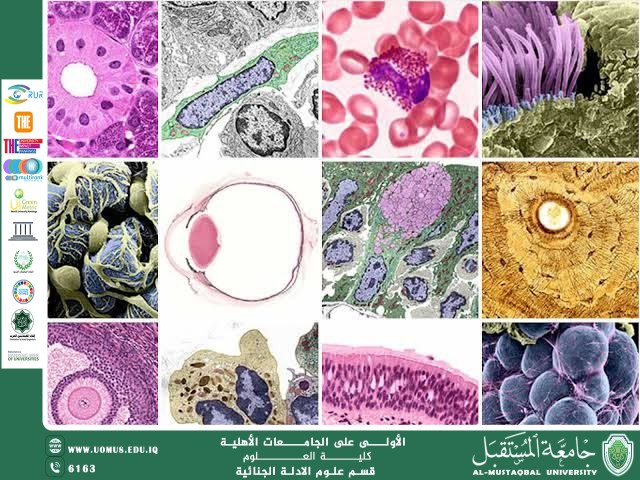
Histology is one of the most important branches of life sciences in forensic medicine. It focuses on the microscopic study of tissues and cells, allowing the detection of pathological changes or injuries that may not be visible to the naked eye. Histology plays a critical role in determining causes of death, especially in suspicious cases.
Concept of Forensic Histology
Forensic histology applies tissue analysis in criminal investigations. Tissue samples are examined microscopically to detect disease, trauma, poisoning, or asphyxia.
This field relies on comparing normal and abnormal tissue structures to interpret events prior to death.
Role of Histological Examination in Determining Cause of Death
Histological analysis helps in:
Detecting internal bleeding
Distinguishing ante-mortem from post-mortem injuries
Diagnosing acute and chronic diseases
Identifying signs of poisoning or oxygen deprivation
These findings strongly support forensic pathology reports.
Histology in Suspicious Death Cases
In many forensic cases, external examination alone is insufficient. Histology is essential in:
Poisoning cases
Sudden deaths
Medical negligence cases
Suspected indirect homicide
It provides scientific evidence to confirm or reject suspicions.
Legal Value of Histological Evidence
Histological findings have high legal value due to their scientific accuracy. They are frequently used in court to support or clarify forensic conclusions.
Conclusion
Histology is a cornerstone of forensic investigations. Its role in determining causes of death has significantly enhanced the accuracy and credibility of forensic science.
Al-Mustaqbal University – the first university in Iraq.