High-resistance faults and transient faults in electrical distribution systems: technical challenges and dimensions of modern protection
As part of the Electrical Engineering Technology Department's commitment to keeping abreast of scientific advancements in the field of electrical power systems, the department strives to foster a research culture and disseminate knowledge about the latest technical challenges facing power engineers in modern electrical networks.
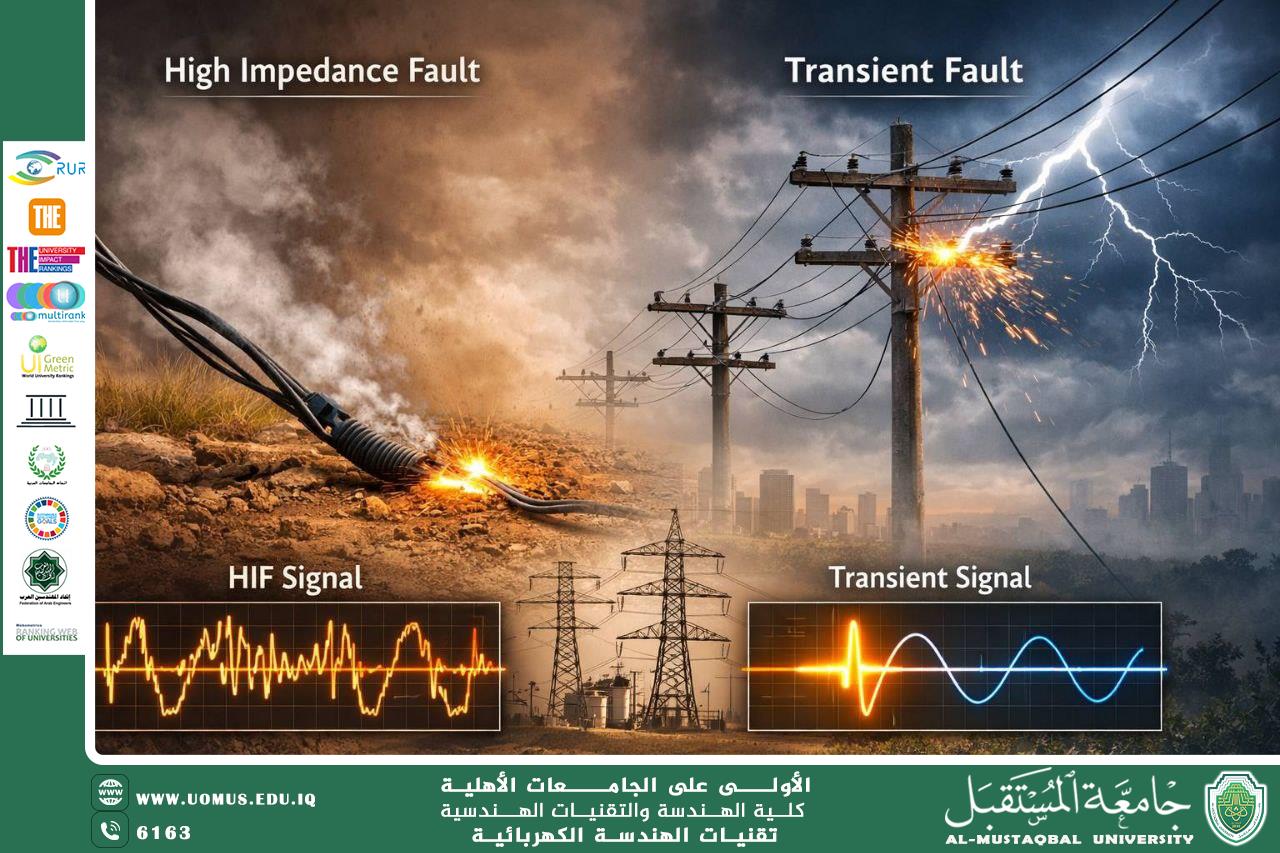
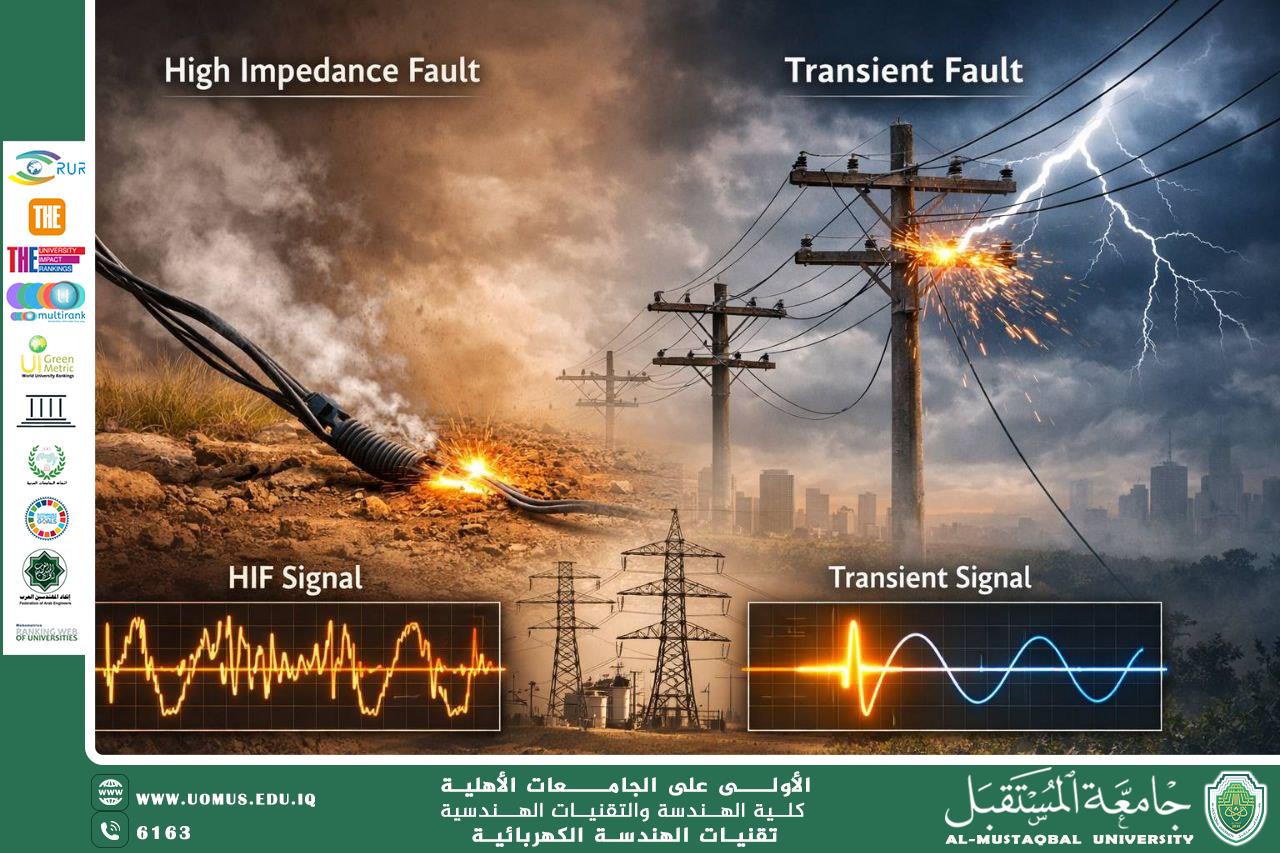
Electrical distribution systems are the backbone of power delivery from generation plants to consumers. They represent the most vulnerable stage to faults due to their extensive geographical reach and direct exposure to environmental and operational factors. While electrical faults are traditionally classified as obvious short-circuit faults with high currents, there are other, more complex and less obvious patterns that pose a real challenge to protection systems. These include high-impedance faults (HIFs) and transient faults.
⸻
First: High-Impedance Faults (HIFs)
A high-impedance fault occurs when a conductor comes into contact with a surface of high resistivity, such as dry soil, asphalt, or semi-insulating materials. Unlike low-resistance short-circuit faults, this type of fault does not result in a large current flow. The fault current is relatively limited and may not exceed the pick-up value specified in conventional surge relays.
High-resistance faults are characterized by several important technical features:
• Non-linear behavior in the voltage-current relationship
• Significant asymmetry in the half-cycles
• Intermittent arc formation
• High-frequency components in the signal due to the arc phenomenon
The danger of this type of fault lies in its potential to persist without immediate detection, posing a risk to public safety, especially in overhead distribution networks. Furthermore, the random and irregular nature of the fault makes its mathematical modeling a complex process, requiring advanced analytical tools that go beyond traditional methods based solely on effective current values.
⸻
Second: Transient Faults
Transient faults are temporary disturbances that arise in the electrical system due to environmental or operational factors. They resolve spontaneously within a very short period without becoming permanent faults. This type of fault is common in distribution networks, especially overhead lines.
The most prominent causes include:
• Lightning strikes and atmospheric discharges
• Tree branches coming into contact with conductors
• Connection and disconnection operations in the network
• Accumulation of dust or moisture on insulators
From an electrical perspective, transient faults are characterized by a momentary surge in fault current followed by a temporary drop in voltage. The system then returns to normal after the electrical arc is extinguished or the cause of the short circuit is removed. They are often addressed using auto-reclosing systems, which allow the line to be energized again after a short period to ensure the fault has been resolved.
Although transient faults do not necessarily lead to permanent damage, their recurrence may indicate poor insulation or aging network components, necessitating a thorough analytical study.
⸻
Challenges in Modern Protection Systems
Traditional protection systems in distribution networks rely on measuring current or voltage intensity and comparing it to predefined reference values. However, while this approach may be sufficient for high-current faults, it has clear limitations in dealing with high-resistance faults or in distinguishing between a true fault and a transient disturbance.
Therefore, it has become essential to adopt more sophisticated analytical methodologies that consider the temporal and frequency characteristics of electrical signals, in addition to studying the nonlinear behavior of the electric arc. A deep understanding of these phenomena is a fundamental step towards developing more reliable and accurate protection systems capable of balancing response speed with preventing unnecessary load disconnection.
⸻
Conclusion
Shams Saleem, [2/12/2026 8:41 PM]
High-resistance and transient faults represent advanced challenges for power engineers in modern distribution systems. While a high-resistance fault is inherently dangerous due to its low current and the difficulty in detecting it, a transient fault is characterized by its temporary nature, which may mask underlying problems in network components.
Strengthening scientific research in this field and developing more advanced analytical and diagnostic tools are strategic necessities to ensure the continuity of electricity supply, improve network reliability, and enhance the performance of protection systems in line with the requirements of modern power systems. Al_Mustaqbal University, the leading university in Iraq.