Dynamics of stability and advanced analysis of electrical power systems under nonlinear operating conditions
M.M. Zahraa Ibrahim explains that electrical power systems represent one of the most complex large-scale engineering systems, consisting of an interconnected network of generators, transformers, transmission lines, and protection and control systems. The behavior of these systems cannot be described by simple linear equations but rather by highly complex nonlinear mathematical models that reflect the continuous interaction between active power, reactive power, frequency, and voltage under varying operating conditions.
Stability analysis in power systems relies on studying the system's response to any sudden disturbance, such as a transmission line loss, a short circuit, or a generator going offline. Stability is classified into rotor angle stability, voltage stability, and frequency stability, each type being described using differential equations that represent the dynamics of synchronous generators.
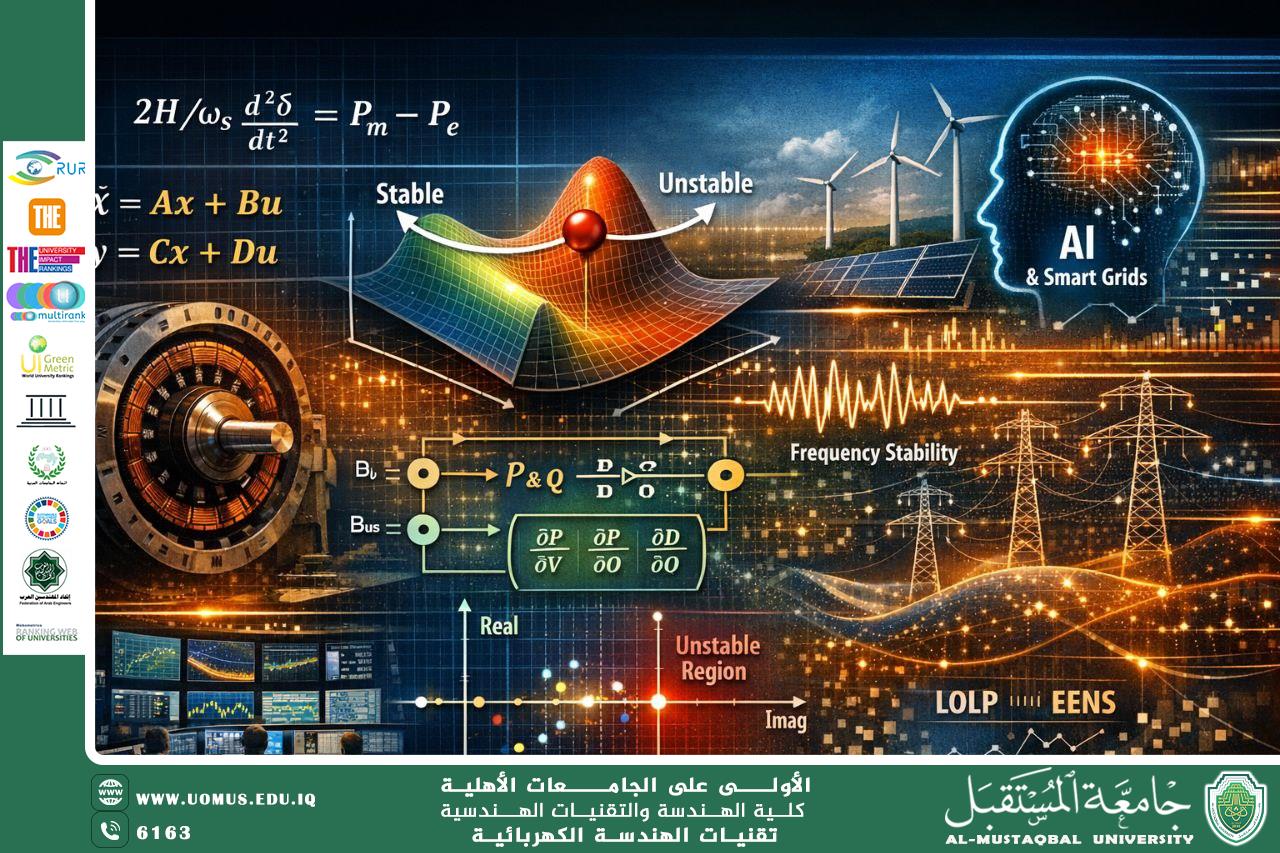
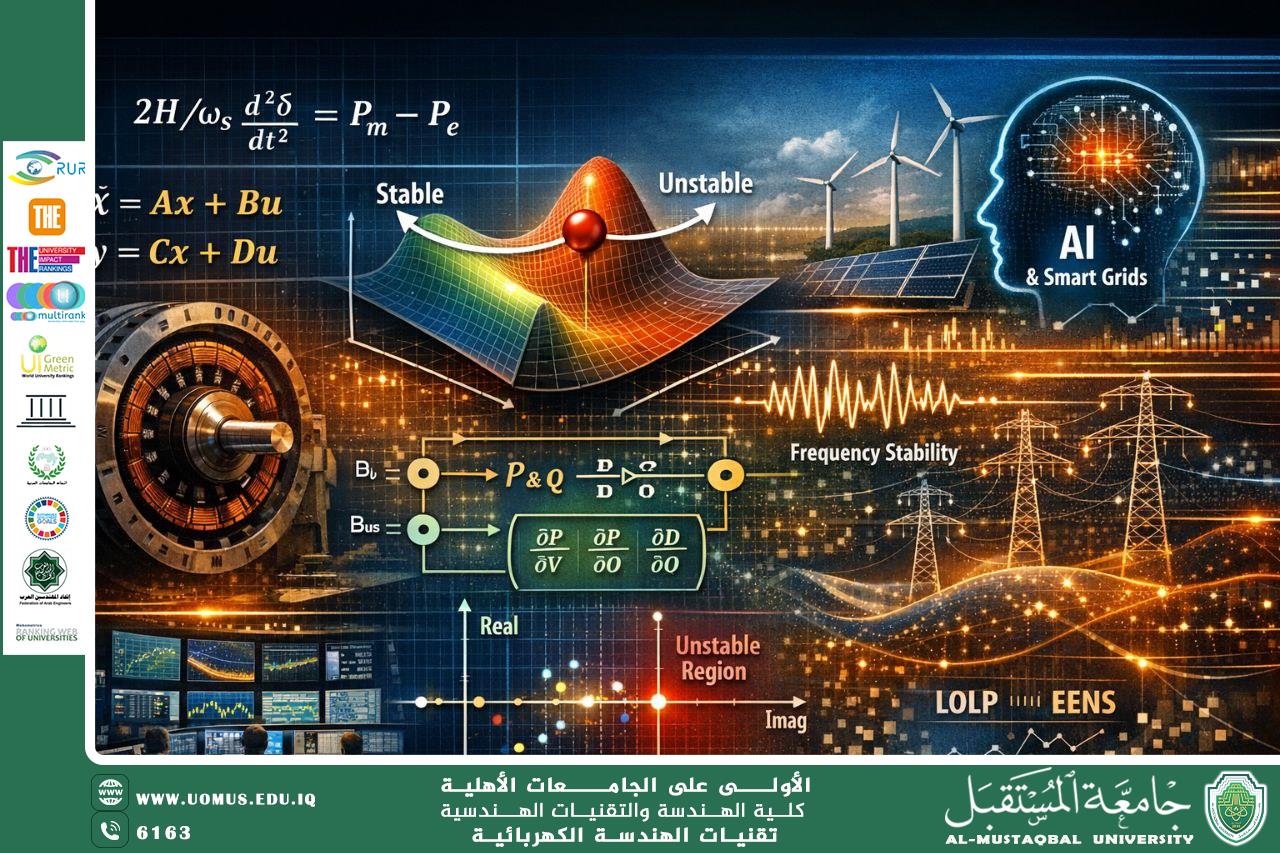
The swing equation is the mathematical basis for angular stability analysis. It expresses the relationship between the mechanical and electromagnetic torques of a generator as:
where represents the inertial constant, ΔL represents the load angle, ΔN represents the mechanical input power, and ΔE represents the electrical output power. This nonlinear equation shows that any imbalance between the input and output power leads to acceleration or deceleration of the generator rotor, which can result in synchronization loss if the stability limits are exceeded.
Potential stability, on the other hand, relates to the system's ability to maintain acceptable voltage levels at all bus stops after experiencing a disturbance. This is analyzed using power flow equations, a system of nonlinear equations typically solved using the Newton-Raphson method, taking into account the Jacobian matrix, which reflects voltage sensitivity to power.
In modern environments that rely on renewable energy sources, the analysis becomes more complex due to the intermittent and unstable nature of sources such as solar and wind power. These sources rely on power electronics rather than traditional mechanical inertia, reducing the overall system inertia and making it more sensitive to rapid frequency changes.
Advanced control systems play a pivotal role in enhancing network stability through the use of technologies such as:
AVR (Automatic Voltage Reduction) systems
Power System Stabilizers (PSS)
FACTS (Flexible Current and Power Flow Control Systems)
Microprocessor-based digital control systems
These systems are based on state-space models, where the system is represented by a set of first-order equations:
y = Cx + Du
This representation allows for the study of stability characteristics through matrix eigenvalue analysis, as the presence of a positive real part for any eigenvalue indicates system instability.
The shift towards smart grids has introduced new concepts such as decentralized control, real-time load management, and AI-powered prediction algorithms. This requires integrating probabilistic and statistical models to analyze system reliability and calculate indicators such as: Loss of Load Probability (LOLP) and Expected Energy Not Supplied (EENS). Thus, the power system transforms from a mere energy transmission network into a dynamic, interactive system that relies on the integration of electrical engineering, mathematical modeling, and complex systems theory.
Al-Mustaqbal University, the leading university in Iraq.