
Lexical Ambiguity in the Holy Qur’an (Asst. Prof. Sarab Abbas Jasim)
Lexical ambiguity, also known as polysemy or lexical homonymy, is one of the most prominent semantic phenomena in the Arabic language. It appears clearly in the Holy Qur’an, which is characterized by linguistic richness and precise expression. Lexical ambiguity refers to a single word that carries more than one meaning, with the intended meaning determined by context. This phenomenon has played an important role in enriching Qur’anic interpretation and linguistic studies.
The Concept of Lexical Ambiguity
Lexical ambiguity is defined as a single word that is originally assigned to two or more different meanings without one meaning being more dominant than the others in isolation. This feature reflects the flexibility and richness of the Arabic language. In the Qur’an, lexical ambiguity serves a rhetorical purpose by allowing depth, brevity, and multiple layers of meaning within a single expression.
Examples of Lexical Ambiguity in the Qur’an
The Holy Qur’an contains many words that share the same form but differ in meaning, including:
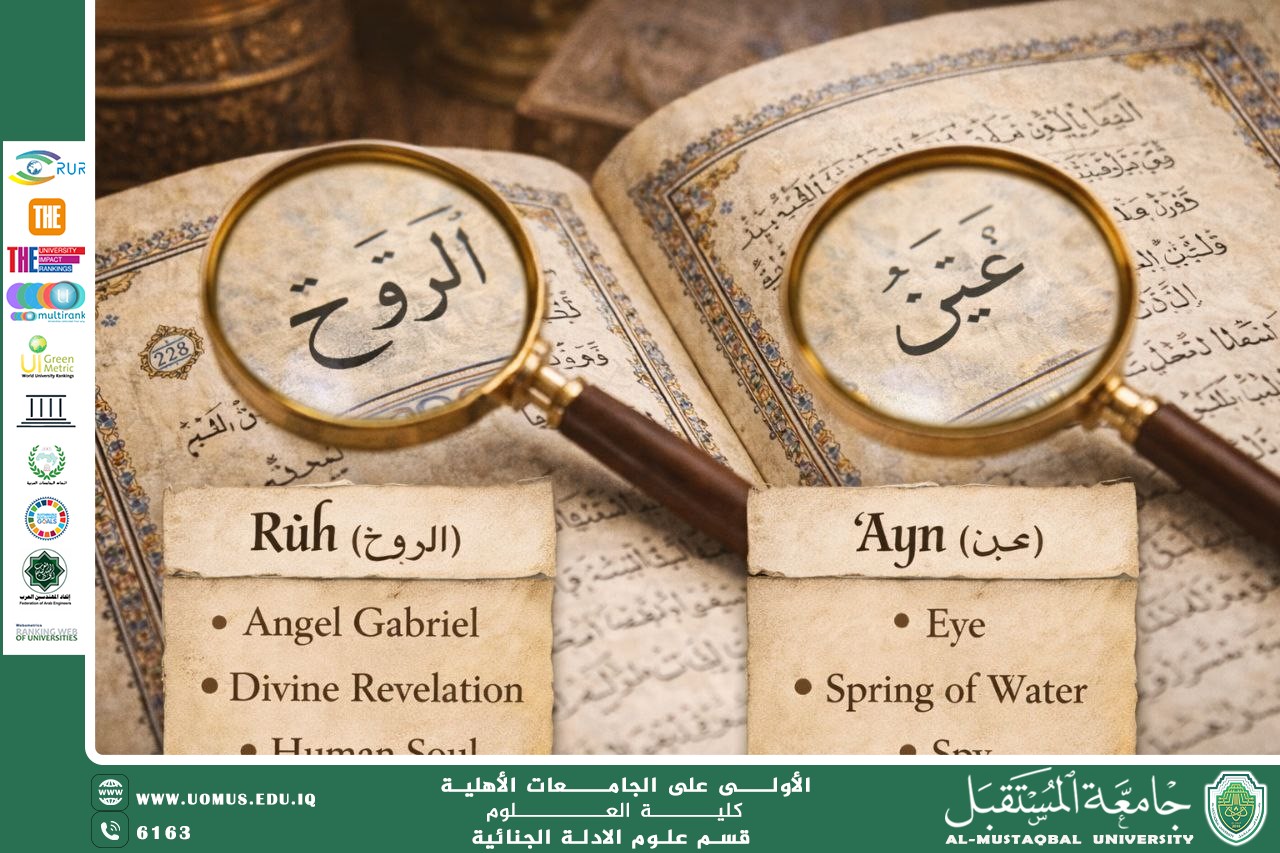
ʿAyn (عين): It may refer to the eye, a spring of water, a spy, or wealth, depending on the context.
Qurʾ (قرء): It denotes both menstruation and the period of purity, as mentioned in the verse:
“Divorced women shall wait by themselves for three qurʾ.”
This lexical ambiguity led to differences among scholars regarding the intended meaning.
Ummah (أمة): It may mean a nation, a religion, a period of time, or a leader who is followed.
Rūḥ (روح): It may refer to the angel Gabriel, divine revelation, or the human soul.
The Role of Context in Determining Meaning
Context plays a fundamental role in identifying the intended meaning of an ambiguous word in the Qur’an. Linguistic context, surrounding expressions, reasons for revelation, and interpretive principles all help clarify meaning. Through context, lexical ambiguity does not cause confusion but rather enhances the eloquence and depth of Qur’anic discourse.
The Impact of Lexical Ambiguity on Qur’anic Interpretation
Lexical ambiguity has contributed to diversity in Qur’anic exegesis. Different interpretations often arise from selecting one possible meaning over another based on linguistic and contextual evidence. This diversity does not contradict the unity of the Qur’anic message; rather, it reflects the richness and flexibility of the Qur’anic text.
Conclusion
Lexical ambiguity in the Holy Qur’an is a significant linguistic phenomenon that demonstrates the Qur’an’s semantic depth and rhetorical excellence. Proper understanding of Qur’anic meaning requires careful attention to context and linguistic principles. Therefore, studying lexical ambiguity is essential for students of Arabic language and Qur’anic sciences, as it deepens comprehension and enhances interpretive accuracy
Al-Mustaqbal University – the first university in Iraq.
SDG4