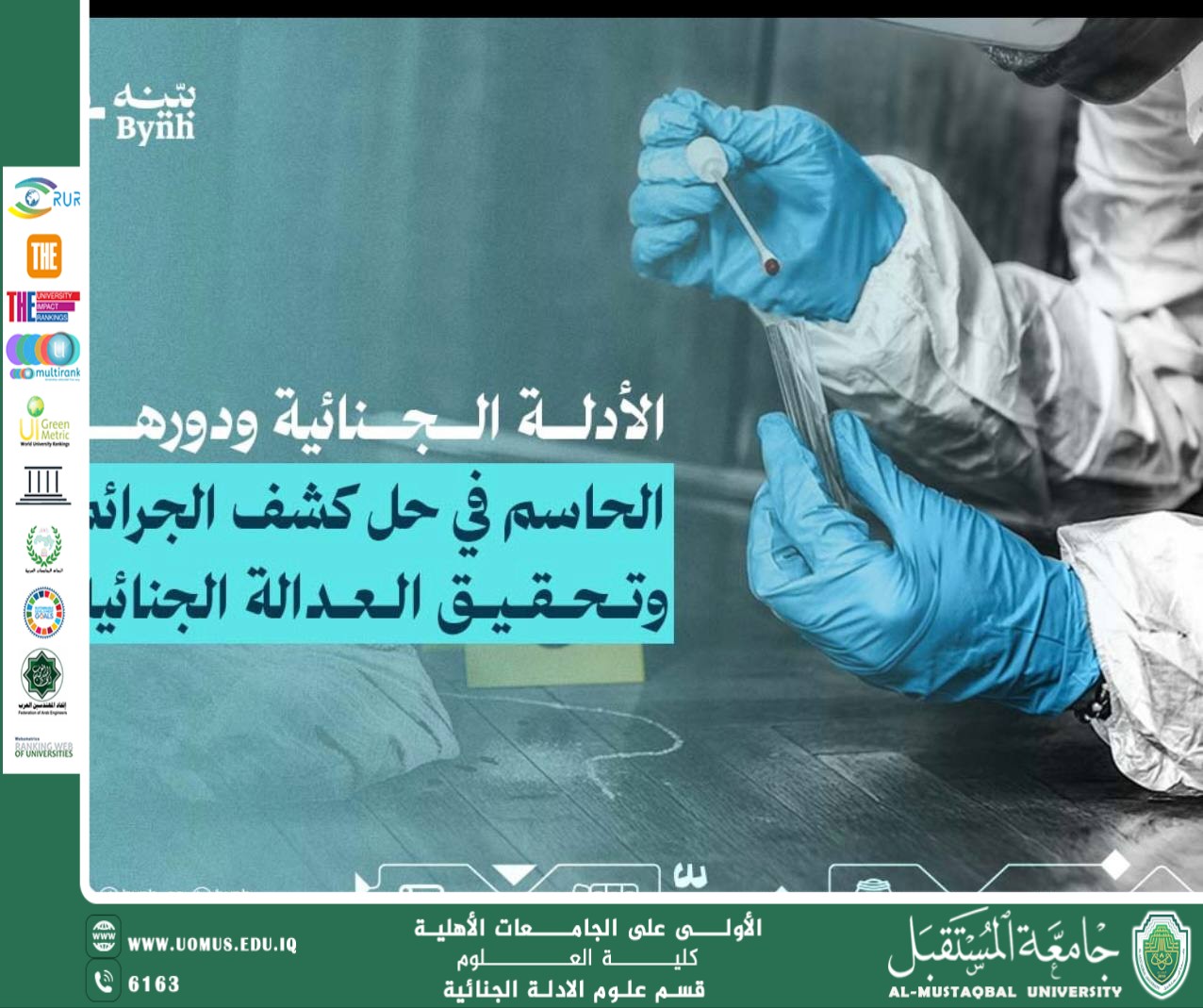

Biology and Its Central Role in Modern Forensic Evidence(Asst. Prof. Bushra Hussein Atiyah)
Biology is considered one of the fundamental pillars of forensic science, as it provides the scientific basis for understanding and analyzing biological materials associated with crime scenes. Advances in life sciences, particularly genetics and microbiology, have revolutionized crime detection and the accurate identification of suspects and victims.
Role of Biology in Forensic Evidence
Forensic science heavily relies on biological principles to analyze evidence such as blood, saliva, hair, tissues, and bones. DNA is one of the most important biological forms of evidence due to its uniqueness to each individual, making it a powerful tool for linking suspects to crime scenes.
Biological Techniques Used in Forensic Investigations
Modern forensic biology includes several advanced techniques, such as:
• DNA profiling for personal identification.
• Forensic microbiology to trace microbial signatures.
• Forensic entomology to estimate time of death.
• Histological examinations to distinguish between ante-mortem and post-mortem injuries.
Importance of Integrating Biology with Forensic Science
The integration of biology with forensic evidence enhances the accuracy of criminal investigations and reduces the likelihood of error. It also strengthens the justice system by providing reliable scientific evidence that can be presented in court.
Conclusion
Biology has become an indispensable component of modern forensic science. Its contribution to the development of advanced analytical tools has greatly improved the ability to solve complex crimes. As scientific research continues to advance, the role of biology in forensic evidence is expected to expand further in the future.
Al-Mustaqbal University – the first university in Iraq.
SDG4