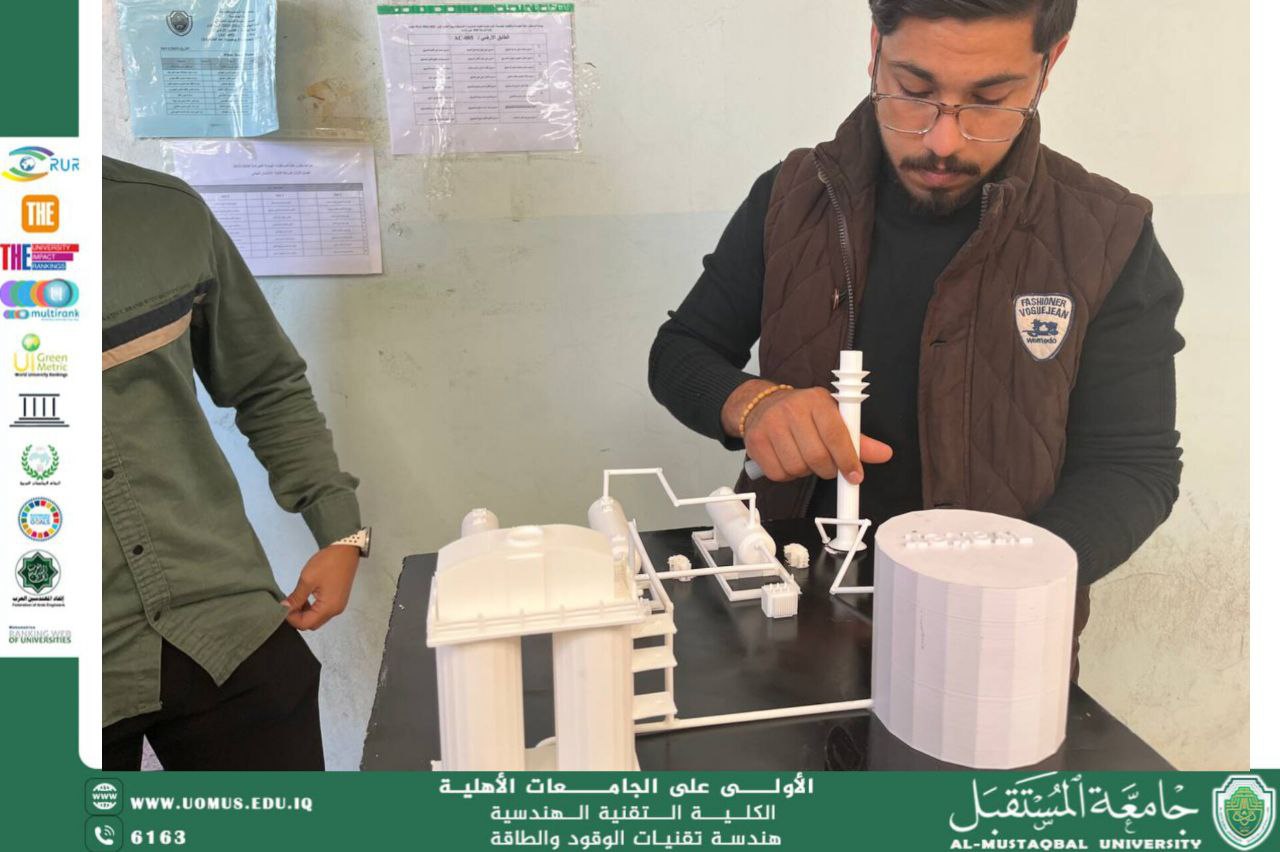
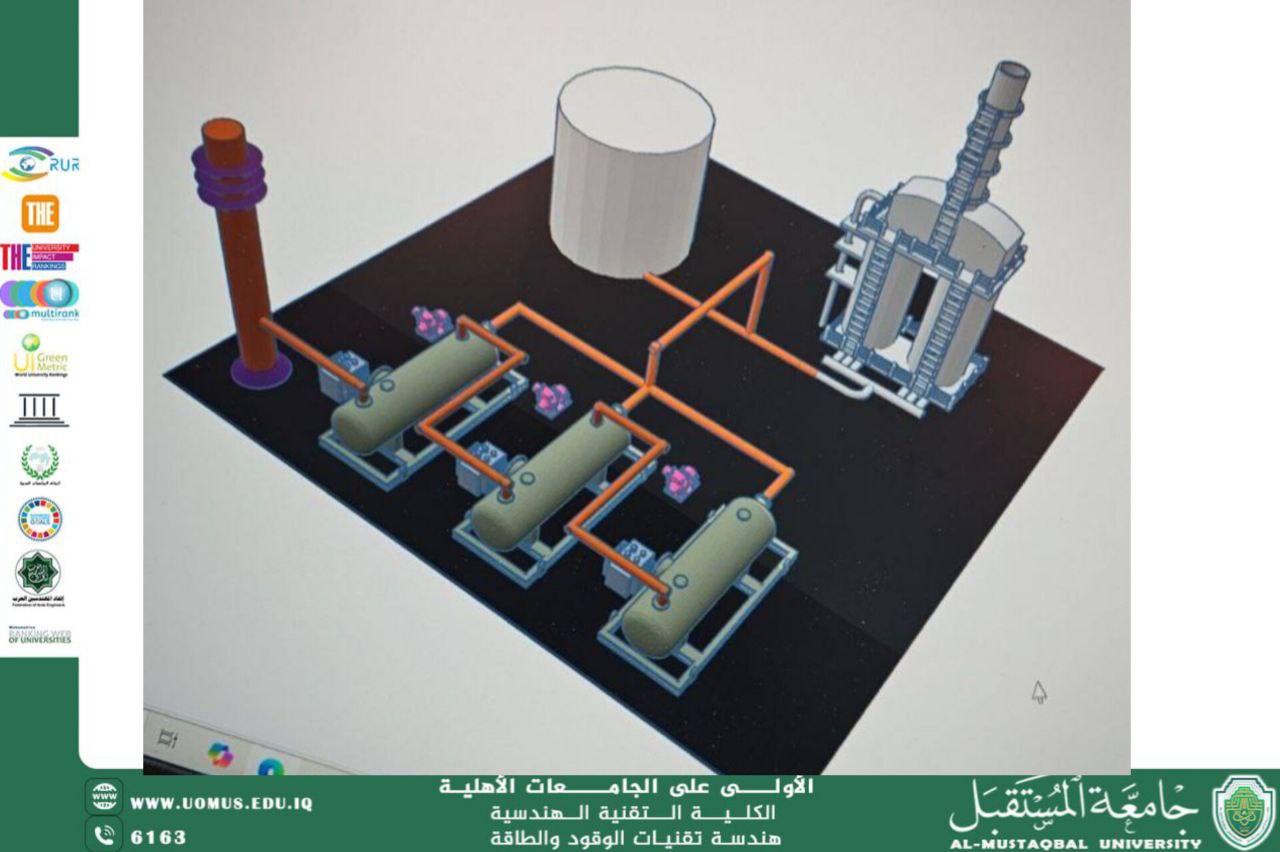
Final-Stage Industrial Project: Integrated Plant for Liquid and Gas Refining and Processing
In a distinguished academic achievement that reflects the advanced practical capabilities of Fuel and Energy Technologies students, the industrial project entitled “Integrated Plant for Liquid and Gas Refining and Processing” has reached its final stage of completion. The project represents a comprehensive engineering model designed according to professional industrial standards, simulating real-world operational environments in the energy and processing sectors.
The project aims to design an integrated industrial facility capable of efficiently refining and treating industrial liquids and gases through advanced separation, purification, thermal, and chemical processing techniques. The students conducted detailed mass and energy balance calculations, developed Process Flow Diagrams (PFD) and Piping and Instrumentation Diagrams (P&ID), selected appropriate industrial equipment such as distillation columns, heat exchangers, absorption units, and separation systems, and proposed a preliminary control strategy to ensure operational stability, efficiency, and safety.
In addition to the technical design, the project includes feasibility analysis, environmental impact considerations, safety standards application, and risk management planning. This holistic approach demonstrates the students’ ability to integrate theoretical knowledge with practical engineering solutions that address real industrial challenges in the oil, gas, and energy sectors.
The project stands as a model of project-based learning, strengthening analytical thinking, engineering design skills, teamwork, and problem-solving abilities. It also prepares students to meet labor market demands and contribute effectively to the development of sustainable industrial systems.
Alignment with the United Nations Sustainable Development Goals (SDGs):
SDG 4: Quality Education
By promoting applied engineering education and enhancing students’ technical and research competencies through hands-on industrial design.
SDG 7: Affordable and Clean Energy
Through improving resource efficiency and optimizing processing technologies to reduce energy losses.
SDG 9: Industry, Innovation, and Infrastructure
By developing innovative industrial solutions that support resilient infrastructure and sustainable industrialization.
SDG 12: Responsible Consumption and Production
Through incorporating environmental considerations, emission reduction strategies, and efficient process management.
This milestone reaffirms the department’s commitment to graduating highly qualified engineers capable of contributing to industrial advancement and sustainable development through innovative, responsible, and forward-looking engineering solutions.