Applications of Virtual Reality in Training Pilots and Engineers
Virtual reality technology has developed significantly in recent years and has become an important tool in education and training, especially in fields that require high precision and practical skills, such as the aviation sector. Virtual reality has introduced a major shift in the way pilots and engineers are trained by providing interactive training environments that closely simulate real-life conditions without exposing trainees or equipment to actual risks.
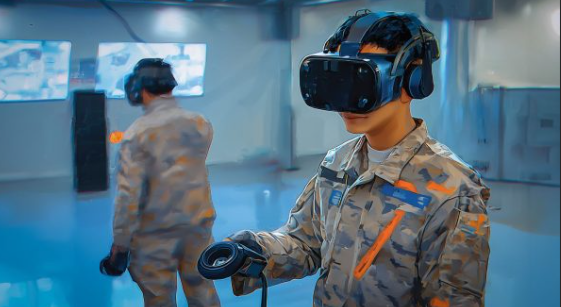
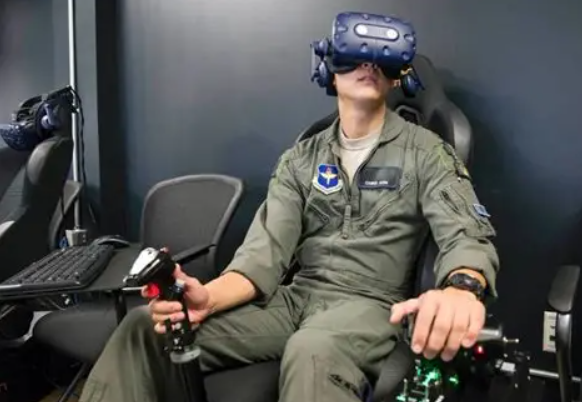
Virtual reality is based on creating a three-dimensional digital environment that users can interact with using special headsets and control devices. In aviation, this technology is used to simulate the cockpit, aircraft systems, and different weather conditions, giving trainees an experience that closely resembles real flight. A trainee pilot can learn how to take off, land, and handle emergency situations within a safe virtual environment before moving to real aircraft training.
Traditional flight simulators have long been an essential part of pilot training, but virtual reality adds a new level of immersion and interactivity. Instead of relying on large, expensive simulators or fixed screens, VR headsets can provide flexible and portable training solutions. Training programs can also be updated easily to include new scenarios or different aircraft models without the need to replace physical equipment.
Virtual reality helps pilots train for emergency situations that are difficult or impossible to practice in real life, such as engine failure, severe weather conditions, or sudden system malfunctions. This type of training improves decision-making skills, response time, and overall confidence when dealing with unexpected situations.
The use of virtual reality is not limited to pilot training; it also plays a significant role in training aircraft engineers and maintenance technicians. Engineers can use virtual environments to inspect aircraft components, learn maintenance procedures, and practice assembling and disassembling complex parts without the need for a real aircraft. This reduces training costs and minimizes the risk of errors during hands-on practice.
Virtual reality also allows engineers to train on different failure scenarios and learn how to fix them, which improves their readiness and technical competence. Trainees can repeat the same procedure multiple times until they master it, something that is difficult to achieve in traditional training due to time and equipment limitations.
From an educational perspective, virtual reality enhances the learning process by making it more interactive and engaging. Trainees learn through direct experience rather than relying solely on theoretical explanations. Studies have shown that simulation- and VR-based training improves knowledge retention and accelerates skill acquisition.
Despite its many advantages, there are still some challenges associated with virtual reality in training. These include the high cost of advanced equipment, the need to develop high-quality training content, and the requirement to train instructors to use the technology effectively. Additionally, virtual reality cannot fully replace practical training but serves as a complementary tool that enhances overall training quality.
The field of Information Technology plays a vital role in developing virtual reality applications in aviation. Software engineers contribute by designing simulation environments, creating 3D aircraft models, and building interactive systems that simulate aircraft behavior and systems. Artificial intelligence can also be integrated into VR environments to create intelligent training scenarios that adapt to the trainee’s skill level.
In conclusion, virtual reality represents an advanced tool that enhances the training of pilots and engineers by providing safe, realistic, and interactive environments. As this technology continues to evolve, it is expected to become an essential part of aviation training systems, improving efficiency, safety, and cost-effectiveness, while strengthening the role of information technology in shaping the future of aviation.