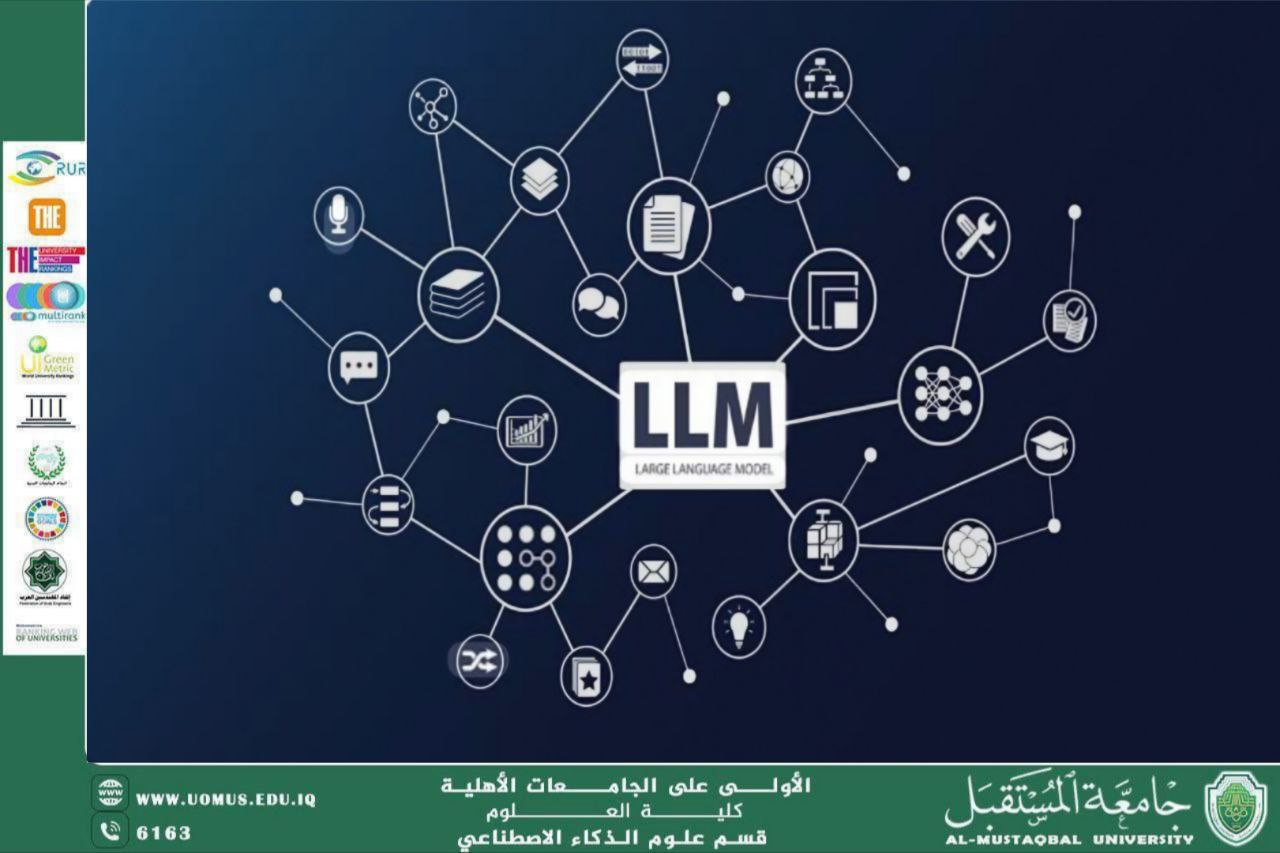

A scientific article entitled Large Language Models (LLMs) and their challenges (Samar Hussein Hilal)
Large Language Models (LLMs) and Their Challenges
Large Language Models (LLMs) represent a quantum leap in the field of artificial intelligence, demonstrating a remarkable ability to understand and generate human-like text, making them a pivotal tool in applications ranging from digital assistants to real-time translation and text summarization. These models, such as GPT-4 and Gemini, rely on vast amounts of textual data and deep neural architectures to capture the complexities and contexts of language. However, this significant technological advancement is not without formidable challenges; these models suffer from the problem of "hallucination," where they generate incorrect or misleading information with high confidence, posing a risk to information credibility. Furthermore, their reliance on training data makes them prone to reinforcing societal biases present in that data, which can lead to unfair or discriminatory outputs. Additionally, these models require immense computational power for both training and inference, limiting their accessibility and contributing to significant energy consumption with environmental consequences. Complex ethical and legal issues also arise, concerning copyright infringement, the difficulty of interpreting how a model arrives at its conclusions, and fears of their use in disinformation campaigns and impersonation. Addressing these challenges necessitates concerted research efforts to develop models that are more accurate, transparent, and ethical, alongside the establishment of clear regulatory frameworks to ensure the responsible use of this promising technology.