Benign vs Malignant Tumors: A Simple Guide for Medical Students
Dr. Lamees Abdulraheem Nabat
Introduction
Tumors are abnormal masses of tissue that arise due to uncontrolled cell proliferation. In pathology, tumors are broadly classified into benign and malignant based on their biological behavior, histological features, and clinical significance. Understanding the differences between benign and malignant tumors is fundamental for medical and health science students, as it forms the basis for diagnosis, prognosis, and treatment planning.
________________________________________
Definition of Benign Tumors
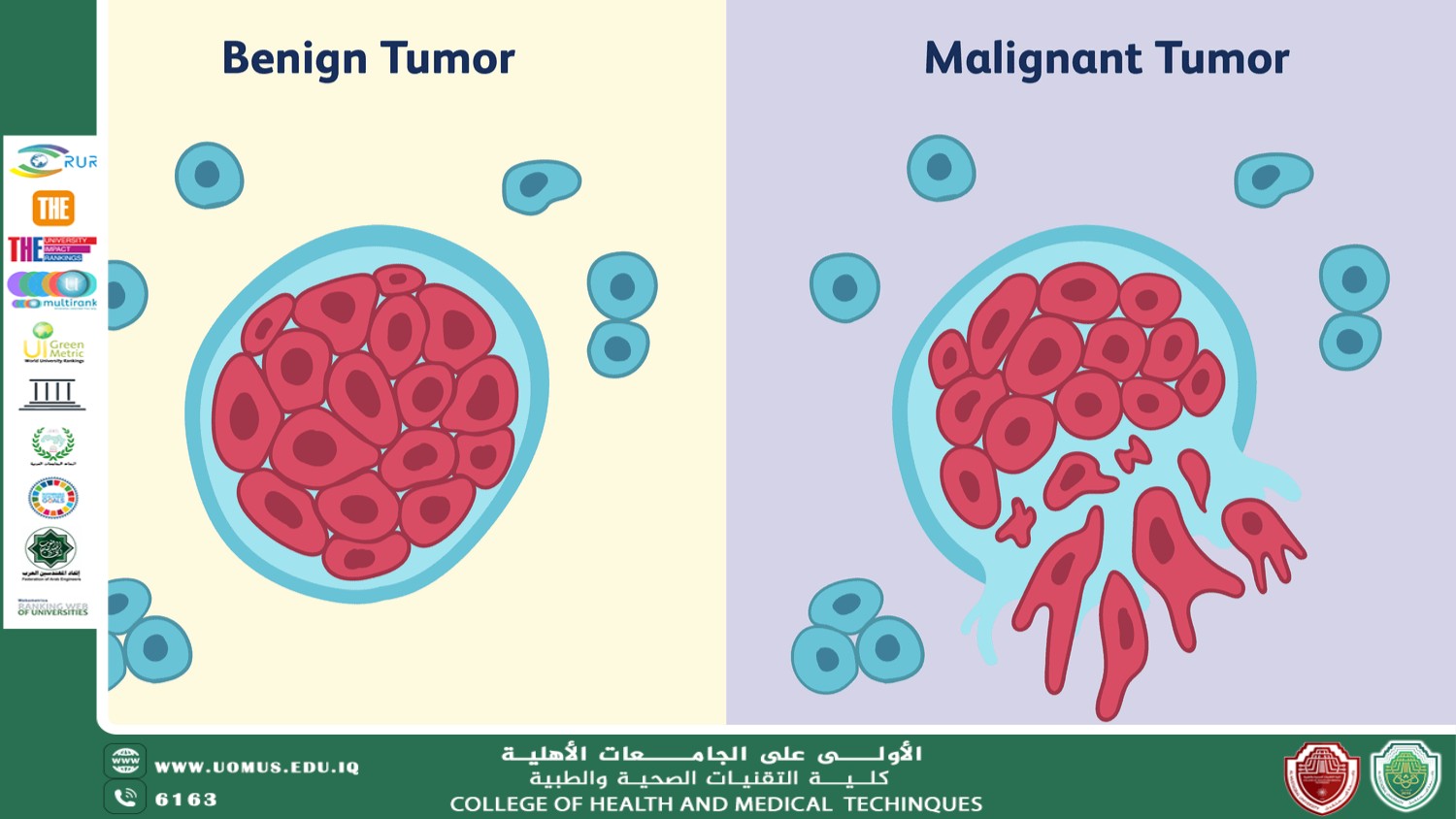
Benign tumors are non-cancerous growths characterized by slow growth and limited local effects. They do not invade surrounding tissues or metastasize to distant organs. Although benign tumors are usually not life-threatening, they may cause clinical problems depending on their size and location.
Key characteristics of benign tumors include:
• Slow rate of growth
• Well-circumscribed or encapsulated margins
• Cells closely resemble normal tissue (well-differentiated)
• Absence of metastasis
• Rare recurrence after complete surgical removal
________________________________________
Definition of Malignant Tumors
Malignant tumors are cancerous growths with aggressive biological behavior. They have the ability to invade surrounding tissues and spread to distant organs (metastasis). Malignant tumors are associated with significant morbidity and mortality if not diagnosed and treated early.
Key characteristics of malignant tumors include:
• Rapid and uncontrolled growth
• Poorly defined and infiltrative margins
• Cells show marked atypia and poor differentiation
• Ability to invade and metastasize
• High likelihood of recurrence
________________________________________
Histopathological Differences
Histopathological examination plays a crucial role in differentiating benign from malignant tumors. Several microscopic features help pathologists reach a definitive diagnosis.
Feature Benign Tumors Malignant Tumors
Cell differentiation Well differentiated Poorly differentiated
Nuclear features Normal size and shape Pleomorphism, hyperchromasia
Mitotic activity Rare and normal Frequent and abnormal
Tissue invasion Absent Present
Metastasis Absent Common
________________________________________
Clinical Significance
Distinguishing between benign and malignant tumors is essential for patient management. Benign tumors are often managed with surgical excision alone, while malignant tumors usually require a combination of surgery, chemotherapy, and radiotherapy. Early diagnosis of malignant tumors significantly improves patient outcomes.
________________________________________
Conclusion
Understanding the fundamental differences between benign and malignant tumors is essential for medical students. Histopathology provides valuable information that guides diagnosis, treatment decisions, and prognosis. A clear grasp of these basic concepts helps bridge the gap between pathology and clinical practice.