
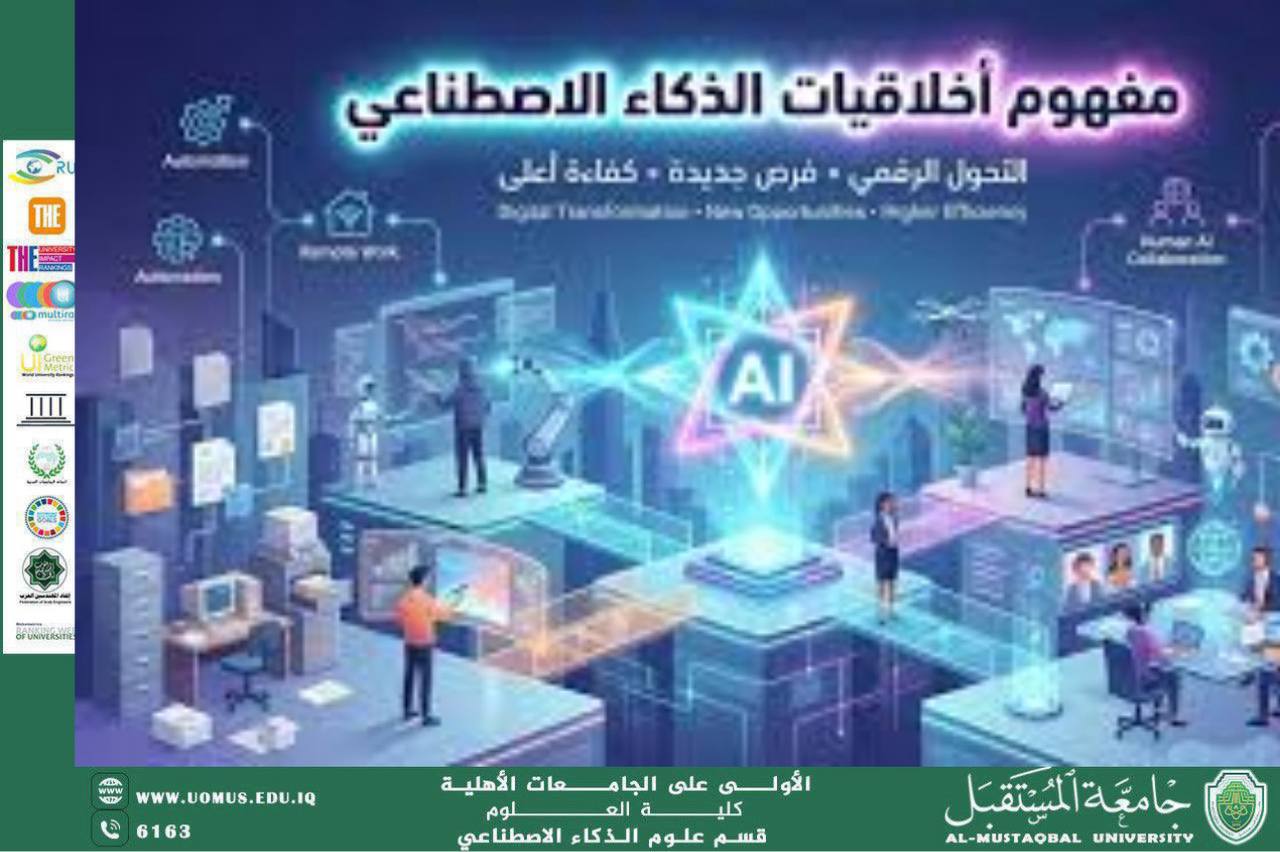
Ethics of Artificial Intelligence and Its Impact on the Future of Work
The world is witnessing a rapid transformation in work practices due to AI applications, ranging from automating routine tasks to supporting strategic decision-making. While AI enhances productivity and service quality, it also raises questions about legal responsibility, algorithmic bias, and potential job displacement.
This paper highlights the importance of ethics in designing and deploying AI systems to ensure a sustainable and balanced future of work.
Ethical Principles of Artificial Intelligence
1. Transparency:
Clear understanding of algorithmic mechanisms for users and decision-makers.
2. Accountability:
Defining responsibility in case of errors or unexpected decisions.
3. Fairness & Non-bias:
Ensuring algorithms are free from social, gender, or racial bias.
4. Privacy & Data Protection:
Safe handling of employee and customer data in a responsible manner.
5. Sustainability:
Using AI to enhance efficiency without negatively impacting workers or society.
Impact of AI on the Workforce
• Automation of routine jobs: Reducing the need for manual or repetitive tasks.
• Job redefinition: Emergence of new roles requiring advanced analytical and technical skills.
• Increased productivity: Supporting faster data analysis and decision-making.
• Social challenges: Concerns about job displacement and the need for digital skills training.
Recommendations
1. Integrate ethics into AI system design.
2. Develop robust data privacy and protection policies.
3. Provide training programs to upskill employees for future roles.
4. Continuously monitor and assess AI’s impact on the workforce.
Conclusion
AI represents a golden opportunity to enhance productivity and innovate work practices, yet irresponsible use may lead to ethical and social issues. By adopting ethical principles and maintaining human oversight in decision-making, it is possible to build a sustainable, fair, and balanced future of work.