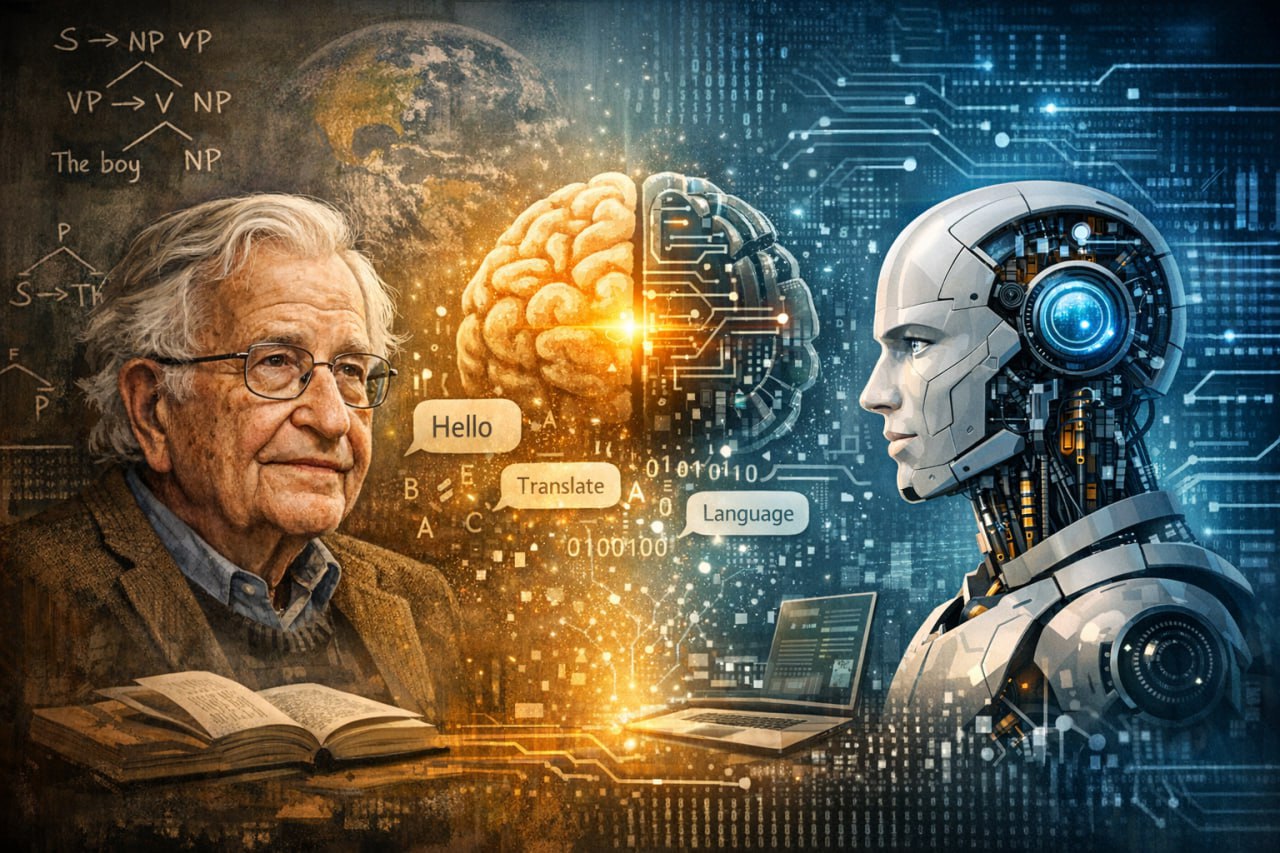
A scientific article titled "Noam Chomsky and Artificial Intelligence" Researcher: (M.M. Rafal Qusay)
Chomsky’s work provides a critical framework for evaluating AI’s strengths and limitations, reminding researchers that language is more than patterns and probabilities—it is fundamentally connected to human thought and creativity.
Looking toward the future, the interaction between Chomsky’s linguistic theories and AI research offers exciting possibilities. By combining insights from Universal Grammar with advanced computational models, researchers may develop more sophisticated AI systems capable of deeper semantic understanding and context-aware communication. While AI may never replicate the full cognitive richness of human language, its development continues to enhance human-machine interaction and expand our understanding of intelligence itself. Chomsky’s influence ensures that questions about meaning, understanding, and the nature of language remain central to these technological advancements.
In conclusion, Noam Chomsky’s contributions to linguistics have profoundly shaped the study of language and influenced the development of Artificial Intelligence. His theory of Universal Grammar emphasizes the innate human capacity to acquire language, highlighting the differences between human cognition and machine processing. Although AI systems can generate impressive language outputs, they do not truly understand meaning as humans do. Studying both Chomsky’s theories and AI technologies provides a richer understanding of language, intelligence, and the evolving relationship between humans and machines. The ongoing dialogue between linguistics and artificial intelligence promises to shape the future of communication, research, and technology for generations to come.