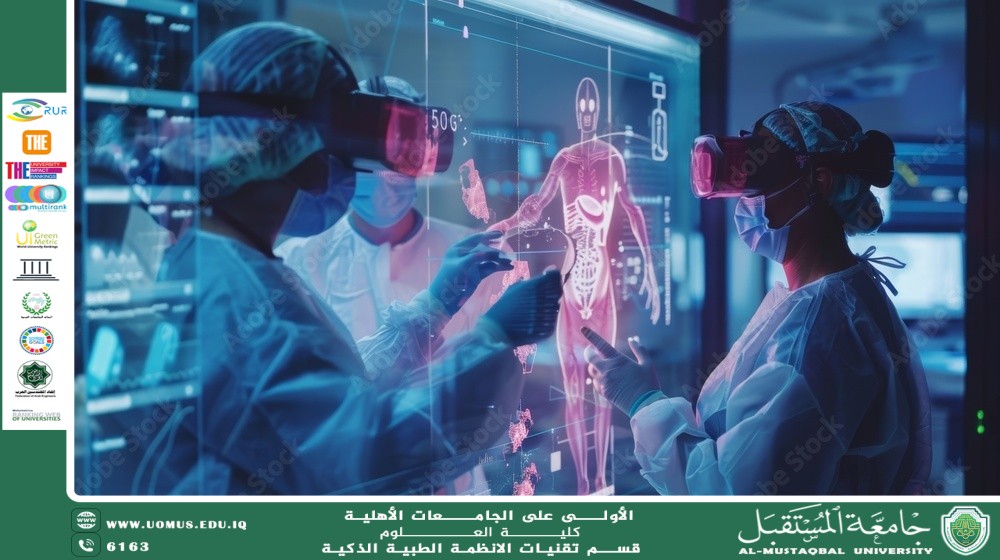

The Role of Augmented Reality in Enhancing the Simulation of Diagnosis and Treatment in Medicine (Assist. Prof. Maytham Nabil Miqdad)
Medical education has witnessed a qualitative transformation in recent years through the integration of advanced digital technologies, most notably augmented reality, which represents an interactive extension of the traditional learning environment. Augmented reality is based on merging three-dimensional digital elements with the real-world environment in real time, enabling learners to visualize anatomical structures or procedural guidance as if they were integrated directly into the clinical setting. This fusion of the real and virtual worlds opens broad horizons for developing more precise and effective training methods, particularly in medical specialties that require highly sensitive practical skills such as surgery.
In training physicians and students in surgical skills, augmented reality technologies provide a safe learning environment that allows experimentation and repetition without exposing patients to risk. By using smart glasses or interactive displays, trainees can observe three-dimensional models of target organs superimposed on a patient’s body or anatomical model, with clear visualization of tissue layers, blood vessels, and nerves. This integrated visual representation enhances spatial understanding of complex anatomical relationships and reduces errors resulting from misjudgment. Furthermore, augmented reality software can deliver instant procedural guidance regarding incision angles and instrument pathways, along with real-time feedback based on motion and precision analysis, thereby progressively improving technical performance according to objective standards.
The role of augmented reality extends beyond foundational training to supporting surgeons during preoperative planning and sometimes even during procedures. By overlaying computed tomography or magnetic resonance imaging scans onto the patient’s body, surgeons can precisely identify the locations of tumors or abnormalities. This integration of medical imaging data with augmented reality enhances surgical accuracy, reduces operation time and potential complications, and strengthens the cognitive expertise of trainees by directly linking radiological images with the actual surgical field.
In the domain of diagnostic and therapeutic simulation, augmented reality provides interactive educational environments that realistically replicate complex clinical scenarios. Virtual patient cases presenting various symptoms can be created, allowing students to examine them through the projection of vital signs, laboratory test results, and radiological images within the learning context. Through this interaction, students develop systematic clinical reasoning skills and practice making diagnostic decisions based on dynamically changing information, with the ability to modify scenarios and test different treatment responses. This capability to simulate diverse clinical cases within a short time frame enhances learners’ experience and broadens their exposure to medical conditions that may not be readily available during traditional clinical training.
Moreover, augmented reality promotes collaborative learning, enabling multiple students or physicians to observe and interact with the same augmented model simultaneously, fostering discussion and collective clinical analysis. Instructors can also monitor trainees’ performance remotely and provide immediate feedback based on objectively recorded data regarding procedural steps and diagnostic decisions, which enhances transparency in evaluation and improves the overall quality of medical education.
Integrating augmented reality into medical education is not merely the adoption of an additional technological tool; rather, it reflects a fundamental shift in the philosophy of healthcare training toward interactive simulation, digital analysis, and instant feedback. By providing safe and information-rich learning environments, this technology helps bridge the gap between theoretical knowledge and practical application, strengthening the competence of future healthcare professionals in addressing complex clinical challenges with greater accuracy and confidence, ultimately contributing to improved healthcare quality and patient safety.
Al-Mustaqbal University is the number one university in Iraq.