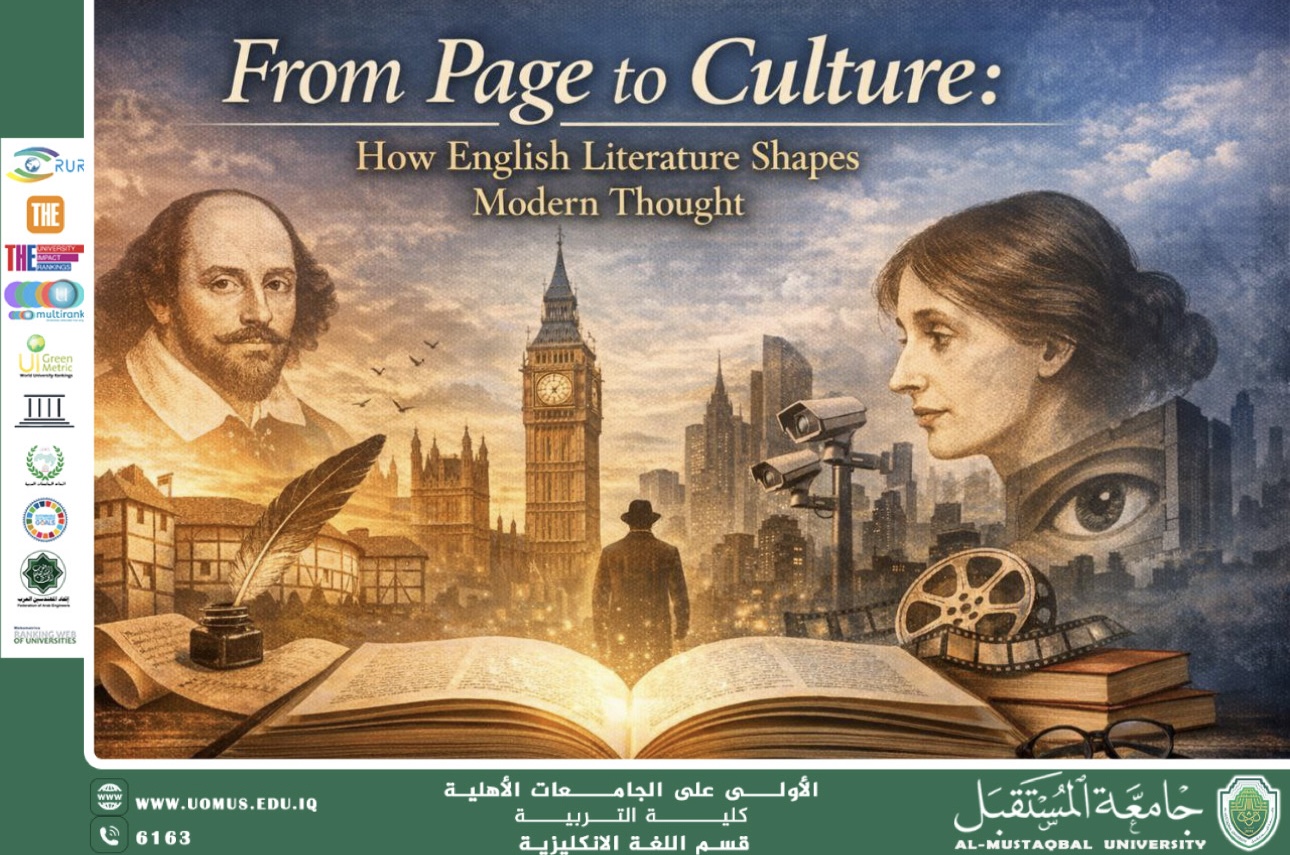

From Page to Culture: How English Literature Shapes Modern Thought
English literature cannot be regarded merely as a historical accumulation of texts completed in past centuries; rather, it constitutes a dynamic intellectual force that has contributed significantly to shaping the cultural and philosophical structures of modern society. Literary texts do not simply mirror reality; they participate in its reconstruction, offering language new conceptual tools through which humanity, authority, and identity may be understood. The relationship between the page and culture, therefore, is not unidirectional influence but an ongoing dialogue between imaginative creation and social formation.
In Culture and Anarchy, Matthew Arnold described culture as “the best that has been thought and said,” emphasizing literature’s role in refining sensibility and shaping collective consciousness. Modern cultural theory, however, has expanded this view. Raymond Williams, in Culture and Society, argued that culture is a lived social practice, and that literary texts interact with economic and political structures sometimes reinforcing them, at other times challenging them.
One of the most profound contributions of English literature to modern thought lies in its redefinition of the human self. William Shakespeare endowed dramatic characters with unprecedented psychological depth. Figures such as Hamlet or King Lear are not merely agents within a plot; they embody existential inquiry, internal conflict, and philosophical reflection. This representation of the self as divided, questioning, and introspective remains central to contemporary understandings of subjectivity.
With the emergence of literary modernism, this exploration of consciousness was further intensified. Virginia Woolf developed the technique of stream of consciousness, notably articulated in A Room of One's Own, foregrounding the interior life as a site of identity formation. The individual was no longer defined solely by outward action but by the fluid and layered movement of thought itself. Such narrative innovation did not merely transform literary style; it reshaped modern conceptions of personal identity.
English literature has also profoundly influenced political discourse. George Orwell’s 1984 introduced a vocabulary of surveillance and authoritarian control that remains embedded in contemporary political analysis. Terms such as “Big Brother” have transcended their fictional origin to become part of global political language. Literature here functions not only as representation but as critical instrument.
The movement from text to culture occurs through multiple channels: educational curricula, cinematic adaptations, public discourse, and cross-cultural reinterpretations. When literary works are adapted or recontextualized, they acquire renewed vitality, ensuring their continued participation in shaping collective thought. Even individuals who have never read the original texts often engage with their ideas indirectly through these cultural transmissions.
Across its historical trajectory, English literature has served not merely as aesthetic expression but as a laboratory of ideas central to modernity—individualism, liberty, justice, and identity. Attentive engagement with these texts cultivates critical reasoning, analytical precision, and interpretive awareness. Literature, therefore, is not an ornamental discipline; it is a formative intellectual practice that equips readers to examine and reimagine the world they inhabit.
The connection between page and culture is thus enduring and reciprocal. The written word does not fade with time; it persists as a generative force within cultural consciousness. Through literature, societies articulate their anxieties, negotiate their values, and envision alternative futures.
Assist. Prof. Dr. Salam Hassan Makki
جامعة المستقبل الاولى في العراق