The Precision Medicine Revolution: How AI is Redefining the Concept of Treatment artical By Noor Firas
Introduction: The Era of Medical Data
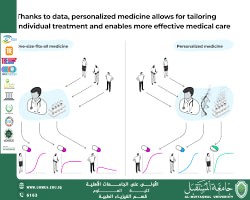
For a long time, traditional medicine relied on unified therapeutic protocols to combat diseases. Patient (A) and Patient (B), suffering from the same type of tumor, would often receive identical doses of chemotherapy. However, the results varied dramatically; one might recover while the other showed no response. This discrepancy led scientists to the concept of "Precision Medicine" or "Personalized Medicine"—an approach that treats every patient as a unique biological entity.
Artificial Intelligence: The Mastermind Behind Diagnosis
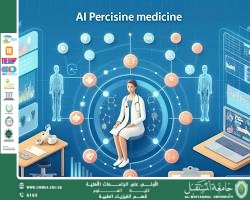
The greatest challenge in precision medicine lies in the sheer volume of data; the human genome map contains billions of pieces of information. This is where Artificial Intelligence (AI) emerges as an indispensable tool. Algorithms possess the capability to examine thousands of radiographic images and genetic analyses in mere seconds, identifying subtle patterns that the human eye simply cannot detect.
From Diagnosis to Prediction
The role of these technologies does not stop at diagnosing current ailments; it extends to "Predictive Medicine." By analyzing medical history, lifestyle, and genetic makeup, intelligent systems can warn individuals about the likelihood of developing specific diseases, such as diabetes or heart disease, years before symptoms appear. This shift from "treating the illness" to "proactive prevention" represents a qualitative leap in human quality of life.
Applications in Teaching Hospitals and Scientific Research
In institutions such as Al-Mustaqbal Teaching Hospital, the integration of these technologies contributes to training medical staff on the use of AI-guided robotic surgery. This ensures extreme precision, minimizes bleeding, and shortens recovery periods. This integration of technology and medical expertise places us on the threshold of an era where human medical errors are significantly reduced, and the chances of surviving the most challenging diseases are greatly increased.
Conclusion
Precision medicine powered by AI is not merely a technical advancement; it is an ethical and scientific revolution that places the human being and their vital value at the center. It opens limitless horizons for a safer and healthier future.
Al-Mustaqbal University: The Leading University in Iraq