
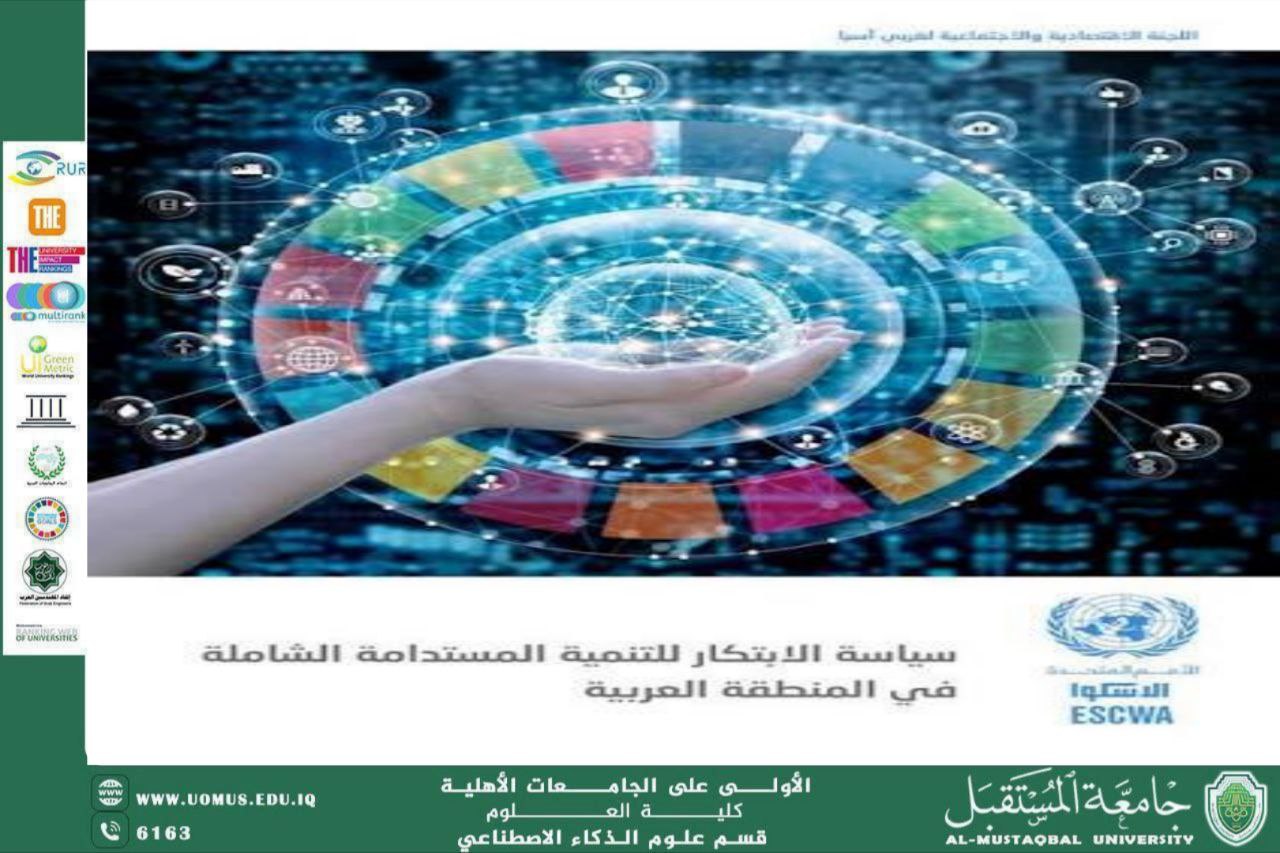
An academic article titled "The Role of Innovation in Achieving Sustainable Development" by Lecturer Samar Hussein Hilal
Innovation today constitutes one of the main drivers for achieving sustainable development, which aims to meet present needs without compromising the ability of future generations to meet their own needs. In a world characterized by increasing environmental, social, and economic challenges, traditional solutions are no longer sufficient to address complex issues such as climate change, poverty, resource scarcity, and providing clean energy. This is where innovation plays a role as an essential tool for finding creative solutions capable of balancing development requirements with protecting the planet.
The role of innovation in supporting sustainable development goals is multifaceted across various fields. On the environmental front, technological innovations contribute to developing renewable energy sources such as solar and wind power, making them more efficient and less costly, thus aiding the transition away from polluting fossil fuels. Innovations in water resource management, such as desalination, treatment, and reuse technologies, help address water scarcity in arid regions. In agriculture, innovations contribute to developing smart irrigation methods and drought-resistant crops, enhancing food security and reducing depletion of natural resources.
On the social front, innovation can provide comprehensive solutions to problems of poverty and inequality. Digital financial services, such as electronic wallets and mobile transfers, enable poor and marginalized groups to access banking services and establish small enterprises. Educational innovations, like distance learning platforms and digital content, help spread knowledge and provide educational opportunities for remote and underserved areas. In healthcare, innovations have revolutionized the delivery of medical services to rural communities through telemedicine applications, not to mention their role in developing vaccines and medicines that save millions of lives.
Economically, innovation creates new job opportunities and enhances productivity, contributing to Sustainable Development Goal 8 (Decent Work and Economic Growth). Knowledge-based and innovation-driven economies are the most dynamic and capable of adapting to global changes. Innovation in business models, such as the circular economy based on recycling and optimal resource use, contributes to achieving more sustainable consumption and production patterns.
However, enhancing the role of innovation in sustainable development requires a supportive environment encompassing several elements. Foremost is investment in research and development, whether by governments or the private sector, as without adequate funding, innovative ideas remain confined to drawers. Quality and inclusive education forms the foundation from which innovators and thinkers capable of solving their communities' problems emerge. Additionally, innovations need legislative frameworks and government policies that encourage experimentation and protect intellectual property rights, while simultaneously ensuring that innovation is directed toward serving the public good rather than narrow interests.
Efforts to employ innovation in service of sustainable development face significant challenges, especially in developing countries. Most prominent are the technological gap between North and South, weak digital infrastructure, and the brain drain of innovative minds to developed countries seeking better opportunities. The cost of many modern technologies also remains an obstacle to their widespread adoption in poor communities.
In conclusion, innovation is not an intellectual or technological luxury but an imperative necessity for achieving sustainable development. Betting on innovation means betting on humanity's ability to overcome major challenges it faces and finding a delicate balance between economic progress, environmental protection, and achieving social justice.