
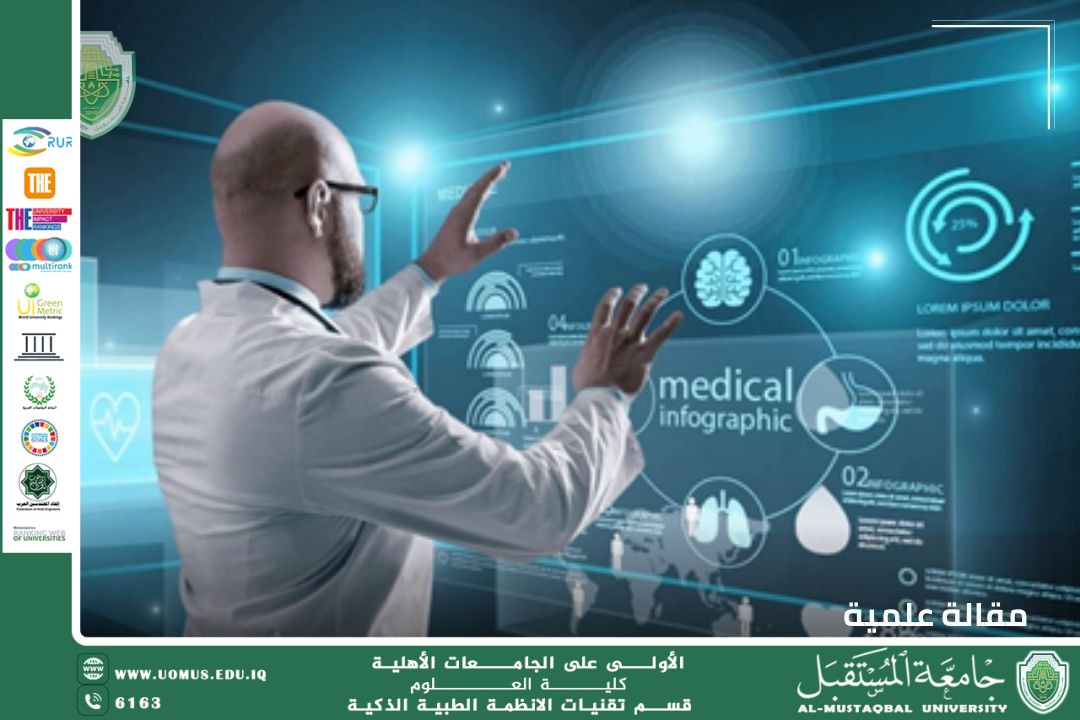
Machine Learning in Smart Medical Systems: Toward More Accurate and Efficient Medicine (Assist. Lecturer Ali Salim Halim)
The healthcare sector has witnessed remarkable development due to the rapid advancement of artificial intelligence technologies. Among these technologies, machine learning stands out as one of the most significant innovations that has contributed to the development of smart medical systems and the improvement of healthcare quality. Machine learning relies on algorithms capable of analyzing large amounts of medical data and extracting patterns and relationships from them. This capability helps support diagnosis, treatment, and medical decision-making with greater accuracy and efficiency. The use of machine learning in the medical field has therefore become a key factor in shifting healthcare from traditional approaches toward intelligent systems based on data analysis and the prediction of health risks.
Smart medical systems rely on machine learning to analyze health data collected from multiple sources, including electronic health records, medical images, laboratory test results, as well as data gathered from smart medical devices and wearable technologies. Machine learning algorithms process these data and identify hidden patterns that may indicate the presence of diseases or the likelihood of developing them in the future. This analytical capability helps physicians diagnose medical conditions at earlier stages, which increases the chances of successful treatment and reduces potential health complications.
Machine learning also plays an important role in analyzing medical images such as X-rays, magnetic resonance imaging (MRI), and computed tomography (CT) scans. Smart systems supported by machine learning algorithms can detect subtle changes in tissues and cells that may serve as early indicators of certain diseases such as tumors or heart conditions. This enables physicians to obtain accurate analytical results in a shorter time compared with traditional methods, thereby improving diagnostic speed and enhancing operational efficiency within healthcare institutions.
In addition, machine learning contributes to the development of clinical decision-support systems that assist physicians in selecting the most appropriate treatment plans for each patient. These systems analyze a patient’s medical history and compare it with extensive medical databases containing similar cases, allowing them to generate treatment recommendations based on evidence and scientific data. This approach represents an important step toward achieving the concept of precision medicine, which focuses on providing personalized treatment tailored to each patient according to their biological and health characteristics.
Machine learning also contributes to improving the management of healthcare institutions by analyzing data related to hospital performance and the use of medical resources. By examining such data, healthcare administrators can predict future healthcare demands and organize operations within medical institutions more efficiently. This helps reduce operational costs while improving the quality of healthcare services provided to patients.
Despite the significant benefits that machine learning offers in smart medical systems, its implementation faces several challenges. These include the need for accurate and reliable medical data to train intelligent models, as well as the necessity of protecting patient privacy and ensuring the security of sensitive health data. Furthermore, the use of these technologies requires advanced technological infrastructure and specialized professionals capable of developing and managing intelligent systems effectively.
In conclusion, machine learning represents one of the fundamental pillars in the development of smart medical systems and in achieving significant progress in healthcare. Through its ability to analyze medical data and identify hidden patterns, machine learning contributes to improving diagnostic accuracy, developing treatment methods, and supporting medical decision-making. With continuous technological advancement, reliance on machine learning in healthcare systems is expected to grow, contributing to the creation of a more efficient, accurate, and responsive medical ecosystem capable of meeting patients’ needs in the future.
Al-Mustaqbal University is the first one university in Iraq.