Blended Learning and Its Impact on Developing Students’ Skills (Asst. Prof. Sarab Abbas Jasim)
In the modern era, the world is witnessing rapid developments in the field of education as a result of technological progress and the widespread use of digital tools in various aspects of life. These developments have significantly influenced educational systems, leading to the emergence of modern teaching methods that combine the advantages of traditional and electronic learning. Among the most prominent of these methods is blended learning. This approach has gained considerable attention because of the opportunities it provides for improving the educational process and enhancing its outcomes, in addition to its role in developing students’ academic, practical, and technical skills.
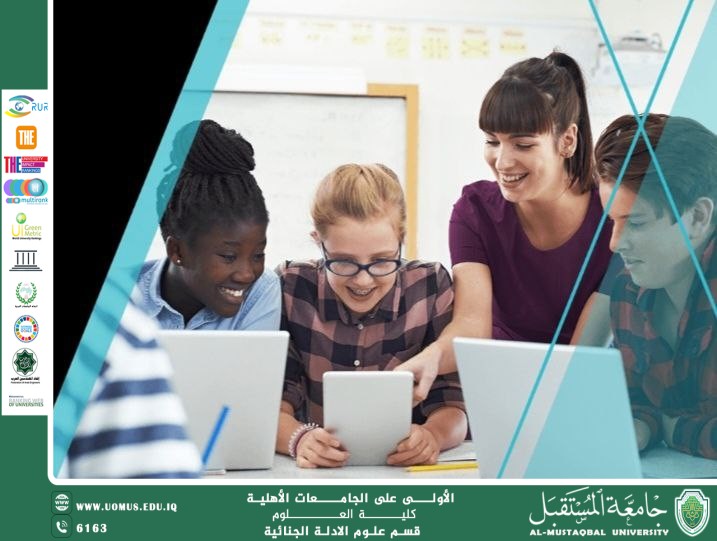
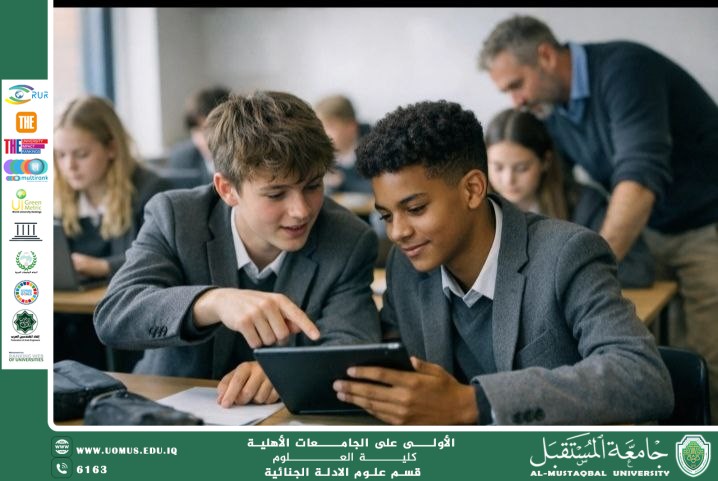
Blended learning is based on combining face-to-face classroom instruction with electronic learning that relies on computers, the internet, and digital platforms. In this model, learning is not limited to direct instruction from the teacher; rather, it extends to electronic and interactive activities that allow students to explore, research, and participate more effectively. In this sense, blended learning does not eliminate the role of the teacher, but rather reorganizes it so that the teacher becomes a guide and facilitator, while the student shifts from being a passive recipient to an active participant in constructing knowledge.
The importance of blended learning lies in the fact that it takes into account the individual differences among students, as it allows each learner to study according to their own pace, abilities, and interests. A student who needs more time to understand the material can return to electronic lessons and accompanying activities more than once, while advanced students can expand their knowledge through additional resources. This flexibility makes blended learning an effective means of enhancing comprehension and achieving better understanding than relying on only one method of instruction.
One of the most important effects of blended learning on students’ skill development is its contribution to fostering self-directed learning. In this system, the student does not rely solely on what the teacher presents in the classroom; rather, they are expected to search for information, follow online lectures, and complete assignments through educational platforms. This kind of practice helps instill a spirit of independence in students and makes them more capable of organizing their time and taking responsibility for their own learning. These are essential skills in both academic and professional life.
Blended learning also plays an important role in developing students’ technical skills because it depends on the use of smart devices, computers, educational programs, and digital applications. Through repeated use of these tools, students gain increasing technical experience, such as learning how to use educational platforms, prepare presentations, search electronic resources, and communicate through digital media. There is no doubt that these skills have become fundamental requirements in the age of knowledge and technology.
The impact of blended learning is not limited to technical aspects alone, but also extends to the development of higher-order thinking skills such as analysis, inference, and problem-solving. Interactive activities and electronic tasks often depend on stimulating thought and encouraging students to discuss, compare, and investigate. When students are exposed to varied educational situations that combine direct explanation, practical application, and digital interaction, they become more capable of understanding problems from different perspectives and reaching appropriate solutions in a scientific and organized manner.
Moreover, blended learning contributes to the development of communication and teamwork skills by providing opportunities for interaction among students both inside and outside the classroom.Students may participate in online discussions, work in groups to complete joint educational projects, or exchange ideas through forums and digital platforms. This type of interaction enhances their ability to express opinions, respect the viewpoints of others, and cooperate to achieve a common goal. These are highly important social and educational skills.
Another positive aspect of blended learning is that it increases students’ motivation toward learning because it adds variety and renewal to the educational process. The use of multimedia, such as educational videos, images, electronic tests, and interactive activities, makes learning more attractive and engaging. When students feel enjoyment and benefit during the learning process, they become more willing to participate, persist, and achieve better results.
Despite the many benefits of blended learning, its success requires the availability of several conditions, most importantly a suitable technological infrastructure, training for teachers and students in the use of modern tools, and the provision of high-quality educational content that combines clarity and interaction. The implementation of this type of learning also requires careful planning to ensure integration between the face-to-face and electronic components so that its intended objectives can be achieved effectively.
In light of the above, it can be said that blended learning represents one of the most important modern educational methods that contribute to the development of students’ skills at various levels. It does not merely transfer knowledge, but also works to prepare students to be more independent and more capable of thinking, communicating, and using technology. Therefore, paying attention to this type of learning and improving its mechanisms is an important step toward building a generation capable of adapting to the demands of the age and facing future challenges.